By
Oral Historian Takes Readers Back in Time to the 'Craw'
To view a transcript of the video above, click here. Video courtesy of author.
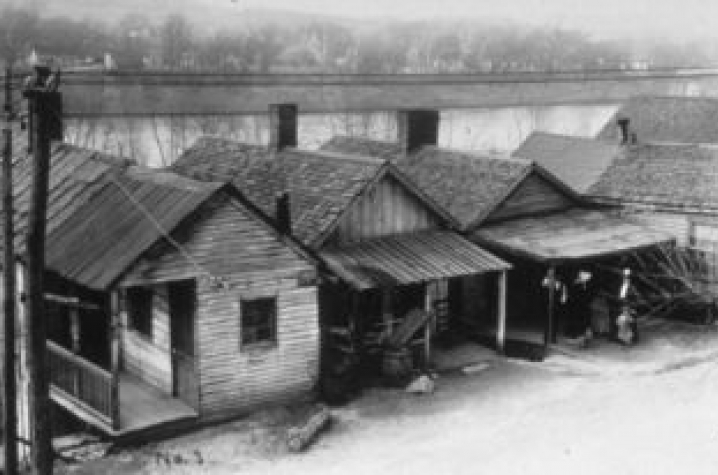
LEXINGTON, Ky. (Aug. 11, 2011) − The 50 acres of swampy land in north Frankfort, Ky., has had many names: "the lower part of the city," "the Craw" or just "Craw," "the Bottom" or just "Bottom." Yet despite its several titles, Crawfish Bottom was known to the outside world as a hotbed of crime, rampant alcohol use, prostitution and bootlegging. Underneath the neighborhood’s reputation as "a rough class of people, who didn’t mind killing or being killed," however, the community had a vigor marked by a sense of belonging, friendships that defied racial segregation, and a cohesion that acted against the daily struggle of poverty.
In "Crawfish Bottom: Recovering a Lost Kentucky Community," Douglas A. Boyd, director of the University of Kentucky Louie B. Nunn Center for Oral History, weaves together history, folklore, and geography to offer a compelling and sensitive meditation on a forgotten neighborhood and what it meant to those who knew it best. Between 1958 and 1984, Crawfish Bottom was progressively destroyed, the victim of an experiment in urban renewal. Though very little of the physical evidence of the neighborhood survived the 1970s, Boyd reconstructs it through interviews with former residents, building a poignant narrative of the community which speaks much louder than the reputation that contributed to its disappearance.
"Crawfish Bottom," published by University Press of Kentucky, provides a window into a neighborhood rampant with contradictions, reviled by outsiders yet beloved by its residents. From the community's colorful characters to everyday life in the "Bottom," the incongruities are startling yet endearing. Boyd introduces us to Ida Howard, one of the area’s most prominent madams. She advertised her prostitutes on the balcony of her house in negligees, yet she is remembered first and foremost as a good neighbor. Residents tell tales of John Fallis, a quick-tempered local political boss crowned "King of Craw." Fallis is recounted as a terrifying figure that gambled, fought, lied, cheated, and womanized, yet he is also described as an honest, hardworking and charitable man who gave back considerably to his community.
"The concept of 'community' is complex and often contradictory, and this contradiction is reality," says Boyd. "These residents were just trying to live, worship, fall in love, learn and mourn like all of us, really. A community is not about living close by. It is about social interaction. I loved going through the late 19th century newspapers and tracking how the neighborhood earned its reputation, then to offset that by the oral histories which painted a different picture."
Though the residents of Crawfish Bottom were immersed in poverty, their strength and cohesiveness seemed to defy circumstances. Several of the book's narratives vividly portray the record-setting 1937 flood which inflicted tremendous damage on Frankfort and drove thousands from their homes. Though residents floated on canoes above their submerged houses, they managed to see this devastation as a sort of celebration, enjoying their time together by playing cards and dancing. Characterized by such vitality and unity even when faced with hard times, the only blow that truly left an impact on the community was the final loss of the neighborhood at the hands of the city. Narratives of the destruction of Crawfish’s most cherished buildings, including the Corinthian Baptist Church, the Mayo-Underwood school and the American Legion building, offer poignant accounts of the heartbreak inflicted by the neighborhood’s dismemberment as it fell to the nation’s sometimes wayward attempts at urban renewal.
Through a combination of research and personal narratives, Boyd reveals how oral history can recapture the essence of what has been lost and helps the reader understand the nature of memory. "Crawfish Bottom" brings back to life a community that was wiped out in the name of progress, documenting how identity and self-understanding are created, challenged and reshaped in both past and present. Boyd transports readers into this colorful, bygone community, which, if not for the work of oral historians, would be lost forever. For more on "Crawfish Bottom," visit online at www.crawfishbottom.com.
This is Boyd's second book with University Press of Kentucky, he is also co-editor of "Community Memories: A Glimpse of African American Life in Frankfort, Kentucky." Before taking the director position at the Nunn Center at UK Libraries, the oral historian previously managed the digital program for University of Alabama Libraries, served as the director of the Kentucky Oral History Commission, and prior to that as the senior archivist for the oral history and folklife collections at the Kentucky Historical Society. Boyd, who received his doctorate in folklore from Indiana University and his undergraduate degree in history from Denison University in Granville, Ohio, serves on the executive council of the Oral History Association.
Offices for the administrative, editorial, production and marketing departments of the University Press if Kentucky are found at UK, which provides financial support toward the operating expenses of the book publisher.
For more information or to purchase "Crawfish Bottom" from UPK, visit the press online at www.kentuckypress.com.
MEDIA CONTACT: Whitney Hale, (859) 257-8716 or whitney.hale@uky.edu