By
UK Historic Preservation Studio Proposes Art Trail for Northern Kentucky
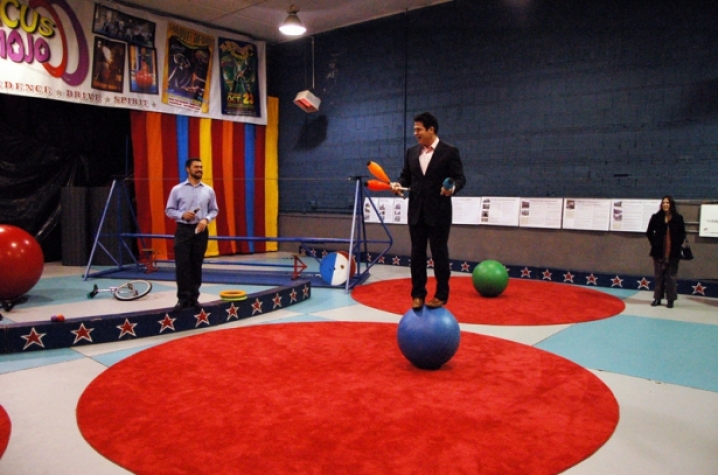
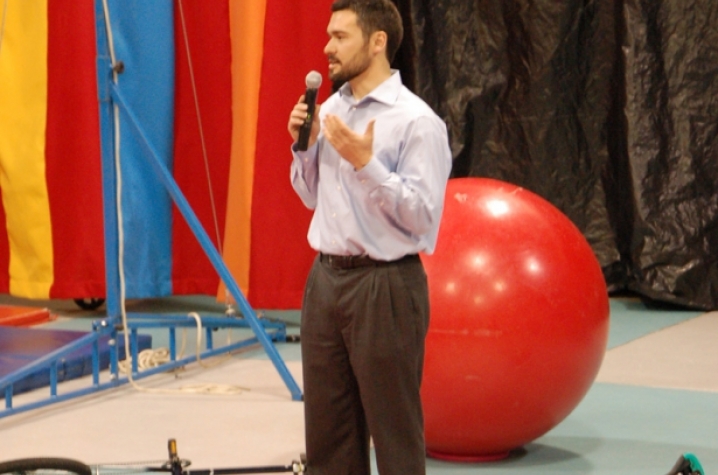
LEXINGTON, Ky. (Jan. 4, 2012) − Students at the University of Kentucky Department of Historic Preservation unveiled plans for the "Northern Kentucky Historic Art Spaces Trail" earlier this week at Circus Mojo, a clown school housed in a historic former theater in Ludlow, Ky. Under the direction of Douglas Appler, the Helen Edwards Abell Endowed Chair in Historic Preservation, the studio identified several historic buildings being used as art spaces in several cities along the Ohio River and developed a trail of the sites to help encourage tourism and economic development in the region.
Appler's historic preservation studio presented the "Northern Kentucky Historic Art Spaces Trail" as part of the UK College of Design "River Cities" project, which has partnered with the development corporation Catalytic Development Funding Corporation; Vision 2015, a Northern Kentucky nonprofit; and Culture Now, a Suprastudio project organized by Thom Mayne at University of California, Los Angeles. The studio is comprised of six graduate students: Angelene Hoffert, of Shakopee, Minn.; Kathy Martinolich, of Lexington; Sarah Rozniak, of Cold Spring, Ky.; Jenn Nash, of Louisville, Ky.; Whitney Schieltz, of Dayton, Ohio; and Emily Skinner, of Lexington.
Many business owners, artists and civic leaders, several of whom were directly involved with the studio, attended the presentation of Appler's studio on Dec. 13. As part of the proposed trail, UK students identified 47 historic buildings that are currently being used as art spaces in Ludlow, Covington, Newport, Bellevue, Dayton and Fort Thomas.
Each student in the UK studio chose three of the buildings and carried out documentary research on the site, sifting through tax records, city directories, historic maps and other resources to develop a history for each space. To supplement their research, and to understand the current social context surrounding these historic structures, the students interviewed the buildings' current owners or tenants using the spaces. These interviews helped shed light on the relationship between the historic space and its modern use and on the role of the arts in the redevelopment of the Northern Kentucky region. In addition, the students were able to identify opportunities for new partnerships, programs and activities that might improve the ability of the arts organizations to act as an agent of change in this region.
From the evaluation of this research, the students developed a proposal for a "Northern Kentucky Historic Art Spaces Trail." "The objective of the project is to change the way people think about Northern Kentucky, its arts community and its historic building stock," Appler said. "Viewed in isolation from each other, no single city featured in the proposal carries quite enough weight to make people think of Northern Kentucky as an arts hub, or as a center for creative activity. But when the cities are framed together as a group, it becomes clear that the region actually presents an unusually wide range of opportunities to experience the arts, and to do so in some fascinating historic spaces. But you only see that if you look at the region as a whole, rather than at its component parts."
Paul Miller, a former Ringling Brothers clown and owner of Circus Mojo, was excited by how the arts trail proposal has created partnerships that will benefit his business and his community. "The Northern Kentucky community straddles a lot of places, and is often lumped in with Cincinnati," Miller said. "This project has already brought needed attention to Circus Mojo, from civic leaders and other business owners, and I think it has a lot of potential to really help the arts in this community thrive."
Several characteristics of this region and other projects contributed to the development of UK College of Design's art trail proposal. These elements include:
- Kentucky State Route 8 that runs almost parallel to the Ohio River, linking the cities and passing through some of their most historic neighborhoods. Current plans for the region continue this trend of connecting communities along the river in the form of the "Riverfront Commons" proposal being developed by Southbank Partners and the Vision 2015 Catalytic Fund. "Riverfront Commons" would create a traffic-free cycling and pedestrian route along the banks of the Ohio, thereby improving connectivity among the region’s cities.
- A complex mix of social forces that allowed parts of these cities to retain much of their historic fabric throughout the 20th century has left the region with commercial and residential building stock of high quality. These sites are affordable and well suited to the needs of the growing segment of the population that is choosing to commit to an urban lifestyle.
- The region also has a surprisingly high number of organizations and businesses dedicated to the fine and performing arts, from large organizations and businesses with deep historical roots, such as the Carnegie Visual and Performing Arts Center and the Madison Theater, to smaller, newer businesses and organizations such as Sigra Gallery, The BLDG or Monmouth Theater. The area also has several instructional spaces such as Circus Mojo, the Baker Hunt Art Center and the Children’s Art Academy.
To date UK College of Design has already engaged in projects in two of the Commonwealth's "river cities." In Henderson, the college has worked with the nonprofit, River City Renaissance, and with the city and county to redevelop HMPL#1 (Henderson Municipal Power and Light Plant No. 1), a retired coal fired power plant built in the late 1950s. And in Paducah, the college is currently working with the city, the city port authority, and the U.S. Department of Energy (DOE) to speculate about future uses for the DOE's uranium enrichment facility in Paducah (the only one in the U.S.), which plans to halt operation in the next 10 years.
In addition to recognition across Kentucky, the "River Cities" project has garnered international attention as well. The project is scheduled to serve as a "CounterSite" at the fifth International Architecture Biennale Rotterdam (IABR), from April through August 2012.
Appler joined the UK Department of Historic Preservation faculty this fall. He holds a doctorate in city and regional planning from Cornell University. Appler has previously worked as a county and regional planner, serving most recently as planning and zoning director for Madison County, Ga.
MEDIA CONTACT: Whitney Hale, (859) 257-8716 or whitney.hale@uky.edu