


NIH awards UK $11.3 million for COBRE Phase 2 pharmaceutical research

LEXINGTON, Ky. (May 29, 2026) — The University of Kentucky has been awarded a prestigious $11.3 million Phase 2 Centers of Biomedical Research Excellence (COBRE) grant from the National Institute of General Medical Sciences of the National Institutes of Health. This five-year award will fund the continued evolution of the COBRE for Translational Chemical Biology (CTCB).
The CTCB serves as an incubator for scientific innovation at the intersection of chemical biology and pharmaceutical science. The center’s director, Jon Thorson, Ph.D., defines this thematic focus as “the nexus of chemical biology (the application of chemical biology principles to develop validated models to advance our understanding of biology) and pharmaceutical science (the application of pharmaceutical principles to advance materials and devices that address unmet clinical needs).”
“CTCB’s Phase 1 success was driven by an exceptional pool of junior faculty members,” said Thorson, associate dean of research in the UK College of Pharmacy and the George A. Digenis Professor in Drug Design and Discovery. “I am thrilled to leverage this new Phase 2 award to continue the work of this talented group of UK scientists as we build toward a competitive Phase 3 renewal.”
The center’s operations are supported by the leadership of Thomas Prisinzano, Ph.D., chair of the Department of Pharmaceutical Sciences and director of the Center for Pharmaceutical Research and Innovation, who serves as the new CTCB associate director, and Tonya Vance, the concierge and administrative operations facilitator.
The next generation
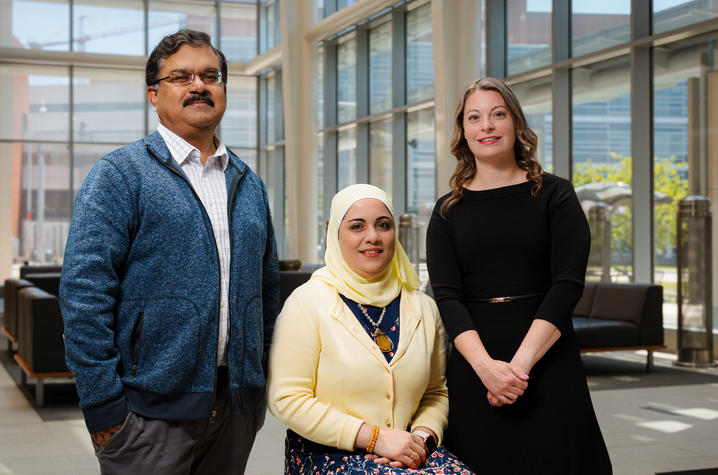
A fundamental pillar of the COBRE program is the recruitment and mentorship of junior investigators. Thorson emphasizes that these faculty members are the “fundamental drivers of the center’s success.” The Phase 2 Research Project Leader cohort will focus on research intersecting the gut-microbiome-disease axis and includes:
- M. Ashfaqual Alam, Ph.D. (College of Medicine): Alam investigates the host-microbiota interactions of the intestinal epithelial barrier, focusing on how its breakdown contributes to inflammatory bowel diseases and colorectal cancer.
- Lindsay Czuba, Ph.D. (College of Pharmacy): Czuba specializes in drug transport and metabolism, specifically the molecular mechanisms of bile acid homeostasis and the ASBT transporter to identify targets for treating obesity and liver fibrosis. She also explores how altered vitamin A and drug metabolism during pregnancy impact maternal and fetal health outcomes.
- Yosra Helmy, Ph.D. (College of Medicine and Martin-Gatton College of Agriculture, Food and Environment): Helmy uses a One Health approach to combat antimicrobial resistance and foodborne pathogens by developing innovative antibiotic alternatives, including probiotics, bacteriophages and small-molecule therapeutics. She leads projects to strengthen antimicrobial surveillance in Kentucky’s retail food commodities and to develop novel therapies for equine health challenges.
Additionally, the center contributed to the recruitment of an outstanding cohort of new junior faculty as CTCB Ignite Scholars, including Caroline Geisler, Ph.D., Anel Jaramillo, Ph.D., Arun Maji, Ph.D., Kristen McLaurin, Ph.D. and Kevin Tidgewell, Ph.D., ensuring a continuous pipeline of innovative research.
Thorson says by investing in the research programs of UK’s exceptional junior faculty, UK can stay at the leading edge of pharmaceutical innovation and translational medicine. The CTCB’s disease-agnostic approach allows researchers to develop novel chemical probes and early-stage drug leads that can be applied to a wide range of health challenges, including those impacting Appalachian Kentucky.
Phase 1 accomplishments
During Phase 1, the center functioned as a scientific incubator, seeing eight junior faculty members transition to major independent funding. Under the center’s mentorship, affiliated junior faculty secured $34.4 million in new grants, contributing to $71.3 million in new center-affiliated funding.
The center has also graduated several junior faculty members to leadership roles across the university, including Martha Grady, Ph.D., now associate department chair of the Department of Mechanical and Aerospace Engineering in the Stanley and Karen Pigman College of Engineering; Samuel Awuah, Ph.D., who co-leads the Markey Cancer Center Translational Oncology Program; and Vincent Venditto, Ph.D., a member of the CURE-KY leadership team and founder of Bluegrass Pharmaceuticals Inc. Collectively, Phase 1 researchers produced 266 peer-reviewed publications and 22 applied for/issued patents.
Infrastructure
The transition to Phase 2 marks a significant milestone in UK’s mission to build a world-class, interdisciplinary research enterprise. The CTCB provides a unifying framework that cuts through traditional scientific boundaries, offering researchers access to infrastructure like the Bio Core (the only assay development and screening core on campus, co-led by Steven Van Lanen, Ph.D., and Chang-Guo Zhan, Ph.D.) and the Chem Core (the only synthesis and medical chemistry core on campus, co-led by Thomas Prisinzano, Ph.D. and Chang-Guo Zhan, Ph.D.). The CTCB provides the UK campus with access to unique, mission-critical research cores and resources that are unavailable elsewhere in the Commonwealth.
- The Bio Core: As the only assay development and screening core on campus, the Bio Core supports assay development/validation and virtual and wet-bench screening to validate biological targets.
- The Chem Core: As UK’s exclusive synthetic chemistry core, it provides medicinal chemistry, probe design and computational ligand design.
- Natural Products Repository: Managed by Phase 1 graduate Khaled Shaaban, Ph.D., this resource has grown to include more than 680 pure microbial natural products and over 3,200 nonredundant microbial strains. Many of these are sourced from unique Kentucky environments, such as coal mines, caves and deep-well drilling collections.
“This Phase 2 award for the COBRE for Translational Chemical Biology is a powerful validation of the University of Kentucky’s scientific incubator model,” said Craig Martin, Pharm.D., interim College of Pharmacy dean. “During Phase 1, this center proved its impact by securing over $71 million in new funding and transitioning eight junior faculty members to major independent research careers. As Kentucky’s land-grant institution, we have a responsibility to turn discovery into tangible hope; by leveraging unique local resources — such as microbial strains sourced from our own Kentucky coal mines and caves — this center is finding cutting-edge drug leads that address the most pressing health challenges facing our Commonwealth.”
Research reported in this publication was supported by the National Institute of General Medical Sciences of the National Institutes of Health under Award Number P20GM130456. The content is solely the responsibility of the authors and does not necessarily represent the official views of the National Institutes of Health.
As the state’s flagship, land-grant institution, the University of Kentucky exists to advance the Commonwealth. We do that by preparing the next generation of leaders — placing students at the heart of everything we do — and transforming the lives of Kentuckians through education, research and creative work, service and healthcare. We pride ourselves on being a catalyst for breakthroughs and a force for healing, a place where ingenuity unfolds. It's all made possible by our people — visionaries, disruptors and pioneers — who make up 200 academic programs, a $1.02 billion research and development enterprise and a world-class medical center, all on one campus.