


UK Art Museum announces Fall ’26 exhibitions
LEXINGTON, Ky. (Aug. 14, 2026) — The University of Kentucky Art Museum’s Fall 2026 season opens with five exhibitions running through Dec. 19, many making use of the museum’s permanent collection as well as collections across the campus and the Lexington community.
The season features “Museum of Natural History and Artificial Curiosities” and “Clarissa Tossin: When Two Places Look Alike,” which both opened Aug. 5, followed by three exhibitions opening Sept. 1: “Leon Golub & Ben Shahn: A Report,” “Capturing the Uncanny: Legacies of Surrealism in Photography” and “Jacques Callot: The Miseries and Misfortunes of War.”
“This year is the 50th anniversary of the College of Fine Arts, and our programming offers many reasons to come for a visit or two and celebrate this milestone with us and our colleagues,” said UK Art Museum Director Stuart Horodner. “We continually provide access to significant art of all kinds, and our free admission policy removes any financial obstacle to engaging with us.”
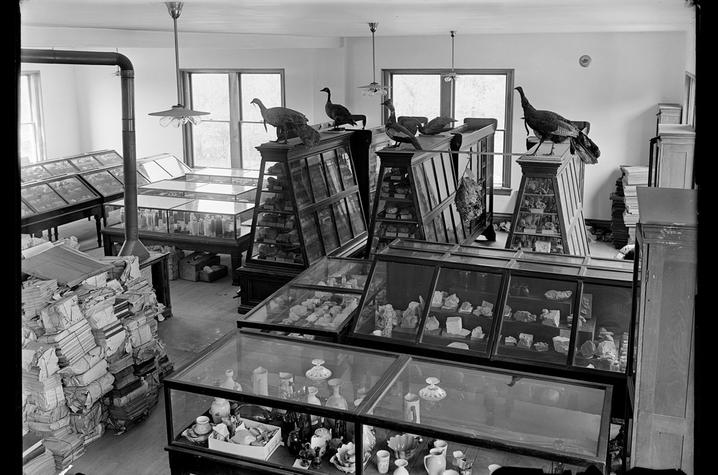
“Museum of Natural History and Artificial Curiosities” traces the origins of collecting at UK back to 1867, when faculty at the newly formed land-grant university assembled specimens to teach geology, zoology and botany — a collection that gradually grew to include paintings, garments and weapons from cultures around the world. Drawing on inventories held in the university archives, the exhibition brings together art, insects, meteorites, minerals and anthropological objects from across campus to consider how collecting has shaped UK's mission to advance Kentucky through education, research, service and care.
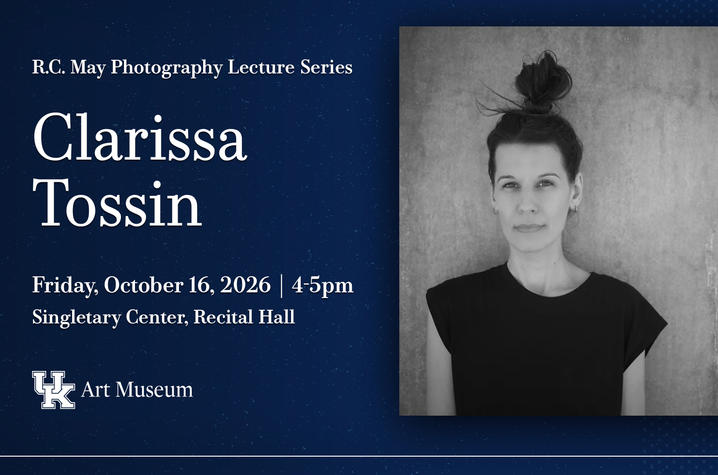
“Clarissa Tossin: When Two Places Look Alike” highlights two decades of the artist’s work connecting the built environment to processes of extraction, in cities including Denver, Los Angeles, Rome and São Paulo. The exhibition focuses on Tossin’s use of photography and the analogies she draws between views of Earth and outer space, as she collages, folds, scrapes and weaves photographs to question the authority of mapping, distant scans and aerial views. As part of the museum’s Robert C. May Endowed Photography Lecture Series, Tossin will give a lecture 4-5pm Friday, Oct. 16, in the Singletary Center for the Arts Recital Hall
“Leon Golub & Ben Shahn: A Report” pairs two acclaimed American artists — Ben Shahn (1898-1969) and Leon Golub (1922-2004) — who worked as visual “reporters” on the social and political conditions of their eras. The exhibition centers on the artists’ image-making, particularly their use of photography and the translation of personal and public data into paintings, drawings, prints and books. Both artists wrote extensively about art, activism and creativity, and both shifted over the course of their careers from direct engagement with social concerns toward more personal investigations of religion, poetry, aging and the erotic. Lectures, film screenings and panel discussions will be presented throughout the exhibition’s run. Scholar and curator Laura Katzman will discuss her acclaimed exhibition “Ben Shahn, On Nonconformity” 4-5pm Friday, Sept. 25, in the Singletary Center for the Arts Recital Hall.
A screening of the documentary “Golub: Late Works are the Catastrophes” will be 7 p.m. Thursday, Oct. 1, at the Kentucky Theatre in downtown Lexington.
“Capturing the Uncanny: Legacies of Surrealism in Photography” traces the legacy of surrealism — rooted in Sigmund Freud’s study of repression and deeply held fears — through 50 years of photography in the UK Art Museum’s collection. Bizarre and imaginative scenes range from Sandy Skoglund’s 1997 large-scale treatment of the domestic as myth in “Walking on Eggshells” to Jahi Chikwendiu’s 2007 layering of semi-transparent portraits and architecture in “Egyptian Blogger,” alongside work by Roger Ballen, Keith Carter, Bruce Cratsley, Denise Dixon, Misha Gordin, Robert C. May, Ralph Eugene Meatyard, Aaron Siskind, Andrey Tatarovich and Betsy Wurl McKean. The exhibition was organized in collaboration with Sophia Maxine Farmer and students in Interdisciplinary Approaches: 100 Years of Surrealism, a course in the College of Fine Arts’ School of Art and Visual Studies.
“Jacques Callot: The Miseries and Misfortunes of War” presents Callot’s landmark 1633 print series, among the first to take a sustained look at the social toll of war. Created during the Thirty Years’ War (1618-1648), the six etchings move from the mustering of an army to the ransacking of villages and the aftermath of death and destruction, prompting reflection on how conflict — past and present — shapes individuals and societies. Callot revolutionized the etching process using a hard varnished ground plate and his invention of the échoppe, a specialized etching tool, techniques that allowed for greater clarity and depth in mass-distributed prints such as newspapers, where his widow later published his war imagery.
All exhibitions and programs are free and open to the public. The UK Art Museum is located in the Singletary Center for the Arts. For more information, visit finearts.uky.edu/art-museum.
As the state’s flagship, land-grant institution, the University of Kentucky exists to advance the Commonwealth. We do that by preparing the next generation of leaders — placing students at the heart of everything we do — and transforming the lives of Kentuckians through education, research and creative work, service and healthcare. We pride ourselves on being a catalyst for breakthroughs and a force for healing, a place where ingenuity unfolds. It's all made possible by our people — visionaries, disruptors and pioneers — who make up 200 academic programs, a $1.02 billion research and development enterprise and a world-class medical center, all on one campus.