


‘Set Your Screen’: Lee Anne Pope, Markey launch campaign encouraging cancer screenings for Kentuckians
Video produced by UK Marketing and Strategic Communication. To view captions for this video, push play and click on the CC icon in the bottom right-hand corner of the screen. If using a mobile device, click on the “thought bubble” in the same area.
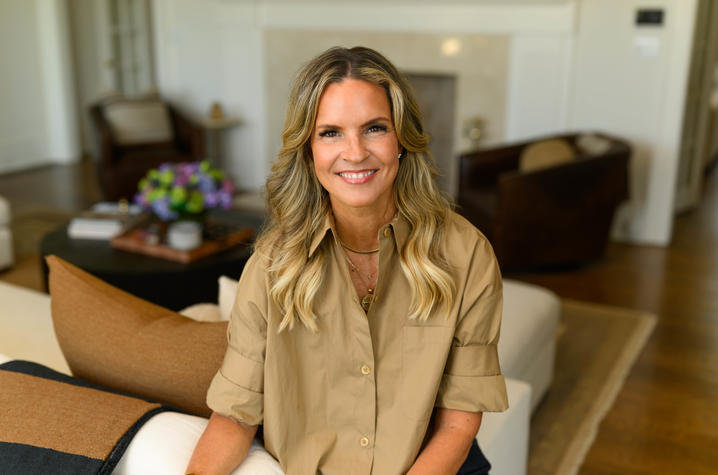
LEXINGTON, Ky. (Oct. 5, 2026) — Working with the University of Kentucky Markey Cancer Center, Lee Anne Pope is launching “Set Your Screen,” a new public awareness campaign encouraging Kentuckians to talk with their healthcare providers about recommended cancer screenings and take steps to detect cancer early.
Lee Anne, wife of UK men’s basketball coach Mark Pope, is a longtime advocate whose family has been deeply affected by cancer. Her father died from prostate cancer, her mother has been diagnosed with breast cancer twice, and several other close family members have been diagnosed with or died from cancer.
“My father was 52 and had terminal prostate cancer,” Pope said. “If he had been screened, there’s a strong possibility my dad would still be here. My mom, she’s had two bouts of breast cancer, but those were discovered because of routine screenings, and they were successfully treated. But she had no symptoms, no discomfort.”
Pope has been supporting cancer care and research for years; while in Utah, she and her husband became involved with Coaches vs. Cancer, a collaboration between the American Cancer Society and the National Association of Basketball Coaches. They also championed Dunk on Cancer, which supported the work of the Simmons Center for Cancer Research. After their first season in Kentucky, Pope met with UK Markey Cancer Center Director Mark Evers, M.D., to discuss ways to support cancer research, treatment and prevention here in the Commonwealth. During that meeting, she was shocked to learn of Kentucky’s high cancer rates.
"When Dr. Evers said we are number one for cancer mortality and incidence rate… I thought, ‘We’ve got to do something,’” Pope said. “I want to be number one in everything —but not that."
Since 2024, the Popes have hosted Hoops and Heels, a popular basketball preseason fan event that benefits the Markey Cancer Center. Now, Pope is using her platform to increase awareness for cancer screenings, with the goal of turning that awareness into action.
Because of her strong family history for several cancer types, Pope began certain cancer screenings at a younger age than standard recommendations, and she undergoes some of these screens more frequently. Through television, digital and social media messages, she’s encouraging Kentuckians to talk with their doctor about the screenings that are right for them — and for people to encourage their own loved ones to get screened.
“Kentuckians are known for taking care of one another,” said Pope. “One of the simplest ways we can do that is by encouraging the people we love to get screened when they’re eligible. It could make all the difference.”
Early detection is one of the most effective tools to prevent deaths from cancer. Recommended screenings can help find some cancers before symptoms develop, when treatments can be more successful.
“As a National Cancer Institute-designated Comprehensive Cancer Center, Markey provides some of the most innovative treatments for all stages of cancer. And advanced treatments save lives, but so does finding cancer early,” Evers said. “In Kentucky, we’ve made cancer screening a priority, and the measurable progress we’ve made against cancer in recent decades is due in large part to diagnosing cancer earlier, when treatments are more successful.”
The need for screening remains urgent in Kentucky, but the results show why it matters. Statewide efforts to increase screening — driven by Markey and public health organizations — have led to declines in late-stage diagnoses and cancer deaths, particularly for lung and colorectal cancer.
Yet, many people are still not taking steps to get screened. According to America’s Health Rankings, more than a third of eligible Kentuckians have not received a mammogram, and just over half of eligible women have received cervical cancer screening consistent with national guidelines. And despite Kentucky’s progress, only about 1 in 5 eligible residents are screened for lung cancer, while 2 out of 3 eligible residents get screened for colorectal cancer.
In basketball, setting a screen can win games. Off the court, setting your screen could save your life. Driven by her personal experience, Pope wants the campaign to serve as both a reminder and a call to action to Kentuckians to “set your screen.”
“If just one person decides to make that appointment, or if one family has a conversation about screening, then it’s worth it,” Pope said. “We have so many tools available today to detect cancer early. Early is everything. It really is everything.”
Cancer screening guidelines
Cancer screening recommendations vary depending on age, gender, personal health, family history and the type of test or exam it requires. Not every cancer has a screening test available, but here are some broad general guidelines for men and women. Talk with a health care provider about age, family history and risk factors to determine which screenings are needed.
- Age 21
- Women should start cervical cancer screening. Both men and women should begin talking with their healthcare providers about their family history and cancer risk.
- Age 40
- Women can begin regular mammograms for breast cancer screening, though if there is a family history of breast cancer, women may start screening as early as age 25.
- Age 45
- Both men and women should begin screening for colorectal cancer. Though if there is a family history of colorectal cancer, screening may be recommended at a younger age.
- Age 50
- Men and women who have a history of smoking should talk to their providers about their eligibility for lung cancer screening.
- Women can also speak to their providers about ovarian cancer screening.
- Age 55
- Men can talk with their provider about prostate cancer screening, especially if they have a family history of the disease.
- Age 65
- Women should speak with their provider about whether cervical cancer screening should continue.
- Age 75
- Both men and women should talk to their provider about which screenings may still be appropriate for their health and risk factors.
More specific information about cancer screenings, including recommendations and resources, is available at SetYourScreen.uky.edu.



UK HealthCare is the hospitals and clinics of the University of Kentucky. But it is so much more. It is more than 10,000 dedicated healthcare professionals committed to providing advanced subspecialty care for the most critically injured and ill patients from the Commonwealth and beyond. It also is the home of the state’s only National Cancer Institute (NCI)-designated Comprehensive Cancer Center, a Level IV Neonatal Intensive Care Unit that cares for the tiniest and sickest newborns and the region’s only Level 1 trauma center.
As an academic research institution, we are continuously pursuing the next generation of cures, treatments, protocols and policies. Our discoveries have the potential to change what’s medically possible within our lifetimes. Our educators and thought leaders are transforming the healthcare landscape as our six health professions colleges teach the next generation of doctors, nurses, pharmacists and other healthcare professionals, spreading the highest standards of care. UK HealthCare is the power of advanced medicine committed to creating a healthier Kentucky, now and for generations to come.