


From the ICU to the commencement podium
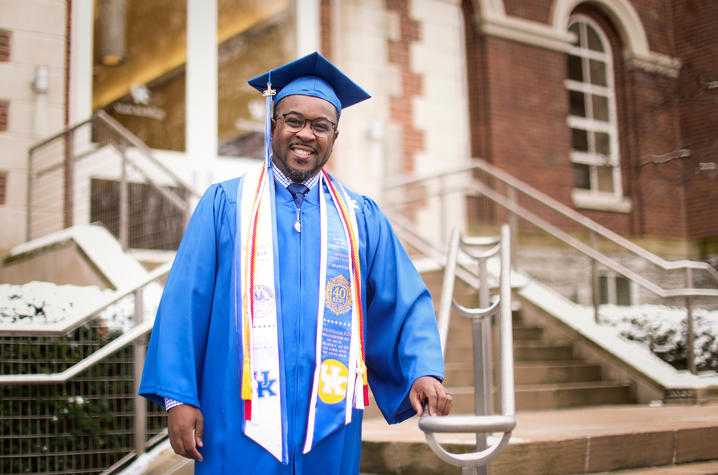
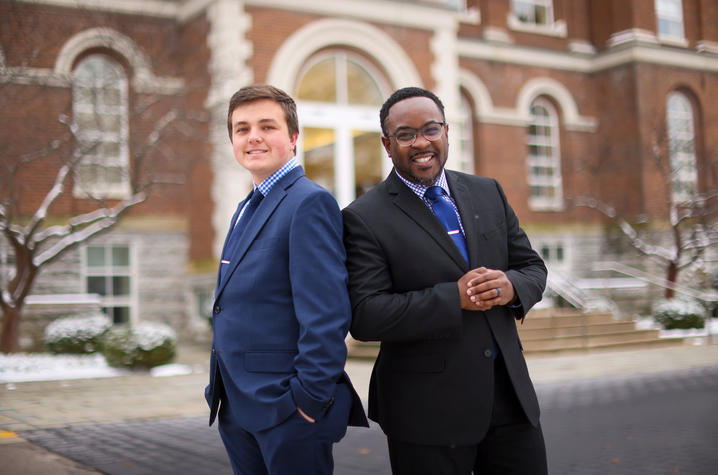
LEXINGTON, Ky. (Dec. 17, 2025) — When RaShaun West steps onto the commencement stage this Friday, he will do so carrying more than a diploma. He will carry a story that weaves city streets and church pulpits, late nights in hospital beds and early mornings writing papers, the quiet work of recovery and the visible honor of serving as a voice of inspiration for his classmates.
As a patient
West was born in Cincinnati and spent the latter part of his childhood in Los Angeles. He describes those early years as “interesting,” shaped by frequent moves and circumstances that could have easily set his life on a different trajectory. “No, I wasn’t a military kid,” he said. “Just what some might’ve called a troubled youth.”
Raised primarily by his single mother, he relocated to L.A. as a teenager shortly after she developed breast cancer and finished high school while living with his godfather.
A chance meeting at a church convention in the early 2000s brought him to Lexington, Kentucky, where he met the woman who would become his wife.
“Church brought me to Kentucky, and love made me stay,” he said. “And now I can’t imagine being anywhere else.”
Eight years ago, however, West’s life hit a hard and unexpected pause.
After enduring three car accidents in less than three months — none of them his fault — he developed persistent, escalating pain. It was attributed to occipital neuralgia, a headache disorder that can cause sudden, sharp pain in the head and upper neck. An MRI later revealed a pituitary adenoma, a type of brain tumor. When a year of medication at a nearby hospital failed to shrink the tumor, he was referred to UK HealthCare for surgery.
He still remembers the relief of meeting Justin Fraser, M.D., associate professor of cerebrovascular, endovascular and skull base surgery in the UK College of Medicine.
“Dr. Fraser explained everything to me in a way I could understand,” West said. “I just instantly felt safe with him.”
Recovery was long and complicated. Three days after surgery, West lost partial vision, required an additional procedure to remove a blood clot and spent six days in the intensive care unit. Radiation treatments soon followed because part of the tumor was too close to his carotid artery to be removed safely.
“It was a pretty long recovery process,” he said. “And I was completely disabled by it all. I was unable to work for six years.”
Through every setback, faith remained West’s anchor. The scriptures he returned to — Colossians 3:23 and Isaiah 26:3 — had been with him since childhood, but during his recovery, they became lifelines.
“God has always been constant in my life,” he said. “He’s allowed me to take my story and share it with others, even the hard parts.”
West fondly remembers the people who helped him through that stage of life: nurses who treated him with unwavering kindness, a church acquaintance he bonded with during radiation and a wife who taped scripture to the hospital walls so he would always have something hopeful to look toward.
“My experience with UK was honestly amazing … all the nurses, doctors, everyone I met, they were just so nice,” he shared.
As an employee
When West was finally ready to return to work, a former colleague helped reconnect him to the university in a different way. What began as a simple request for résumé feedback quickly opened the door to something more. He joined UK Human Resources as an employment consultant, supporting the College of Medicine, and found himself doing work that combined his people skills with institutional purpose.
“To go from being in a UK hospital bed to working at the College of Medicine, it’s humbling,” he said. “Now I get to be part of the place that helped save my life.”
Today, West serves as faculty recruitment manager, helping the college bring exceptional faculty to campus. He also facilitates chair searches, and when candidates visit campus, he is often the person they lean on. At times, the dean will ask for his insights during the search process. And West doesn’t take that responsibility lightly. He knows what bedside manner feels like from the other side, and it shapes what he looks for in clinician leaders: not just technical skills but the capacity to comfort, to teach and to steward patients’ trust.
As a student
Returning to school at nearly 40 years old required a different kind of resilience. West balanced full-time work, ministry responsibilities (he is a youth pastor), fatherhood and lingering health challenges, all while pursuing his Bachelor of Arts in Communication from the UK College of Communication and Information. His dedication not only carried him through but propelled him to graduate magna cum laude, a testament to his discipline, perseverance and passion for excellence.
The degree represents years of early mornings, late nights and weekends traded for slow, steady progress — sacrifices he described with gratitude rather than regret. He hopes to use his communication degree to grow his career in higher education leadership, strengthen his ministry work and continue mentoring others who are navigating challenges of their own.
The title of his commencement speech centers on a simple refrain: “We made it.”
For West, that phrase captures the heart of his journey. He remembers writing summer papers on airplanes, his wife proofreading every essay, his children serving as photography models for a class project and even being tutored in statistics at the dining room table.
On commencement day, West won’t dwell on every hardship he’s faced. Instead, he’ll offer a message that mirrors his own lived experience: success isn’t always loud. Sometimes it looks like showing up when it would be easier not to. Sometimes it looks like finishing something simply because you refused to give up on it.
“I want my kids to see that this is attainable,” he said. “Not just for me — for them.”
UK is part of that attainment. From the health care workers who cared for him during his darkest moments, to the professors and classmates who challenged him to never stop learning, to the colleagues who welcomed him into a role where he now helps shape the future of the College of Medicine, the University of Kentucky is woven throughout West’s story as both a place of healing and of purpose.
His advice for other aspiring students, especially those who may take a nontraditional path, is straightforward: “Don’t quit. Don’t be too embarrassed or too prideful to seek help. Finish strong.”
And so, when he steps onto the commencement stage — patient, colleague, graduate, speaker — West will stand as living proof of the words he now offers his classmates with conviction: “We made it.”
****
UK’s December 2025 Commencement ceremonies will take place at 10 a.m. and 3 p.m. Friday, Dec. 19, at Rupp Arena at Central Bank Center, and livestreamed on YouTube. Visit uknow.uky.edu or commencement.uky.edu on Friday to watch.
As the state’s flagship, land-grant institution, the University of Kentucky exists to advance the Commonwealth. We do that by preparing the next generation of leaders — placing students at the heart of everything we do — and transforming the lives of Kentuckians through education, research and creative work, service and healthcare. We pride ourselves on being a catalyst for breakthroughs and a force for healing, a place where ingenuity unfolds. It's all made possible by our people — visionaries, disruptors and pioneers — who make up 200 academic programs, a $1.02 billion research and development enterprise and a world-class medical center, all on one campus.