


From real-world care to virtual reality, UK nursing grad brings advanced training to the PICU
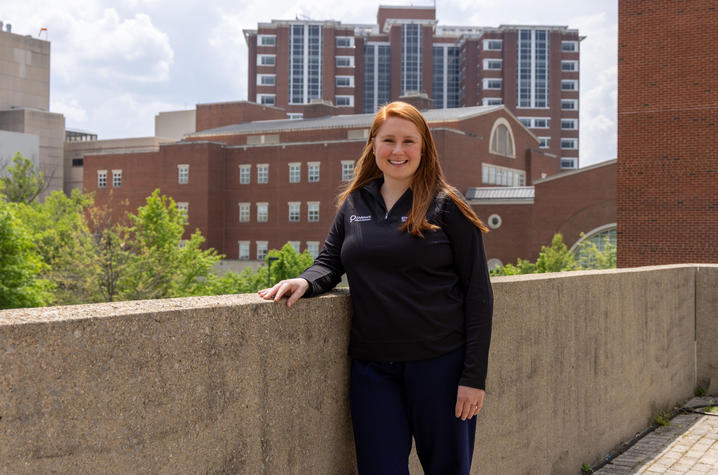
LEXINGTON, Ky. (May 4, 2026) — Kelsey Wagler, a registered nurse in the Golisano Children’s at UK pediatric intensive care unit (PICU), chose to stay at her alma mater to take the next step in her career as a clinician.
Soon, she’ll be walking the stage completing the Doctor of Nursing Practice (D.N.P.) program from the UK College of Nursing, specializing in pediatric acute care.
Wagler will be turning her tassel just weeks after welcoming a new baby. The D.N.P. program has seen her through marriage, a new home, full-time work and innovative research using virtual reality to inform sepsis education.
In her new capacity as a D.N.P., Wagler will have the means to bring her leadership, research and hard-earned expertise back to the bedside.
UKNow: What first drew you to pediatric critical care, and what has kept you working in the PICU?
Wagler: I struggled with the thought of whether I wanted that level of acuity with adults versus kids, and I ended up interviewing for the PICU. These kids are truly amazing.
Just recently, I had a patient who was a 2-year-old who, when she was a newborn, we really didn’t think was going to make it. I distinctly remember how sick she was. Recently, she was running around, blowing bubbles, jumping in my arms and talking.
Our work means so much when these kids get better. She’s not a “normal” 2-year-old, but she’s running, walking and gets to live a full life.
Adults have lived their lives. Kids are just at the start. A lot of times in critical care, we get to follow them for the rest of their lives. Once they visit us, they tend to visit again, and we get to watch them grow up. That’s why I chose pediatrics.
UKNow: You’ve spent several years at the bedside. Why did pursuing D.N.P. feel like the right next step for you?
Wagler: When I was in the College of Nursing Ph.D. program, I learned pretty quickly that I hate writing papers. One of my advisors and I looked at sentence syntax for 20 minutes, and I thought, “I can’t do this anymore.”
During that time, I also knew I wasn’t ready to leave the bedside. I loved being with patients every day, knowing I was making an impact, rather than writing research papers.
D.N.P. felt like the best mix — still doing research and making changes in practice but also staying at the bedside with these kids.
I’ve really enjoyed the program because it’s research-heavy, but we’re also becoming experts — for me, in pediatric acute care. It’s the best of both worlds, where I get to do research to improve pediatric care.
UKNow: Your D.N.P. research focuses on virtual reality simulations. How would you describe your project?
Wagler: We recreated a medical scenario using a virtual reality headset.
Participants put the headsets on, used hand-held devices, and practiced how to take care of kids — how to assess them and what interventions are necessary to give the best care.
We looked at patient care outcomes to see whether kids received better care after this education, but also at nurses’ confidence and knowledge in managing these situations.
At the end of the day, yes, we want what’s best for the kids, but we also want nurses to feel empowered.
This project did both — empowering nurses while improving patient care.
UKNow: Why did you choose pediatric sepsis as the focus of your research, and why is early recognition so important in children?
Wagler: When we first implemented this simulation, the patient we practiced with was an 8-year-old boy who had just been admitted to the PICU, and he had signs and symptoms that made us think he might have sepsis.
There are signs and symptoms of sepsis that lead us down that pathway, and we recently implemented a new protocol in August 2024 in the PICU, it includes an algorithm and a predictive model for sepsis.
Every patient is at risk for sepsis when they’re in the hospital, whether it’s hospital-acquired or community-acquired.
It’s something we have to watch for in every patient, no matter their admitting diagnosis.
UK HealthCare is the hospitals and clinics of the University of Kentucky. But it is so much more. It is more than 10,000 dedicated healthcare professionals committed to providing advanced subspecialty care for the most critically injured and ill patients from the Commonwealth and beyond. It also is the home of the state’s only National Cancer Institute (NCI)-designated Comprehensive Cancer Center, a Level IV Neonatal Intensive Care Unit that cares for the tiniest and sickest newborns and the region’s only Level 1 trauma center.
As an academic research institution, we are continuously pursuing the next generation of cures, treatments, protocols and policies. Our discoveries have the potential to change what’s medically possible within our lifetimes. Our educators and thought leaders are transforming the healthcare landscape as our six health professions colleges teach the next generation of doctors, nurses, pharmacists and other healthcare professionals, spreading the highest standards of care. UK HealthCare is the power of advanced medicine committed to creating a healthier Kentucky, now and for generations to come.