


Farm Inc.: Students experience the business of farming through extension education program


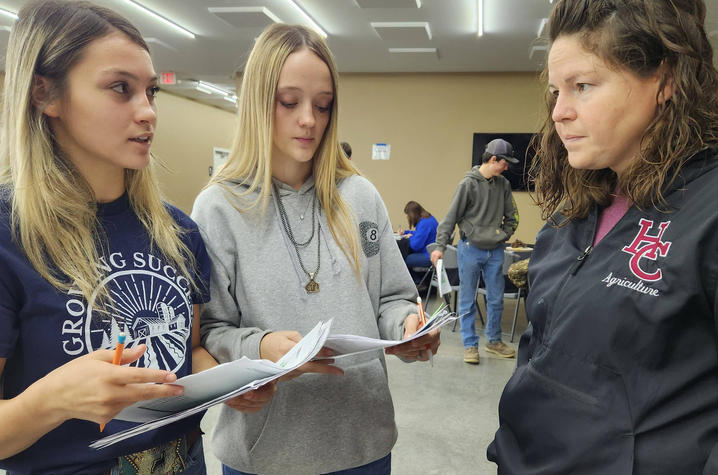
CYNTHIANA, Ky. (March 19, 2026) — Agriculture students in Harrison County are learning important lessons long before they turn a profit from the land. Farming is a business that takes planning, people and perseverance.
Those lessons come to life through Farm Inc., a two-week experiential learning program led by Harrison County 4-H Youth Development agent Shannon Farrell. The University of Kentucky Cooperative Extension Service program blends classroom instruction with a culminating hands-on simulation known as the Farming Game.
“The Farming Game brought together over 30 agribusiness leaders representing a range of farming enterprises and business sectors to ‘do business’ with high school agriculture students,” Farrell said. “Students come prepared, having already spent days in their agriculture classroom learning about budgeting, finance, soil type, topography and farm management.”
Farrell said the program was created to help fill a gap she saw in traditional agricultural education, especially for students without experience in commercial farming.
“While agricultural classes are offered in many Kentucky high schools, there has been a void of educating and preparing young individuals on in-depth, step-by-step farming endeavors,” Farrell said. “Farming has often been considered a career where only minimal education is needed, but it has evolved into a prestigious occupation that requires countless hours, enormous expenses and great risks.”
Modeled after a similar program created in Ohio, Farrell has coordinated Farm Inc. in several counties in the last nine years, impacting nearly 470 students.
For the 2025-26 program, 41 agriculture students “farmed” more than 1,500 acres by working with local agribusiness volunteers and participating in a live auction.
During the first phase of the program, students choose from seven farming scenarios and decide whether to operate as a full-time farmer or supplement their farm business with an off-farm job. They build personal and farm budgets, factoring in cost-of-living expenses, production costs and income projections.
Soil conservation representatives visit classrooms to teach students how to read soil maps and interpret soil series profiles, crop yield potential and land-use options. Loan officers guide students through income and expense sheets, preparing them for the final simulation day.
On the final day, the students visit the “marketplace” at the Harrison County Fairgrounds. Students rotate among vendors, including equipment dealers, loan officers, crop insurance agents, livestock buyers and feed suppliers, all of whom volunteer their time to create a realistic experience.
Harrison County agriculture teacher Lacey Short said the project is a great way for her students to learn to network with community members and ask what works best for their farming operations.
"On paper, it is easy to write down numbers to create fake budgets, but with Farm Inc., they have to create a realistic budget for their farmland going into the event,” Short said. “Then they have to take it a step further by talking and meeting with community agriculture members to get actual numbers for what the market price is that day and try to crunch the numbers to break even or be profitable.”
Through conversations with vendors, students quickly learn the ripple effects of management decisions. Buying cows means considering pasture management, veterinary costs, fencing, feed, facilities, calf survival and market volatility. Every choice affects the bottom line.
“This event provides such an eye-opening experience on annual expenses, which are usually much greater than realized, and income, which is usually much less than needed,” Farrell said.
Survey results show that the program is making an impact. 93% of participating students strongly agreed that they gained a better understanding of agricultural production and business practices. Students described the experience as interactive, realistic and engaging, often highlighting the value of talking directly with industry professionals.
“Farm Inc. was an opportunity to see the real-life challenges that farmers face every day, especially financially,” said Harrison County senior Sarra Skinner.
For Farrell, that kind of takeaway is exactly the point.
“When young people can connect classroom learning to real-life applications, they begin to understand agriculture as both a science and a business,” she said. “They also see the value of community partnerships and the people who support agriculture every day.”
To learn more about the role of Extension in agriculture education, visit the UK Cooperative Extension Service website at extension.mgafe.uky.edu.
As the state’s flagship, land-grant institution, the University of Kentucky exists to advance the Commonwealth. We do that by preparing the next generation of leaders — placing students at the heart of everything we do — and transforming the lives of Kentuckians through education, research and creative work, service and healthcare. We pride ourselves on being a catalyst for breakthroughs and a force for healing, a place where ingenuity unfolds. It's all made possible by our people — visionaries, disruptors and pioneers — who make up 200 academic programs, a $1.02 billion research and development enterprise and a world-class medical center, all on one campus.