


Compassion, delivered with robotic precision, helps UK patient find relief



LEXINGTON, Ky. (Feb. 17, 2026) — For Ashley Martin of Winchester, every day was a battle against endometriosis. Over the course of years, she tried every available medication and procedure to keep her persistent, painful condition at bay.
Endometriosis is a complex condition, affecting more than 6 million women in the United States. It occurs when tissue, similar to the kind found in the uterus, grows outside the organ and throughout the pelvic area. Unlike uterine tissue that is flushed out of the body with each menstrual cycle, endometriosis tissue doesn’t leave the body. If left unchecked, it can grow into thick, fibrous bands that can wrap around the other organs in the pelvic region — including the uterus, ovaries and bladder — and fuse them together.
For Martin, nothing worked. The last resort in her fight against endometriosis was a total hysterectomy — a procedure to remove to remove her uterus and cervix. Her surgeons opted to leave her ovaries in place, as the estrogen hormones they produce would reduce her risk of osteoporosis. At least, that was the plan.
“They had to take my right ovary because it ruptured during surgery,” Martin said. That wasn’t the only complication. “They cut my ureter tube, so my kidney wasn’t connected to my bladder anymore.”
Martin was transferred to another hospital where surgeons placed a nephrostomy tube; for a month, her kidney drained into a bag outside her body. She recalls those miserable weeks while she waited for her body to heal from the hysterectomy so she could undergo the necessary bladder reconstruction surgery.
“Multiple, multiple times within that month I was in the hospital,” she said. “They didn’t tell me I was septic. I actually read that in my chart. I was on constant IV antibiotics and no one said why.”
Even after the bladder reconstruction, Martin's troubles continued. A few months later, she had what she felt was urinary tract infection (UTI). She went to her local urgent care where she was given antibiotics. When the pain and discomfort persisted, she returned to the urgent care where she was again prescribed a round of antibiotics. And once again, the drugs offered no relief. Discouraged and frustrated, she went to the emergency department at the University of Kentucky Albert B. Chandler Hospital.
“The first doctor I saw there took me so seriously,” Martin said. “Instead of just like, ‘Oh, here’s a girl with a UTI, let’s get her some medicine and send her on her way.’ But he did a CT scan and did some blood work. And that’s when they found the mass.”
Martin was referred to Tricia Fredericks, M.D., a gynecologic oncology surgeon at the UK Markey Cancer Center. Fredericks discovered that Martin’s remaining ovary developed an endometrioma, a type of ovarian cyst that forms when uterine-like tissue grows on the ovary. The mass was putting pressure on Ashley’s bladder, causing her UTI-like symptoms.
“Unfortunately, no one ever addressed her remaining ovary,” said Fredericks. The mass had begun to form an abnormal connection to Martin’s vagina, called a fistula. The result wasn’t just pain, but bleeding as well. Despite the findings, Martin felt relieved; after multiple surgeries, complications and recurring symptoms, Fredericks had not only a diagnosis, but a plan to address Martin’s endometriosis once and for all.
“I was telling Dr. Fredericks about all of this, and she was like, ‘I’m going to take care of you,’” Martin said. “She took every precaution that was never taken into consideration before. She took a problem that wasn’t hers to fix and she fixed it.”
Fredericks outlined every treatment option to Martin, as well as the potential for complications with each one. Because of the size and precarious position of the mass, as well as the residual scar tissue from Martin’s previous surgeries, Fredericks wanted to be prepared for every contingency. She asked urology surgeon Patrick Hensley, M.D., and colorectal surgeon Erin Wolf-Horrell, M.D., to be on standby.
“Even with her history of a major complication, she was very comfortable going into surgery knowing we had plans in place in case something occurred given the adhesive disease from endometriosis and previous surgery in her pelvis,” said Fredericks.
In May 2025, two years after her hysterectomy, Martin underwent a procedure called a salpingo-oophorectomy to remove the remaining ovary. To address the fistula, Fredericks also performed an upper vaginectomy to remove the top part of the vagina. The procedures were performed robotically with minimal incisions. This was a major benefit to Martin, who bears scars from multiple invasive surgeries.
“I have the full C-section scar from the hysterectomy,” she said. “Then there’s a bunch from the bladder reconstruction. I’ve got scars on my front and back. I want to say I have a least 15 from all these surgeries, so not to have big new ones was awesome.”
Another benefit of robotic surgery is the recovery period, which is generally shorter and less painful than with larger invasive surgeries. Having experienced both, Martin can personally attest to that.
“With the hysterectomy and bladder surgery, I was out for a while,” she said. “I was expecting to be out for a month and not being able to get up and have difficulty moving around. But that wasn’t there. I was up and walking around within days.”
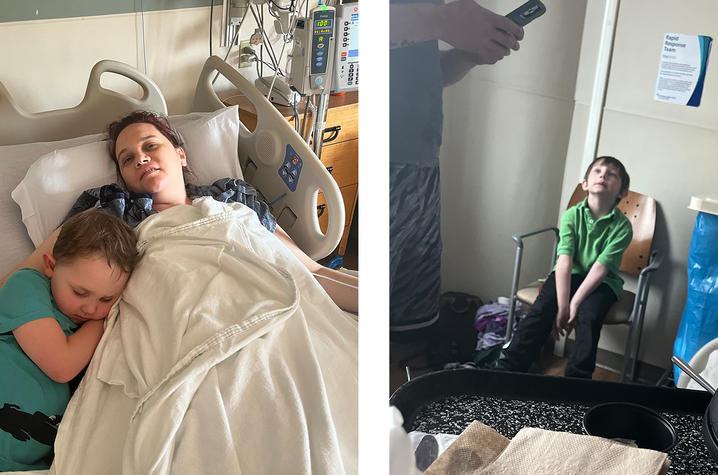
Her husband and stepchildren were with Martin every step of the way, staying by her side throughout her hospital stay. The boys, now ages eight and seven, appointed themselves as her personal care team, making sure her recovery at home was comfortable.
“I really like cases like this because it shows what we are able to offer patients in terms of robotic surgery,” said Fredericks. Because of the nature of the minimally invasive procedure, patients typically have less need for pain medication and can return to normal life quickly.
Even though she’s fully healed and free of the debilitating effects of endometriosis, Martin still checks in with Fredericks on a regular basis.
“The plan was, when I was done, to see a regular gynecologist for everything else,” Martin said. “But when I saw her last, she said if I wanted to make an appointment to get my hormones here, I could. That was her way of saying I can come back if I want to. I feel really good about starting hormones, because if that kicks anything back up, I know I’m going to be monitored, taken care of and taken seriously.”
Looking back at the past two years, Martin considers how symptoms such as hers can be dismissed or misdiagnosed, especially when the answers aren’t straightforward. Rather than accept continuous pain and symptoms, she advocated for herself — something she encourages anyone in a similar situation to do. That persistence paid off, leading her to an expert who not only identified the root of her symptoms, but approached her care with careful planning, collaboration and compassion.
“You know your body more than anyone else does,” she said. “You know when something is wrong — don’t take the answer that doesn’t feel right. In my case, the easiest answer wasn’t the answer. Find someone who’s going to take you seriously.”
UK HealthCare is the hospitals and clinics of the University of Kentucky. But it is so much more. It is more than 10,000 dedicated healthcare professionals committed to providing advanced subspecialty care for the most critically injured and ill patients from the Commonwealth and beyond. It also is the home of the state’s only National Cancer Institute (NCI)-designated Comprehensive Cancer Center, a Level IV Neonatal Intensive Care Unit that cares for the tiniest and sickest newborns and the region’s only Level 1 trauma center.
As an academic research institution, we are continuously pursuing the next generation of cures, treatments, protocols and policies. Our discoveries have the potential to change what’s medically possible within our lifetimes. Our educators and thought leaders are transforming the healthcare landscape as our six health professions colleges teach the next generation of doctors, nurses, pharmacists and other healthcare professionals, spreading the highest standards of care. UK HealthCare is the power of advanced medicine committed to creating a healthier Kentucky, now and for generations to come.