


UK launches specialized care for rare but life-altering headache condition


LEXINGTON, Ky. (Feb. 2, 2026) — For more than a year, Jennifer Highland lived her life in halves.
Each morning, she went to work, teaching preschool and kindergarten as she had for decades. By early afternoon, she was home — not by choice, but because the pain had become unbearable. What began as ringing in her ears slowly progressed into daily headaches and migraines that worsened the longer she stayed upright.
“I could work until noon, and that was it,” Highland said. “After that, I’d come home with a migraine and have to lie down. That was my whole life for 14 months.”
When she lay flat, the pain eased. When she stood up, it surged back — a hallmark sign of a rare and often underdiagnosed condition called intracranial hypotension, caused by low pressure in the fluid surrounding the brain and spinal cord.
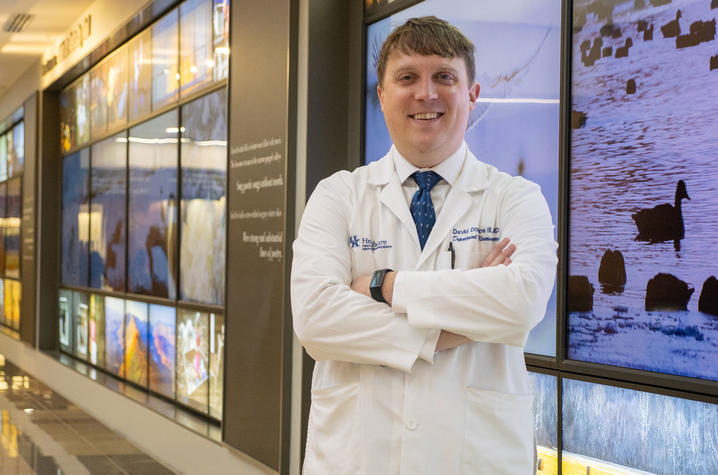
“These are headaches that get significantly worse when patients go from lying down to standing,” said David Dornbos III, M.D., a neurosurgeon at UK HealthCare’s Kentucky Neuroscience Institute. “They’re debilitating, and because the symptoms can be vague, patients often struggle for months or even years before getting answers.”
In Highland’s case, the cause was especially elusive. Her spinal fluid wasn’t leaking into surrounding tissue, as is more common. Instead, it was being siphoned directly into a vein through an abnormal connection known as a cerebrospinal fluid, or CSF, venous fistula.
“There’s an abnormal connection where the spinal fluid essentially gets sucked into the venous system,” Dornbos said. “So instead of staying where it belongs, patients are constantly losing spinal fluid, which causes their symptoms.”
Finding that connection can be difficult. Patients often undergo multiple MRIs, CT scans and specialized imaging studies before the fistula is identified — if it’s identified at all.
“Because this diagnosis is relatively new, it’s frequently missed,” Dornbos said. “Many patients start to feel like they’re crazy because all their tests come back negative, but they’re incredibly uncomfortable.”
That uncertainty weighed heavily on Highland.
“When no one can find what’s wrong, you start to doubt yourself,” she said. “But I knew this wasn’t normal.”
Historically, patients with CSF-venous fistulas were either left untreated or referred out of state for major surgery — often to specialty centers like the Mayo Clinic or Duke University. Surgery typically required an open incision and, in some cases, sacrificing a nerve root.
“It was a really tough trade-off,” Dornbos said. “Patients were often faced with choosing between living with the headache or risking permanent weakness.”
Today, that’s no longer the only option.
UK HealthCare has launched a revamped care pathway for patients with low spinal fluid pressure headaches, bringing together neurology, radiology, pain management and neurosurgery. As part of that effort, Dornbos and his team now offer a minimally invasive, catheter-based procedure to treat CSF-venous fistulas — a treatment available at only a small number of hospitals nationwide and the only one of its kind in Kentucky.
Using a catheter inserted through a small puncture in the leg, Dornbos navigates to the site of the fistula and seals the abnormal connection with medical adhesive.
“There’s no incision, no spinal surgery,” he said. “It’s essentially a pinprick in the leg — like a glorified IV — and we can cure the underlying problem.”
Highland underwent the procedure in October. Within days, her symptoms began to resolve.
“By about three days, I realized something had changed,” she said. “When I started getting up and moving around, the pain just wasn’t there anymore.”
Dornbos said that timeline is typical.
“For patients we’re able to treat successfully, symptoms improve dramatically within 72 hours,” he said. “By the two-week follow-up, most are essentially back to normal.”
Today, Highland says she feels like herself again — something she once feared might never happen.
“I went out to see live music for the first time in more than a year,” she said. “People asked where I’d been. They had no idea I’d spent so much of that time at home, in bed.”
For Dornbos, stories like Highland’s underscore why expanding access to this care matters.
“These patients often come to us exhausted — physically and emotionally,” he said. “Even before we fix the problem, just finding the cause gives them hope again.”
Highland agrees. She hopes sharing her experience will help others recognize the signs — and seek care sooner.
“If your headaches get better when you lie down and worse when you stand up, that matters,” she said. “Listen to your body and keep pushing for answers.”
Now, those answers — and treatment — are available closer to home.
“People no longer have to travel halfway across the country for this care,” Dornbos said. “We can do it here, and we’re seeing lives change because of it.”
UK HealthCare is the hospitals and clinics of the University of Kentucky. But it is so much more. It is more than 10,000 dedicated healthcare professionals committed to providing advanced subspecialty care for the most critically injured and ill patients from the Commonwealth and beyond. It also is the home of the state’s only National Cancer Institute (NCI)-designated Comprehensive Cancer Center, a Level IV Neonatal Intensive Care Unit that cares for the tiniest and sickest newborns and the region’s only Level 1 trauma center.
As an academic research institution, we are continuously pursuing the next generation of cures, treatments, protocols and policies. Our discoveries have the potential to change what’s medically possible within our lifetimes. Our educators and thought leaders are transforming the healthcare landscape as our six health professions colleges teach the next generation of doctors, nurses, pharmacists and other healthcare professionals, spreading the highest standards of care. UK HealthCare is the power of advanced medicine committed to creating a healthier Kentucky, now and for generations to come.