


UK student gains recognition, experience as plant breeding ‘independent researcher’
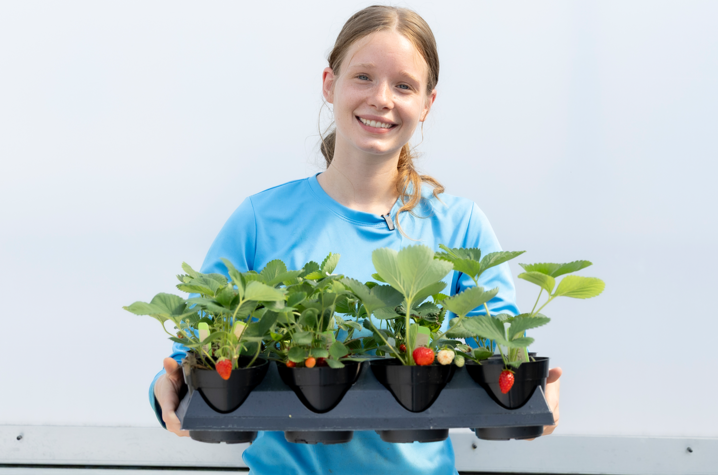
LEXINGTON, Ky. (Oct. 13, 2026) — Ella Shields, a University of Kentucky student graduating in December with a horticultural science degree from the Martin-Gatton College of Agriculture, Food and Environment, was recognized by the National Association for Plant Breeding (NAPB) as a 2026 Borlaug Scholar.
Shields has gained valuable experience through undergraduate research in plant breeding at UK, through which she combines hands-on work with research aimed at solving production challenges.
‘Always came back to horticulture’
At her grandmother’s house, Shields’ favorite snack was strawberries, cut up and sugared — “the best thing ever in the whole world,” Shields said. So when she joined a UK research lab, studying strawberry breeding was a perfect fit.
“I love strawberries,” Shields said. “My Mimi is not surprised at all that I’m working with them.”
From Lexington, Shields earned her associate degree in science from Bluegrass Community and Technical College before attending UK.
“I wasn’t sure what I wanted to do yet, but I just always came back to horticulture,” Shields said. “I looked at different avenues, but I thought that it would bring me a lot more satisfaction to work with plants.”
In 2025, Shields joined the Sapkota Horticultural Breeding and Genetics Lab, soon after Manoj Sapkota, Ph.D., joined UK as an assistant professor of horticulture crop breeding for nutrition. The lab seeks to improve horticultural crops, like tomatoes and strawberries, and develop practical tools for crop research.
Sapkota said Shields has grown from a research assistant who was eager to learn the basics to an “increasingly independent researcher” who conducts experiments and helps train other undergraduate researchers.
“She now has become an essential part of our lab’s daily operations and research culture,” Sapkota said.
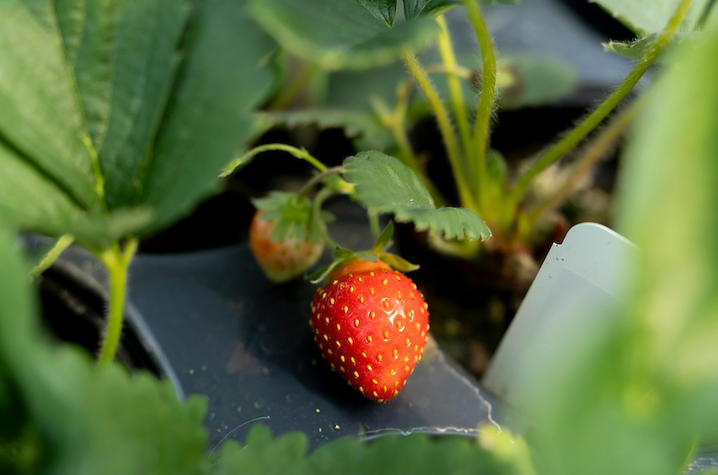
While also helping with the lab’s other projects, Shields has primarily worked on strawberry resistance to Neopestalotiopsis, an emerging and severe disease that affects multiple parts of the strawberry plant. By identifying genetic material in strawberries with greater resistance to Neopestalotiopsis, the researchers hope to breed more disease-resistant varieties.
Strawberries are a popular and high-value crop, so new varieties can help both producers and consumers.
“We can hopefully make strawberries more available for all consumers, who can be a little healthier because they have access to fresh strawberries,” Shields said.
This summer, Shields continued her strawberry research as a UK Sustainability Summer Research Fellow and a Tracy Farmer Scholar. Her summer project focused on developing and optimizing a detached-leaf bioassay, in which strawberry leaves are inoculated with Neopestalotiopsis and evaluated for disease development and severity.
In the future, Shields plans to move the research into field trials and study the whole strawberry plant.
'An honor’ to be a Borlaug Scholar
Named for Nobel Peace Prize laureate Norman Borlaug, the NAPB Borlaug Scholar program recognizes students pursuing careers in plant breeding.
“He did a lot — he started the Green Revolution; he made wheat varieties that helped solve a lot of hunger issues across the world,” Shields said of Borlaug. “So it was an honor to be part of that.”
As a Borlaug Scholar, Shields received financial support to attend the NAPB Annual Meeting at Texas A&M in June 2026, where she met others who work in breeding and toured horticulture facilities. Each scholar is also assigned a mentor who can help students connect with colleagues and companies.
“You have a lot of networking opportunities that you wouldn’t get otherwise,” she said.
Sapkota worked with Shields on her application to show that the Borlaug program was an opportunity not only for Shields’ professional development but also to strengthen plant-breeding capacity in Kentucky.
“If you support or train this new generation of scientists, that’s how the field will flourish,” Sapkota said.
Sapkota said he knew Shields would be a good applicant, but he was still thrilled when she was selected.
“For a young lab, seeing one of our undergraduate researchers recognized nationally was incredibly meaningful,” Sapkota said. “More importantly, it showed Ella that the work she is doing here can connect her to the broader plant-breeding community.”
'The next great opportunity’
After graduating, Shields will begin her master’s degree at UK in integrated plant and soil sciences with a horticulture focus.
She will continue her strawberry research as a graduate student, building on the collaborative mentorship she has received from Sapkota, Namrata Maharjan, Ph.D., a research analyst in the Department of Horticulture, and Nicole Gauthier, Ph.D., professor and Extension plant pathologist.
Maharjan, who recently finished her doctorate, said her graduate training taught her the importance of persistence, independent problem-solving and learning through research challenges. Now, as a mentor, she enjoys helping undergraduate researchers develop those same skills while providing the guidance they need as they become more independent.
“When I’m working with these undergrad students, and when I’m capable of teaching them what I learned, it’s very rewarding,” Maharjan said.
Shields said she feels very grateful to the lab and her mentors.
“I need to take advantage of the opportunities that have been given to me and use them wisely,” Shields said. “They should take me to the next great opportunity and research that hopefully has bigger and bigger impacts.”
Learn more about the horticultural science program and the Sapkota Horticultural Breeding and Genetics Lab at mgcafe.uky.edu.
This material is based upon work that is supported by the Kentucky Agricultural Experiment Station (KAES), National Institute of Food and Agriculture, U.S. Department of Agriculture, Hatch Capacity Funding project under award number KY011063. Any opinions, findings, conclusions or recommendations expressed in this publication are those of the author(s) and do not necessarily reflect the view of the U.S. Department of Agriculture.
As the state’s flagship, land-grant institution, the University of Kentucky exists to advance the Commonwealth. We do that by preparing the next generation of leaders — placing students at the heart of everything we do — and transforming the lives of Kentuckians through education, research and creative work, service and healthcare. We pride ourselves on being a catalyst for breakthroughs and a force for healing, a place where ingenuity unfolds. It's all made possible by our people — visionaries, disruptors and pioneers — who make up 200 academic programs, a $1.02 billion research and development enterprise and a world-class medical center, all on one campus.