


‘I Am a UK Innovator:’ College of Pharmacy’s Chang-Guo Zhan
LEXINGTON, Ky. (Oct. 14, 2025) — What happens when bold thinking meets collaboration? Innovation that changes lives. Through the video series “I Am a UK Innovator,” Research Communications and UK Innovate highlight the University of Kentucky researchers transforming breakthrough ideas into discoveries, technologies and ventures with real-world impact. UK Innovate works collaboratively with innovators to strategically assess, protect and license early-stage technologies and co-create new technology startups.
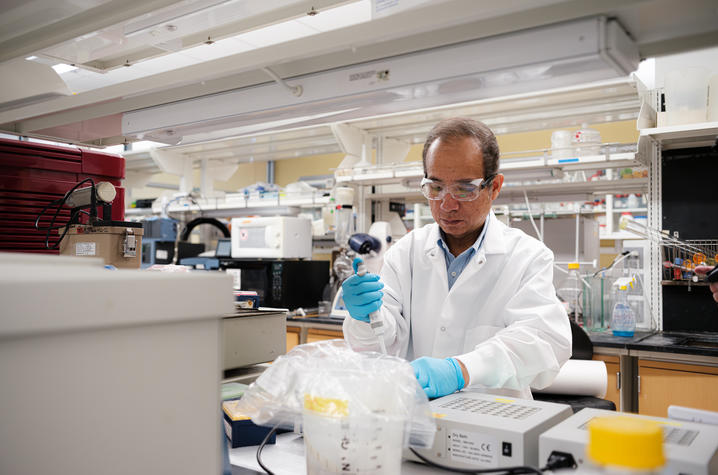
In this Q&A, Chang-Guo Zhan, Ph.D., Endowed College of Pharmacy Professor, in Pharmaceutical Sciences, explains how his work bridges chemistry, physics and biomedicine to pursue new treatments for some of healthcare’s most pressing challenges.
UKNow: What inspired you to pick this specific area of research?
My training in chemistry, physics and biomedicine has given me the opportunity to approach biomedical problems from different perspectives. I became interested in bringing these disciplines together to understand molecular processes and use that knowledge to develop new medicines. What has continued to inspire me throughout my career is the possibility that our research can eventually lead to novel therapies that make a meaningful difference in people’s lives. That goal motivates us to pursue challenging problems in areas such as substance use disorders, pain and other inflammation-related diseases, where there remain significant unmet medical needs.
UKNow: What is the most challenging aspect of your research?
One of the greatest challenges is translating a promising scientific discovery into a therapy that can ultimately benefit patients. A finding that looks promising in the laboratory is only the beginning. We need to understand how a potential treatment behaves in complex biological systems, optimize it, demonstrate its safety and efficacy, and meet the rigorous FDA requirements for advancing it toward patients. The process rarely goes exactly as planned, so persistence and adaptability are essential. It is challenging, but also what makes the research exciting and rewarding.
UKNow: What have been the most fulfilling moments for you regarding your discoveries?
The most fulfilling moments are when an idea that began at the molecular or computational level is supported by experimental evidence and shows the potential to become a new therapeutic approach. It is especially rewarding when we see that our work may eventually address an important unmet medical need. Those moments give us a sense that the research could ultimately make a meaningful difference in patients’ lives. I also find it very fulfilling to see students and postdoctoral researchers make discoveries of their own, grow as scientists and develop the skills to pursue their own research careers.
UKNow: How has your research impacted the way you train students?
My interdisciplinary training in chemistry, physics and biomedicine has strongly influenced the way I mentor students. I encourage them to look at scientific problems from multiple perspectives and to think beyond the boundaries of a single discipline. Important biomedical problems often require us to combine different types of knowledge and approaches. I also encourage students to think critically, question assumptions and be persistent when experiments do not produce the expected results. Most importantly, I want them to become independent scientists who can develop creative solutions to important problems and ultimately use their knowledge to make a positive impact on human health.
UKNow: What drew you to the University of Kentucky?
I was drawn to the University of Kentucky because it provides an environment where fundamental science, biomedical research and the development of new therapies can come together. I value the collaborative nature of the university and the opportunity to work with talented colleagues and students from different disciplines. The College of Pharmacy is also a particularly good environment for my research because of its focus on drug discovery and development and its commitment to improving human health. What continues to inspire me is the opportunity to pursue challenging scientific questions while training the next generation of scientists and working toward discoveries that may eventually become novel therapies for patients.
As the state’s flagship, land-grant institution, the University of Kentucky exists to advance the Commonwealth. We do that by preparing the next generation of leaders — placing students at the heart of everything we do — and transforming the lives of Kentuckians through education, research and creative work, service and healthcare. We pride ourselves on being a catalyst for breakthroughs and a force for healing, a place where ingenuity unfolds. It's all made possible by our people — visionaries, disruptors and pioneers — who make up 200 academic programs, a $1.02 billion research and development enterprise and a world-class medical center, all on one campus.