


My White Oak mobile app helps landowners assess their woods, plan for white oak’s future

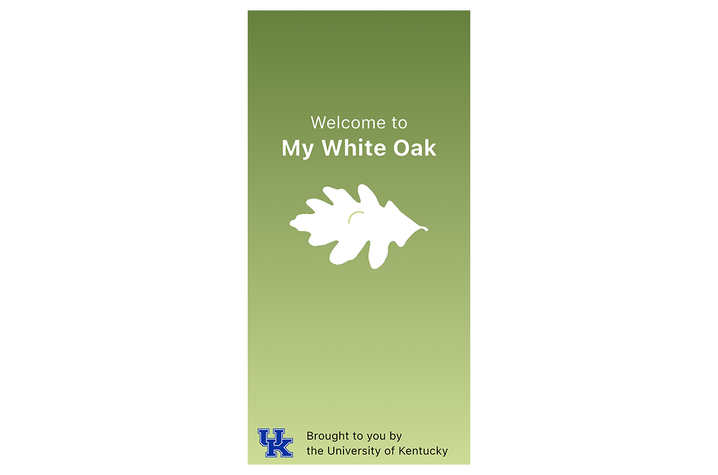
LEXINGTON, Ky. (May 14, 2026) — A new mobile app is helping woodland owners across Kentucky and the Central Hardwood region determine whether white oak is present in their woodlands and is offering ways to help regenerate and sustain the species.
The app was developed through a partnership among the University of Kentucky Martin-Gatton College of Agriculture, Food and Environment (CAFE), the White Oak Initiative and the Kentucky Division of Forestry. The My White Oak app guides landowners through a straightforward woodland assessment and generates a property-specific report focused on white oak sustainability.
White oak is a key part of regional forests and economies. It supports wildlife through dependable mast production, helps stabilize soils and supplies products such as flooring and furniture, as well as cooperage for bourbon barrels. Sustaining white oak has become a persistent challenge in eastern hardwood forestry, however. In many places, oak remains mostly in older trees, with limited younger trees coming behind them — often due to long-term fire exclusion, competition from shade-tolerant species, dense understories and browsing pressure.
“The question many landowners face now isn’t whether white oak matters; it’s how to keep it in the forest,” said Jacob Muller, Ph.D., forestry and natural resources assistant professor at Martin-Gatton CAFE and author of the project overview. “My White Oak was built to help people look at what’s already on their property, recognize barriers early and start planning for the future with research-backed information.”
A guided woodland assessment that leads to a tailored report
At the center of the app is a woodland assessment completed by the landowner. Through guided questions and basic observations, users evaluate stand characteristics tied to white oak presence, regeneration potential and site conditions. After the assessment, the app generates a woodland-specific report.
That report is designed to do three things. First, it helps landowners understand whether their woods show strong white oak potential or whether issues such as limited regeneration, dense midstories or heavy competition are likely to limit success. Second, it introduces management practices that may improve conditions for white oak, described in clear, nontechnical language. Third, it emphasizes working with a professional forester to refine and implement actions within a long-term plan.
Built from well-established oak science
The app’s guidance reflects a broader oak management framework that focuses on light, competition and regeneration over time. Research across the Central Hardwood region has shown that many mature stands have low understory light — conditions that favor shade-tolerant species and hold oak back. The app highlights practices commonly used to address these limits, while stressing that good outcomes depend on site conditions, stand structure, landowner objectives and the implementation of oak-friendly management activities over time.
“My White Oak doesn’t ask landowners to become silviculture experts,” Muller said. “It breaks the process into a practical first step and then points to what those results may mean, so the next conversation with a forester starts on the same page.”
Supporting clearer conversations with foresters
Project partners describe My White Oak as a communication tool as much as an assessment tool. By providing landowners and foresters with a shared reference point, Muller said the app can help align goals and clarify expectations early, especially since white oak management often spans decades, and decisions made now can shape future forest composition.
“Our hope is that this app can make management easier, more efficient and influence positive impacts to promote and sustain our white oak woodlands long into the future,” Muller said.
As the state’s flagship, land-grant institution, the University of Kentucky exists to advance the Commonwealth. We do that by preparing the next generation of leaders — placing students at the heart of everything we do — and transforming the lives of Kentuckians through education, research and creative work, service and healthcare. We pride ourselves on being a catalyst for breakthroughs and a force for healing, a place where ingenuity unfolds. It's all made possible by our people — visionaries, disruptors and pioneers — who make up 200 academic programs, a $1.02 billion research and development enterprise and a world-class medical center, all on one campus.