


UK economists point to livestock strength, row crop strain in 2026
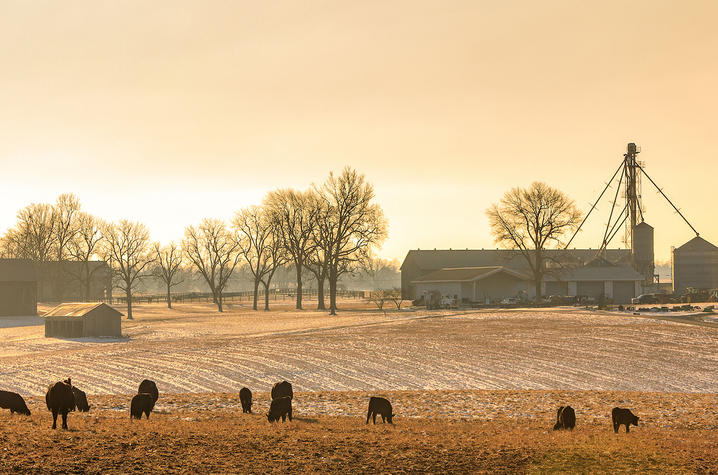
LEXINGTON, Ky. (Dec. 4, 2025) — Strong cattle, poultry and horse sales dominated for much of 2025, leading economists to predict Kentucky agricultural sales will be $8.3 billion for the year despite lower grain prices burdened by supply outpacing demand.
Will Snell, Ph.D., extension economist at the University of Kentucky Martin-Gatton College of Agriculture, Food and Environment, said that while final 2024 agricultural cash receipts ― reported at $7.9 billion by the Economic Research Service in September ― were slightly lower than the previous year, 2025 receipts offer hope for recovery and may rival the record high cash receipts in 2022.
“A challenging trade environment coupled with abundant global supplies had an adverse effect on grain prices, but livestock prices left Kentucky in a much better position,” Snell said. “For many years, the market share of livestock and crop sales was similar, but the spread widened this past year considerably, with livestock accounting for 65% of projected sales in 2025.”
Snell reported that the real story, however, is the variability of net farm income.
“While we expect a rebound in Kentucky net farm income, from $2.4 billion in 2024 to around $3 billion in 2025, this is largely due to an increase in government payments and crop insurance proceeds, not market strength on the crop side,” Snell said. “Obviously, this will vary considerably from farm to farm and region to region in the state. Despite the influx of government payments, a continued price-cost squeeze will cause many of our grain farmers to face serious financial stress heading into 2026.”
Row crop market slump continues, but hope is in exports
Near-record crop production and a third year of depressed prices have Kentucky farmers facing another year of diminished cash flow. Grain crop cash receipts are projected to drop nearly 20% — from $2.9 billion to $2.3 billion — in 2025.
According to UK Extension grain economics specialist Grant Gardner, Ph.D., oversupply and lower exports are the driving factors.
“Another year of near record grain production, both in the U.S. and the rest of the world, puts Kentucky producers in a similar situation as last year,” he said.
Gardner pointed to broader challenges posed by China’s recent export cut. For the past several years, China has bought nearly 25% of U.S. soybean production, and the recent halt in Chinese buying pushed soybean prices to unprofitable levels. With China’s recent purchase commitment, soybean prices have increased a couple of points.
“That’s a big upswing, and anything moving forward is going to be dependent on whether they fulfill those commitments,” Gardner said. “If they are, I could see prices get up to about $12 per bushel, and that could bring some profitability to the soybean sector.”
Gardner does not expect corn prices to change dramatically, estimating they will be between $4.80 and $5 at peak next year, but drop back to about $4.50 per bushel during harvest. Exports are unlikely to trigger large price swings in corn. Global weather is an unknown factor that could result in much greater volatility.
Jerry Pierce, coordinator for the Kentucky Farm Business Management (KFBM) program, said the economic outlook for grain crops is gloomy compared to a few years ago.
“Commercial Kentucky crop farms have been profitable over the last five years, but most of that income came in the first three years,” Pierce said. “We were seeing the highest net farm income ever in 2021, but now we’ve come to a cliff and can’t see the bottom.”
Pierce said that grain farms in the KFBM program last year had an average gross income of $900 per acre, yet operating expenses averaged $816 per acre. Total operating expenses per acre fell slightly, but gross revenue dropped considerably, driving profit margins down.
“This pattern is projected to continue,” Pierce said, “and will likely impact future conversations with farm lenders.”
Cattle, equine and poultry receipts counter the grain slump
Livestock, equine and poultry income should account for a significantly larger share of agricultural receipts in 2025 ― estimated at $5.3 billion ― and demand is expected to remain strong in 2026.
“Tight supplies have gotten a lot of attention, particularly in the beef cattle world,” said Kenny Burdine, Ph.D, UK Extension livestock economics specialist. “But I also think we’ve got to recognize how strong demand for proteins is right now.”
Burdine said that beef and pork production have been lower, but broiler production has picked up as we moved through the year.
“We can ratchet up broiler production very quickly, in a matter of weeks, where it takes us years to increase beef production,” Burdine said.
Despite sharply lower prices in the fourth quarter, the supply of cattle remains tight, with the smallest U.S. beef cow herd since 1961. Burdine said that 2025 has been a very strong year, with Kentucky cattle prices up over 25% through the first 11 months of 2025.
“While the last couple of months have been frustrating, this is still a strong cattle market, and the supply fundamentals remain positive,” Burdine said. “We will see a slightly larger cow herd next year, but that has primarily been driven by reduced cow slaughter.”
The dairy sector, according to Burdine, experienced three solid years from 2022 to 2024, but 2025 has seen tightening margins with a modest fall in milk prices. Higher production is expected, however, as cow numbers have increased.
Burdine said the equine market has also been impressive, with Keeneland sales up 23% from 2024.
“This will easily offset another decrease in mares bred and result in a significant increase in receipts,” Burdine said. “The strength in sales also has potential to impact stud fees going forward and creates optimism for 2026.”
Tobacco market working toward stabilization
Following a long, downward trend in tobacco receipts, Snell expects the value of tobacco production to fall again in 2025 but could stabilize in 2026 at around $200 million, compared to more than $800 million 30 years ago.
“While cigarette sales in the U.S. continue to decline at an accelerated rate, a short 2025 burley crop, coupled with recent cigarette export growth and tariff protection on leaf imports, is providing some revitalized support for the waning burley sector,” said Snell.
Snell added that dark-fired tobacco has seen a third year of deep volume cuts as the industry adjusts to the new smokeless market, where consumers are switching to products like nicotine pouches and vapes that do not use Kentucky dark tobaccos. However, dark tobacco inventories are so low that contract volume could stabilize or increase modestly in 2026.
Kentucky specialty crops surge past tobacco sales
Specialty and horticulture crops showed substantial growth over the last year, earning $299 million in 2024, up 35% over 2023. Higher sales are expected for the coming year.
Tim Woods, Ph.D., UK Extension professor and faculty director of the Center for Crop Diversification, said that while Kentucky farm gate cash receipts are difficult to estimate in the specialty crop space due to more direct-to-consumer marketing, produce auction reports provide a clear picture of industry growth.
“We are continuing to see a significant expansion in pretty much every sector of specialty crops,” Woods said. “Fruits, vegetables, nursery, greenhouse, floriculture, cut flowers, on-farm retailing and farmers’ markets, and CSAs (community supported agriculture) are all continuing to expand. The auctions have shown the biggest increase in overall sales by far in 2025, even after a really difficult production year due to weather.”
Woods said high sales point not only to the strength of market growth but also to an interesting change occurring on Kentucky farms.
“We’ve got a number of pretty decent-sized, fairly new produce operations that are moving into really large-scale fruit and vegetable production,” Woods said.
The biggest contributor to specialty crop sales is now coming from controlled-environment greenhouses. These firms focus on high-value crops such as tomatoes, strawberries and leafy greens and have collectively contributed just under $100 million in sales above the produce grown in field or high tunnel settings.
A market that is benefiting from shrinking dark-fired tobacco contracts, Woods said 2024 was the first time that specialty crop sales in Kentucky actually outpaced tobacco sales.
“It's certainly going to happen again this year,” Woods said.
Woods projects income from nursery crops, floriculture and produce to be firmly between $300 to $325 million by year’s end, as Kentucky improves its ability to supply local markets.
Lower log prices and fewer markets continue to impact forestry sector
Kentucky’s forestry industry continued to struggle in 2025 as log prices fell across all species due to global trade disruptions and low domestic demand. Despite an estimated $20 billion total economic impact, timber sales are expected to generate only $552 million for loggers and landowners this year, with similar trends expected for 2026.
“Prices for grade lumber logs remain generally lower than last year,” said Chad Niman, UK forest products specialist, noting that increased wages and contributions mask underlying market weakness. “Since 2022, at least 72 sawmill or wood manufacturing facilities have closed statewide.”
Niman said white oak saw the steepest price decline, down about 20% across all log grades, driven by reduced stave log competition and lower lumber demand. In contrast, railway tie log prices have stabilized, he said.
“This is a market that consumes a lot of red oak, and some large companies are investing in equipment upgrades, signaling cautious optimism for recovery by mid-2026,” Niman said.
Looking for another bright spot, Niman said he sees industry investment as a positive sign that markets will begin to improve. He emphasized the importance of developing outlets for low-grade and residue wood to sustain forest health and expand lumber markets, especially as paper mills and sawmills have closed.
“We need all wood markets in general, but there is a need for more markets for lumber, where we have such a strong lumber production system,” Niman said. “One emerging opportunity is hardwood cross-laminated timber (CLT) for construction, which could be used to build schools, public buildings, low and high-rise projects, if production facilities are established in Kentucky.”
Looking to 2026
Snell said livestock and row crop farmers will head into 2026 with considerably different financial outlooks.
“Row crop producers will likely continue to face tight margins evolving from excessive supplies, volatile export markets and potentially declining government payments,” Snell said.
As the livestock sector remains relatively strong, coupled with some potentially modest recovery in grain prices, Kentucky’s agricultural cash receipts could approach $8.5 billion in 2026. Yet economists caution that trade and monetary policy decisions, along with unpredictable weather, remain wild cards.
“Adding to the financial stress of many Kentucky farms, input costs ― driven by the outcome of interest rates and tariffs on imported farm inputs ― may continue to rise,” Snell said. “But we expect input prices to increase at a slower pace in the coming year.”
Snell concluded that Kentucky agriculture will continue to benefit from a very diversified farm economy, unlike the many states that depend on just a few agricultural enterprises.
For regular industry updates and news from the UK Department of Agricultural Economics, visit https://agecon.ca.uky.edu/econ-policy-updates.
As the state’s flagship, land-grant institution, the University of Kentucky exists to advance the Commonwealth. We do that by preparing the next generation of leaders — placing students at the heart of everything we do — and transforming the lives of Kentuckians through education, research and creative work, service and healthcare. We pride ourselves on being a catalyst for breakthroughs and a force for healing, a place where ingenuity unfolds. It's all made possible by our people — visionaries, disruptors and pioneers — who make up 200 academic programs, a $1.02 billion research and development enterprise and a world-class medical center, all on one campus.