


UK students explore Australia’s equine industry
LEXINGTON, Ky. (Aug. 27, 2026) — Oliver Wendell Holmes said, “A mind that is stretched by a new experience can never go back to its old dimensions.” A group of University of Kentucky students set out to prove that quote true as they began their summer break with an Education Abroad program to Australia.
The program included 13 students from UK’s equine science and management undergraduate degree program within the Martin-Gatton College of Agriculture, Food and Environment and featured a 10-day, nearly 1,500-mile journey through some of Australia’s most important industries, with a specific focus on equine. The program was jointly constructed and led by Fernanda Camargo, Ph.D., a faculty member in the Department of Animal and Food Sciences and instructor in the equine undergraduate degree program, and Holly Wiemers, communications director for UK Ag Equine Programs and part-time marketing communications instructor in the Department of Agricultural Economics.
“The equine Education Abroad program to Australia was a very impactful experience. Students returned with a deeper understanding of the global equine industry, cultural awareness and a renewed passion for their future careers,” Camargo said. “By stepping outside the classroom and into another country’s horse industry, students gained perspectives, professional connections and transformative life experiences. The program was a powerful reminder of how personal connections, reputation and industry relations matter worldwide.”
Senior Codie Campbell summed up that impact.
“Going into this study abroad trip to Australia, I expected to learn a lot about the equine industry, but I did not expect how much the experience would also change my perspectives on culture, communication, conservation and even my own future career goals,” Campbell said.
The program began May 11, and after meeting their local guide, participants set off on a quick motor coach tour of Sydney, including the famed Sydney Opera House, Sydney Harbour Bridge and Bondi Beach.
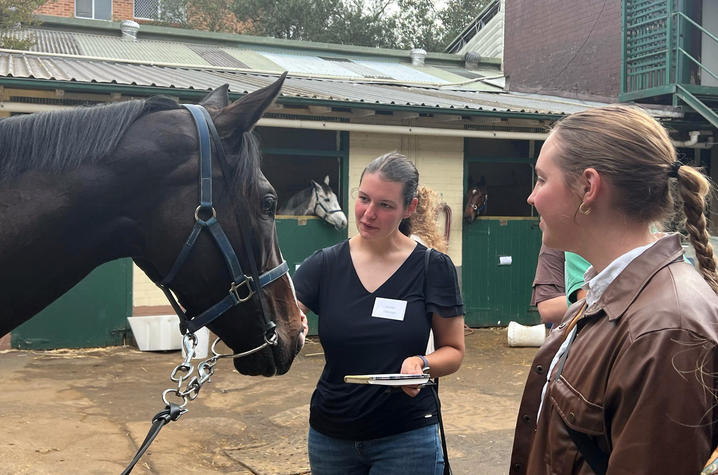
Their first equine visit set the tone for the program’s equine educational experiences. Students were hosted by Gai Waterhouse at the historic Tulloch Lodge in urban Sydney, a formative visit which helped the students establish their credibility as being serious about learning Australia’s equine industry.
Waterhouse has established herself as one of the world’s most respected trainers, having trained more than 150 top tier horse racing winners and collected seven Sydney trainers’ premierships. She was the first Australian female trainer to prepare a Melbourne Cup winner. The Melbourne Cup is one of Australia’s most prestigious races.
The group also visited three equine facilities in and around Sydney: the Warwick Farm Racecourse, a Thoroughbred racecourse owned and operated by the Australian Turf Club; Inglis, home to Australia’s leading thoroughbred auction company; and Silverdale Farm, a boutique thoroughbred broodmare facility and location of the Silverdale Academy, whose stated purpose is to provide early integrated learning for all future participants across all aspects of the industry.
The students also experienced two other key Australian industries with a wine tasting tour at Audrey Wilkinson Winery in the famed Hunter Valley region and a coal mining tour in Singleton. Australia is one of the world’s largest exporters of wine and coal. The thoroughbred breeding and racing sectors contribute billions to Australia’s GDP and the country has the second-largest breeding industry worldwide.
The group also spent a day visiting two of the most important thoroughbred operations worldwide, Godolphin and Coolmore Australia, both located in the Hunter Valley. The group visited Godolphin’s Woodlands division, an operation that centers around raising mares and foals, developing young horses through their early education and providing a well-managed home for thoroughbreds after racing. Their second stop of the day was Coolmore Australia, where the group was able to see some of the world’s top stallions, tour the farm and meet several of the other important equine residents on the property.
Afterward, students shifted gears to learn about other aspects of Australia’s storied equine industry and important cultural heritage, traveling to Tamworth to visit Hagon’s Equine, a family-owned and -run veterinary practice that specializes in equine reproduction, dentistry and entertainment. The veterinarian duo and husband and wife team of Kym and Kim Hagon, along with their three sons, opened up their facility, incidentally also their home, to showcase their work. From artificial insemination practices within some of the country’s top stock horses to uniquely Australian competitions in campdrafting, the Hagons shared their work.
It was then on to Len Waters Aboriginal Cultural Tours, where the group heard about aspects of aboriginal culture and visited some of its sacred locations. Waters, who describes himself as a Kamilaroi man with a passion for sharing his culture, showcased aboriginal art and took them on a tour of aboriginal land in the area.
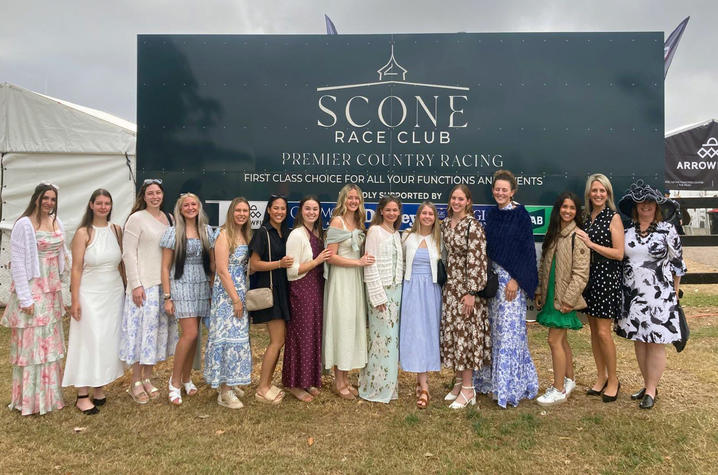
The group then headed to the Scone Race Club for a day of thoroughbred racing, where the students learned some of the differences in American versus Australian racing — including the clockwise versus counterclockwise direction horses race, the use of turf as the primary racing surface and betting via bookmakers.
The last equine experience turned out to be one of the most popular. Ell Parker of ParkAvenue Livestock hosted the group at her farm, which specializes in providing world-class Australian rodeo stock genetics to breeders, contractors and cowboys. The farm also specializes in genetics for campdraft and cow horses and maintains a separate Brangus cattle herd they breed and sell.
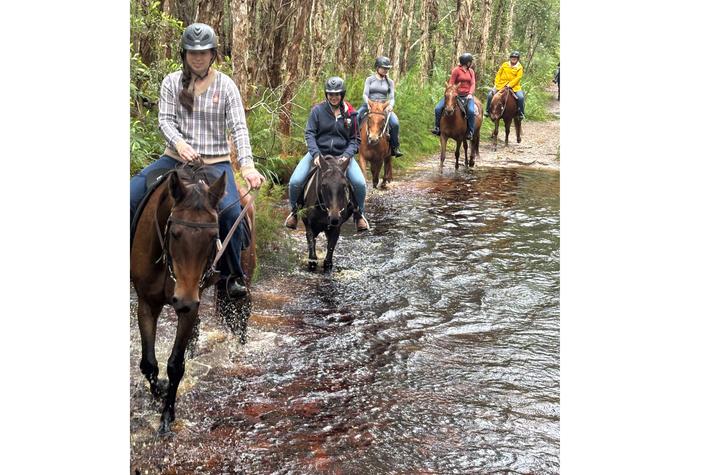
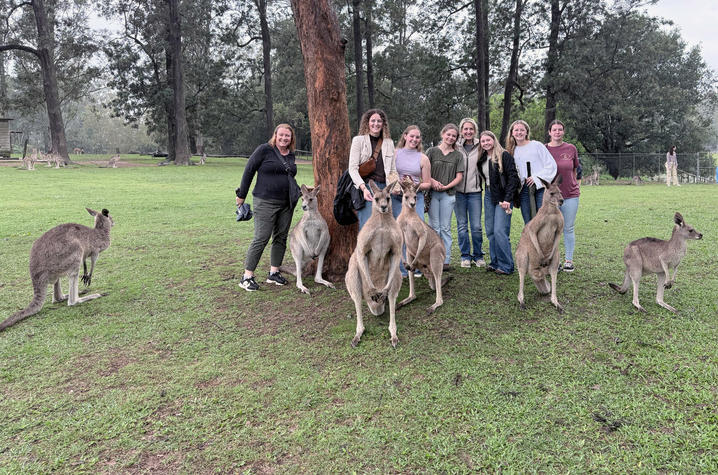
The final days of the group’s Australian experience included a group horseback ride in the Byron Bay area, as well as visits to the Lone Pine Koala Sanctuary and the Australia Zoo, both in Brisbane. The sanctuary and zoo visits both focused on conservation efforts in Australia for a wide variety of endangered and threatened species.
Senior Sabrina Mikula reflected on her takeaways from the program.
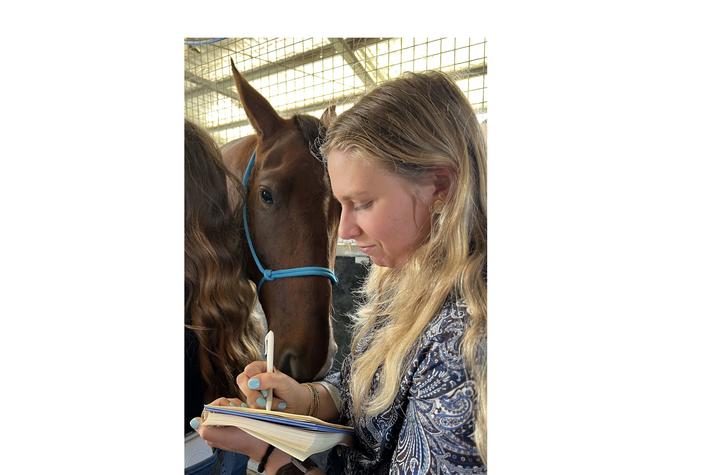
“In the classroom, I can apply what I learned about asking questions, conducting research and building confidence in professional settings. Rather than simply taking notes, I now feel more motivated to engage with course material, seek out additional information and participate in discussions,” she said. “As a teaching assistant this semester, I expect these experiences to be especially valuable. I hope to encourage students to be active agents in their own learning and help create an environment where they feel comfortable asking questions and sharing ideas.”
Senior Hanna Ascari agreed that the program was life-changing for participants.
“Experiencing the Australian culture firsthand helped me develop a broader perspective and a greater appreciation for the importance of understanding people and the equine industry on a global scale,” Ascari said. “I came home with a confidence in myself that I have never had before, along with greater independence, new friendships and memories that I will carry with me throughout my career and personal life.”
As the state’s flagship, land-grant institution, the University of Kentucky exists to advance the Commonwealth. We do that by preparing the next generation of leaders — placing students at the heart of everything we do — and transforming the lives of Kentuckians through education, research and creative work, service and healthcare. We pride ourselves on being a catalyst for breakthroughs and a force for healing, a place where ingenuity unfolds. It's all made possible by our people — visionaries, disruptors and pioneers — who make up 200 academic programs, a $1.02 billion research and development enterprise and a world-class medical center, all on one campus.