


Mule helps scientists build the clearest horse and donkey genomes yet
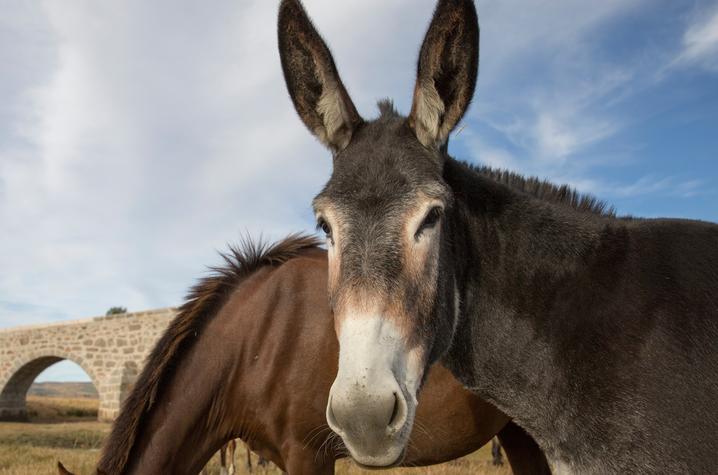
LEXINGTON, Ky. (Aug. 24, 2026) — A mule has helped researchers build the most complete reference genomes to date for horses and donkeys, giving scientists access to complex regions of DNA that earlier versions could not fully capture.
Led by researchers in the University of Kentucky Martin-Gatton College of Agriculture, Food and Environment (CAFE) and published in Cell Genomics, the international study introduces new genomes that provide a clearer view of centromeres, telomeres and other highly repetitive parts of chromosomes. These historically impossible-to-assemble regions are important for understanding how chromosomes work, how species evolve and genetic differences that may affect animal health and physical traits.
Ted Kalbfleisch, Ph.D, a researcher in the UK Department of Veterinary Science, led the project. Kai Li, also in the Department of Veterinary Science, was one of the study’s lead authors.
“For a long time, some of the most complex regions of the horse genome were essentially invisible to us,” Li said. “With this new reference genome, we can finally begin to explore those regions and ask how they contribute to chromosome biology, genetic diversity and traits that matter in horses.”
The researchers created new horse and donkey genomes using DNA from a female mule. A mule receives one set of chromosomes from its horse mother and another set from its donkey father; however, their DNA contains enough differences for scientists to tell the two sets apart — making the mule an especially useful animal for this project.
Instead of trying to separate two very similar sets of horse chromosomes, the researchers could identify which pieces came from the thoroughbred mother and which came from the donkey father. Scientists call this process “phasing,” allowing the team to reconstruct a horse genome and a donkey genome from the same animal.
The team combined several advanced DNA-sequencing methods. Some produced highly accurate reads on the order of tens of thousands of bases, while others produced extremely long DNA reads (hundreds of thousands of bases). These new technologies made it possible to assemble the very repetitive telomeres and centromeres. The researchers also used information about how different parts of chromosomes physically interact. Together, these methods helped them place millions of DNA letters in the correct order.
The resulting assemblies are described as telomere-to-telomere, or T2T, genomes. Telomeres are protective structures at the ends of chromosomes, much like the plastic tips on shoelaces. A T2T assembly aims to follow a chromosome from one end to the other while leaving as few gaps as possible.
A small number of gaps and unanchored chromosome ends remain because some repetitive regions are still difficult to assemble. Even so, the new genomes add a large amount of sequence that was missing from earlier references. Compared with the genomes they replace, the horse assembly contains about 11.4% more sequence and the donkey assembly contains about 11.5% more.
The National Center for Biotechnology Information has adopted and annotated the assemblies as reference genomes for horses and donkeys. Reference genomes act like maps that researchers use when studying genetic differences among animals.
One of the largest improvements involves centromeres. A centromere is the region that helps pull copies of a chromosome apart when a cell divides. If this process goes wrong, cells may end up with missing or extra chromosomes.
Centromeres are often surrounded by satellite DNA, which consists of short genetic sequences repeated thousands or even millions of times. These repeated patterns made centromeres nearly impossible to assemble accurately with older sequencing technology.
The researchers found that satellite DNA makes up about 9% of the horse genome and 8.3% of the donkey genome. They also discovered that horse and donkey centromeres are more varied than centromeres in many other mammals.
Most horse centromeres are built within large areas of satellite DNA. Donkeys are different. Sixteen donkey centromeres do not contain satellite DNA and the remaining 15 use several different types of satellite sequences.
The findings also show that centromeres can move within a chromosome without changing the underlying DNA sequence. Earlier research found that some satellite-free centromeres could shift within a region of about 600,000 DNA letters. The new study found variation in donkeys across an area as large as 2.8 million DNA letters. It also showed that movement can occur in centromeres containing satellite DNA.
Beyond explaining chromosome evolution, the new reference genomes may improve studies of equine health, disease, breeding and genetic diversity. Researchers will be able to examine areas that were missing or incorrectly arranged in older genome maps.
“We can now inexpensively build very accurate, very complete phased genomes. These assemblies were derived from a thoroughbred dam, and a donkey sire,” Kalbfleisch said. “We and others are now working to assemble the genomes of horses from different breeds, and different health conditions. This assembly will serve as a backbone to our Horse Pangenome effort, where we will compare all these horses against one another and learn how Clydesdales, Arabians and all other breeds differ from one another both at the nucleotide level and now structurally."
The assemblies will also support the Equine Pangenome Project, which is building a broader picture of genetic variation across horse breeds. That effort will help scientists identify structural differences, study immune-response genes and better understand how genetic changes relate to traits and disease risks.
Learn more about the Department of Veterinary Science at vetsci.mgcafe.uky.edu.
This material is based upon work that is supported by the National Institute of Food and Agriculture, U.S. Department of Agriculture, under award number 2024-67015-42330. Any opinions, findings, conclusions or recommendations expressed in this publication are those of the author(s) and do not necessarily reflect the view of the Department of Agriculture.
As the state’s flagship, land-grant institution, the University of Kentucky exists to advance the Commonwealth. We do that by preparing the next generation of leaders — placing students at the heart of everything we do — and transforming the lives of Kentuckians through education, research and creative work, service and healthcare. We pride ourselves on being a catalyst for breakthroughs and a force for healing, a place where ingenuity unfolds. It's all made possible by our people — visionaries, disruptors and pioneers — who make up 200 academic programs, a $1.02 billion research and development enterprise and a world-class medical center, all on one campus.