


A look into the mental game: Q&A with UK sport psychologist
LEXINGTON, Ky. (March 20, 2026) — March is more than just another month for basketball fans — it’s their favorite time of year. March Madness brings excitement, bracket challenges and watch parties that fans look forward to each season. Whether it’s the love of the game or the thrill of competition, every fan is keeping up with their favorite teams.
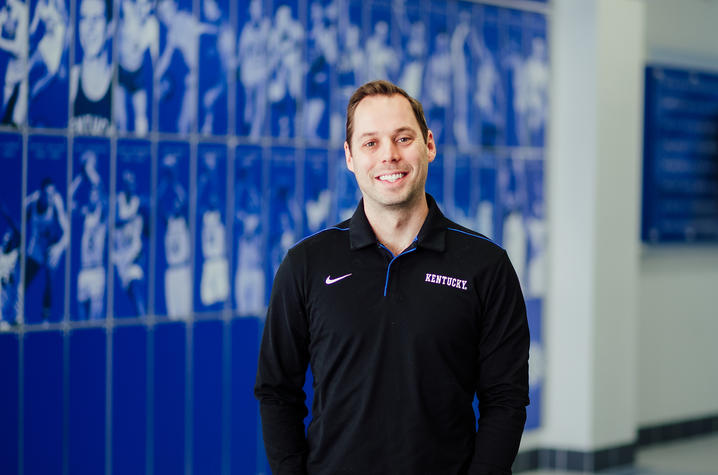
But what goes on behind the scenes and in student-athletes’ minds during these significant moments? Marc Cormier, Ph.D., director of the Sport and Exercise Psychology graduate program in the University of Kentucky College of Education Department of Kinesiology and Health Promotion, and director of Counseling and Sport Psychology Services in UK Athletics, recently explained the mental game for student-athletes.
UKNow: What do sports psychology professionals study?
Cormier: Sport psychology is an umbrella field that focuses on the relationship between psychological factors and human performance. Within this field, professionals typically work in two broad areas: mental health and mental performance/fitness, each with their own specialized subfields. Sport psychology professionals study and address topics such as focus, emotional regulation, anxiety, motivation, team cohesion, managing expectations and the psychological aspects of injury and rehabilitation. Some professionals are trained and certified to support mental performance, while others are licensed to provide mental health care; a smaller number are qualified to work across both areas.
Just as elite athletes rely on strength and conditioning coaches to train the body and athletic trainers to keep it healthy and recover from injury, sport psychology professionals focus on developing and maintaining the mind. This might involve helping an athlete work through a performance slump or teaching mental skills that reduce the likelihood of slumps in the first place. By highlighting the role of mental factors in performance, sport psychology professionals help athletes recognize that they can influence how they think and, ultimately, how they perform.
UKNow: Does the importance of the mental aspect of sports change as the stakes increase? Why?
Cormier: It is important to recognize that pressure and the intensity of a rivalry are largely shaped by an athlete’s appraisal of the situation. The same game may feel pressure-filled to one athlete, while a teammate may approach it as simply another, albeit important, competition. Research also suggests that rivalries often carry greater meaning for fans and media than they do for student-athletes. In general, important games/rivalries all come down to how people interpret their meaning, which can shift their emotional and psychological responses (e.g., confidence, excitement or anxiety). These vary widely even within the same team or event.
That said, the mental side of sport is always important and often becomes more visible as the stakes increase. In high-pressure situations, such as rivalry games or the SEC/NCAA tournaments, athletes tend to experience heightened expectations, greater external attention and stronger emotions. Those factors can amplify challenges related to focus, anxiety, confidence and decision-making, which can directly influence performance.
UKNow: What impact does an injury have psychologically on the injured player and the team? How do sudden changes to responsibility/physical load affect players mentally?
Cormier: An injury can have a profound psychological impact. For the injured player, the response is highly individualized and influenced by a mix of personal and situational factors. Personal factors might include coping skills, pain tolerance or athletic identity, while situational factors could include the level of social support, team culture and the level of competition. Emotionally, injuries can trigger a wide range of responses like frustration, anxiety and even grief. It’s also common to experience an identity crisis due to an abrupt change in their role on the team. Most have spent decades identifying strongly as an athlete, involving daily training and commitments. Suddenly, removing that can be a harsh adjustment where athletes feel “off” without realizing why.
At the extreme, injuries can be career-threatening, though in most cases they are an inconvenience that temporarily disrupts performance. Interestingly, some athletes may also experience relief, as the injury can reduce immediate responsibilities and the pressure to perform.
The ripple effect on the team is also significant. Teammates may feel increased pressure to fill the gap, which can elevate stress and sometimes affect cohesion. Suddenly shifting responsibilities, whether taking on a larger role or adjusting to a different style of play, can challenge players mentally, requiring adaptability and emotional regulation. How well teams navigate these changes often depends on preexisting communication, trust and leadership within the group. In short, injuries aren’t just physical setbacks. They can test the resilience and coping skills of the individual, the team and the coaching staff.
UKNow: How has the rise of social media changed the mental aspect of being a student athlete overall? How does fan commentary on social media affect athletes mentally?
Cormier: There’s no doubt in my mind that the rise of social media has fundamentally changed the psychological landscape of being a student-athlete because the audience is now constant and immediate. Just two decades ago, when I was finishing my undergrad, student-athletes might have read a game recap or watched highlights the morning after. Today, opinions, predictions and criticism are available instantly at an athlete’s fingertips. This means that, in addition to managing the demands of training, competition and academics, student-athletes are also navigating a continuous stream of public evaluation.
Leading up to big games, it’s the media’s job to frame matchups with strong narratives (predictions, rivalries, etc.). These can heighten the sense of pressure if athletes internalize those messages. That said, the impact varies widely. Some athletes are highly aware of what’s happening on social media, while others intentionally limit their exposure (and follow my frequent recommendation to “stay off socials” on game day) or simply don’t appraise the comments of strangers as meaningful. Increasingly, sport psychology practitioners and athletics departments are helping athletes develop strategies, such as setting boundaries with social media use, to manage these influences and maintain a healthy mental approach to competition. I’ve worked with elite athletes for 20 years and find myself having these conversations more and more, including how to mentally process social media comments addressed directly to them, which are more personal and immediate than a traditional media segment.
UKNow: What role do coaches and support staff members play in influencing the mental tone during high-pressure moments?
Cormier: We often take emotional and behavioral cues from those around us, especially those in leadership positions. Athletes are no different. If coaches communicate calmly, with clarity and confidence, it can help athletes appraise the moment as a challenge to embrace, rather than a threat to fear. I’ve witnessed an entire bench of players subconsciously turn their heads toward a coach at pivotal moments of a game. It’s a natural thing humans do, and most coaches are aware of this.
This extends well beyond competition. During training sessions, film and lifts, the entire staff should maintain a shared climate and clear expectations for how they communicate and respond to both positive moments and challenges. The most effective environments are those where coaches and staff create a psychologically stable and supportive culture. When athletes know they are trusted and supported, they are more likely to approach high-pressure situations with confidence, focus and resilience.
UKNow: Are there any mental stress coping skills you recommend to athletes that other people could also benefit from in their own high-pressure situations?
Cormier: One of the things I often emphasize is that a lot of what we practice in performance psychology with athletes is highly transferable to everyday life. The same mental skills that help an athlete stay calm, focused and confident under the pressure of a championship game or an Olympic final can be applied to high-pressure situations in which UK students frequently find themselves. For example, it can be counterproductive for people to be too outcome oriented because the outcome can be out of our control. Instead, by focusing on the process (i.e., what you can do to achieve a desired outcome), we become agents of success.
I meet with a lot of corporate leaders, healthcare professionals and performing artists. In other words, people who regularly find themselves in their own pressure-packed “final four” moments. The strategies we teach, such as reframing, mindfulness and communication apply across contexts and are applicable in nonsport settings. Essentially, whether on the court, in the boardroom or on a stage, these tools help people manage stress, maintain focus and perform at their best.
To learn more about Cormier’s suggestions for how to develop a mindset for peak performance, watch his recent TEDx talk.
As the state’s flagship, land-grant institution, the University of Kentucky exists to advance the Commonwealth. We do that by preparing the next generation of leaders — placing students at the heart of everything we do — and transforming the lives of Kentuckians through education, research and creative work, service and healthcare. We pride ourselves on being a catalyst for breakthroughs and a force for healing, a place where ingenuity unfolds. It's all made possible by our people — visionaries, disruptors and pioneers — who make up 200 academic programs, a $1.02 billion research and development enterprise and a world-class medical center, all on one campus.