


Public Health students explore community through Photovoice research initiative
Video produced by UK College of Public Health. To view captions for this video, push play and click on the CC icon in the bottom right-hand corner of the screen. If using a mobile device, click on the gear icon in the same area.
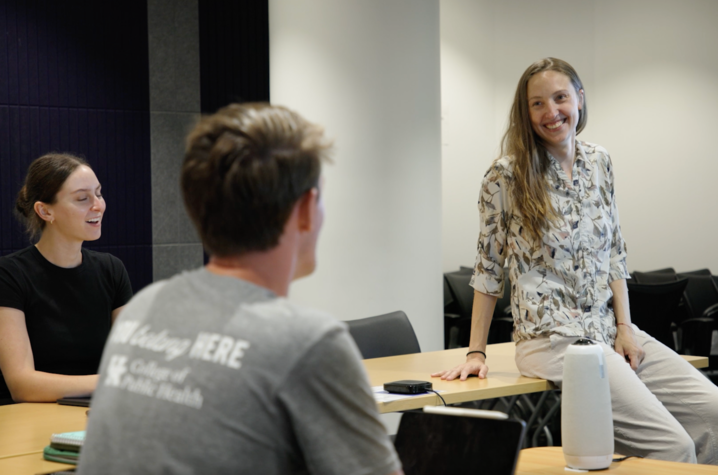
LEXINGTON, Ky. (Jan. 7, 2026) — A unique research initiative at the University of Kentucky College of Public Health is giving students a hands-on way to understand community health issues through the lens of Photovoice — a participatory research method that blends photographs, lived experience and collective storytelling.
“Photovoice is a way to combine photography, your own lived experience, your view of what’s happening in your world with voice. It’s an opportunity to provide captions and narratives describing what your pictures mean,” said project lead Margaret McGladrey, Ph.D., who is an assistant professor in the College of Public Health.
According to the project team, Photovoice is a participatory action research method that empowers community members to share their perspectives and promote action for change. Across multiple sessions, participants identify and discuss strengths and concerns that exist within their community. Community members use photos to document these conditions and personal storytelling to spark critical dialogue around the selected topics.
Additionally, each Photovoice project concludes with a collaborative analysis and action planning session, where participants caption their photos and develop strategies to engage community leaders and decision-makers.
McGladrey said that Photovoice is not just sharing individual points of view but also building group knowledge.
“We’re doing this kind of photography and collaborative topic setting and interpretation and caption writing together in groups so that we’re creating kind of this collective perspective on what is happening in a community at different levels, from the individual level all the way up to the system level,” she said.
That collaborative spirit was what drew public health students like Emma Grace Hague, Mason Taylor and Brayden Ward into the project.
“I think that a lot of people, myself included, are visual learners,” Taylor said. “So, if they see a picture, they can kind of infer what’s going on and it can tell a story. And I think they can learn about the community through that way.”
Ward added, “I think it’s really neat because it gives you an opportunity to connect with your community. This gave me an opportunity to connect with where I live.”
Hague said the sense of connection is what makes the methodology stand out, and it’s also a great way for students to get associated with the research and make connections with professors.
“It’s a very community-based and very socially based project, and we all work together to make these things happen,” she said. “And having that as like a young student working in research, I think is very unique but also very important.”
McGladrey said that Photovoice brings a depth that traditional research methods sometimes miss.
“We know we can learn and understand and study what’s happening from a book perspective,” she said. “But Photovoice really allows you to get into folks’ hearts, to get into the emotions and get into their whole lived experience.”
The initiative continues to expand as both students and faculty explore new opportunities to use Photovoice in community partnerships across Kentucky.
For those interested in learning more about the Photovoice project, contact Kangai Miriti at kangai.miriti@uky.edu.
As the state’s flagship, land-grant institution, the University of Kentucky exists to advance the Commonwealth. We do that by preparing the next generation of leaders — placing students at the heart of everything we do — and transforming the lives of Kentuckians through education, research and creative work, service and healthcare. We pride ourselves on being a catalyst for breakthroughs and a force for healing, a place where ingenuity unfolds. It's all made possible by our people — visionaries, disruptors and pioneers — who make up 200 academic programs, a $1.02 billion research and development enterprise and a world-class medical center, all on one campus.