


UK researcher helps shape the future of AI in legal practice and education
LEXINGTON, Ky. (Sept. 16, 2026) — As artificial intelligence (AI) continues to transform society, University of Kentucky researcher Michael Murray is examining the legal implications of AI and its growing role in legal practice and education.
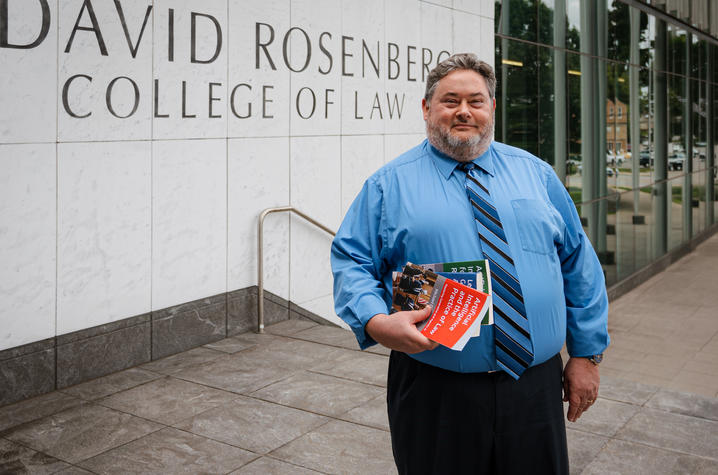
Murray, the Spears-Gilbert Professor of Law in the UK J. David Rosenberg College of Law, focuses his research on the connection of law and artificial intelligence, including emerging legal issues surrounding generative and agentic AI.
"My research currently is on three major areas that correspond to the areas of the books that I published in 2026,” Murray said. “First is ‘Legal Issues of Generative and Agentic AI,’ which discusses the emerging and quite present legal issues that AI has caused that don’t necessarily call for new laws, but they call for the adaptation of laws that were not designed to be adaptable to this unusual artificial intelligence situation.”
Through his teaching, Murray helps students navigate challenging legal questions that often lack well-established answers.
“In this book and in the teaching I do in my class and seminars, we look at these issues,” Murray said. “We try to figure out the two sides of each case. We try to plan how do you spot issues and how do you address issues for which there is no precedent?”
Murray and researchers in the AI and the Law Lab are exploring how artificial intelligence can support legal practice, reduce errors and help develop AI agents for both legal tasks and law student instruction.
“AI is not there to replace the expertise and judgment. Students have to develop that on their own,” Murray said.
Murray’s work has been supported through UK’s Celebrating University Research Across the Enterprise (CURATE) program supported by the Office of the Vice President for Research.
“The first CURATE grant I used was to do an empirical study to test if AI tutors can, in fact, improve somebody’s knowledge of a legal subject,” Murray said.
Participants engaged with the tutoring system and demonstrated measurable gains in their understanding of upper-level law concepts that they had not yet studied. The project served as early proof of concept for AI-assisted legal education.
His second CURATE-supported project explores the growing field of agentic AI, systems that can independently identify and pursue the steps needed to complete a task or solve a problem.
“The big change from 2025 to 2026 is this development of agentic AI,” Murray said. “In basic terms, the agentic AI is an AI system that can figure out the second, third and fourth questions it needs to answer in order to address the problem you gave it.”
Murray hopes his research will influence both the future of legal education and the day-to-day practice of law.
“I’m hoping to make an impact in the practice of law. Again, just talking to an AI, you can generate a great deepfake, a fantastically convincing deepfake. That challenges evidence law in ways that a lot of judges and practitioners are not ready for. But we’re also trying to make an impact on the day-to-day work, because it does, if used properly, augment and really make the efficiency of your time and you’re at a legal practice, much greater.”
As the state’s flagship, land-grant institution, the University of Kentucky exists to advance the Commonwealth. We do that by preparing the next generation of leaders — placing students at the heart of everything we do — and transforming the lives of Kentuckians through education, research and creative work, service and healthcare. We pride ourselves on being a catalyst for breakthroughs and a force for healing, a place where ingenuity unfolds. It's all made possible by our people — visionaries, disruptors and pioneers — who make up 200 academic programs, a $1.02 billion research and development enterprise and a world-class medical center, all on one campus.