


UK HealthCare partners with community health providers to expand women’s health services in rural Kentucky
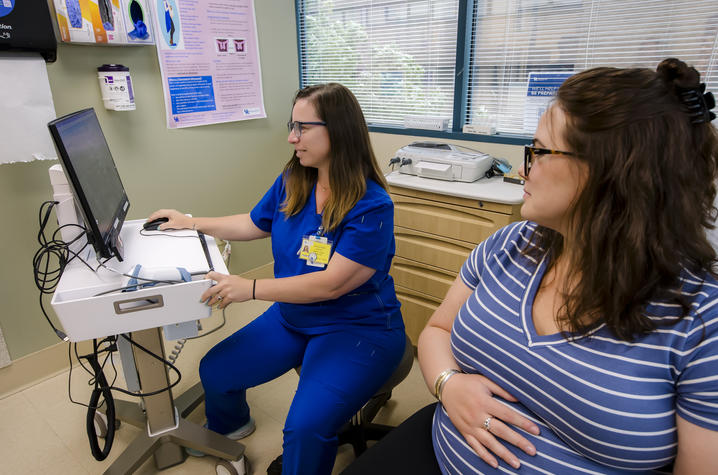
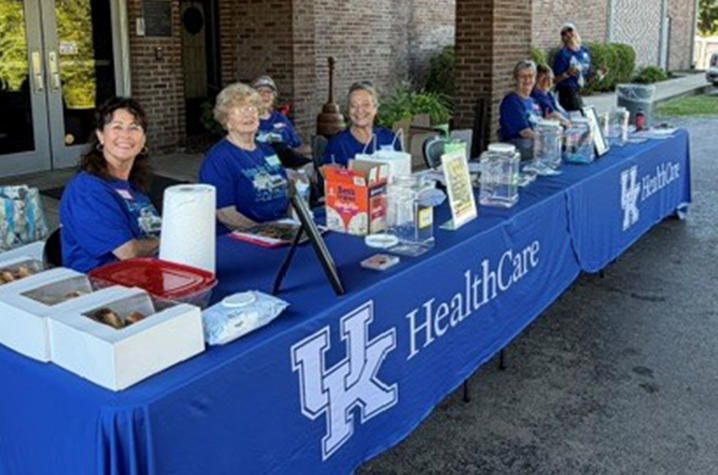
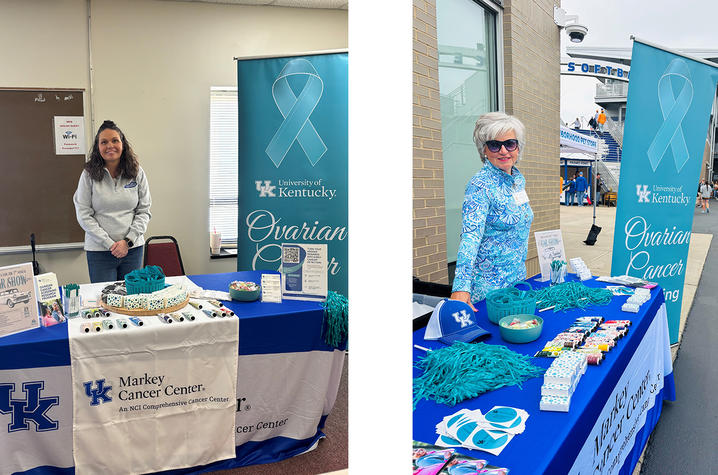
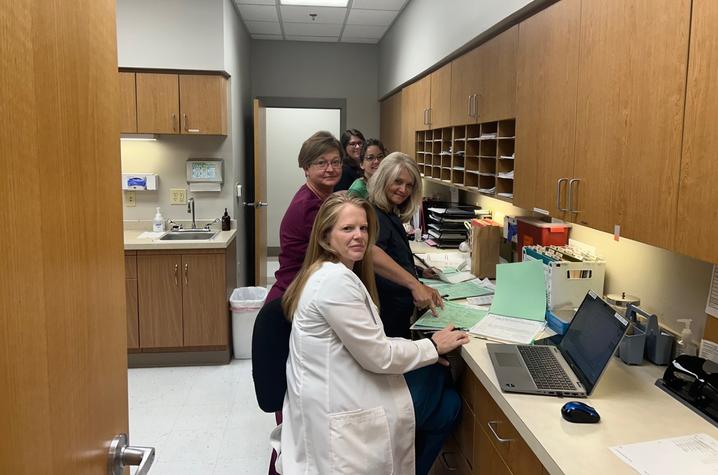
Lexington, Ky. (Oct. 28, 2026) — Providers from UK HealthCare’s Markey Cancer Center and Department of Obstetrics & Gynecology teamed up with local hospitals and health departments to expand gynecological care, ovarian cancer screening and high-risk pregnancy telehealth services across Kentucky. These partnerships help women receive crucial prenatal care and cancer screenings closer to home.
“For women living in rural Kentucky, access to specialized medical care can be challenging,” said Val Moore, director of clinical outreach at UK HealthCare. “Distance, transportation, work schedules, childcare and financial concerns can make it difficult to see a specialist, leading some women to postpone or go without care.”
Many Kentucky counties lack general gynecology and obstetrics providers, as well as resources to screen for ovarian cancer or identify pregnancy complications. UK HealthCare’s outreach teams work with local hospitals and health departments to fill those gaps while reducing patients’ travel and financial burdens.
Working directly with communities, UK HealthCare provides women’s health services to Kentucky River Medical Center, Bourbon County Health Department, Middlesboro ARH, Hazard ARH, Highlands ARH and The Medical Center at Bowling Green. Recently, services have expanded to WEDCO District Health Department that includes Harrison, Scott, and Nicholas County, as well as Greenup County Health Department and Jessamine County Health Department.
Crystal Dobson, a nurse practitioner who provides gynecological outreach services, works with patients throughout her native eastern Kentucky and assures them that specialty care is not out of reach.
“I treat all my patients like I would a family member,” she said. “I want to get them the best help that we can. We serve many women who don’t have insurance, and we don’t let that stop them from getting care. We have a great team that works to help with financial assistance when needed.”
During the pandemic, many people fell out of the routine of having regular appointments with a primary care provider, during which crucial interventions such as ovarian cancer screenings would be recommended and scheduled.
“I’ve had several patients say, ‘I’ve not seen a provider in seven years,’” said Dobson. “Some fell out of care and are scared to come back. I listen, explain the process, and assure them that we’re here to get them the care they need. We receive many referrals because we’ve built that rapport and trust.”
The silent killer
Ovarian cancer causes more deaths than any other cancer of the female reproductive system. It’s often called a “silent disease.” It presents no symptoms in its early stages; in later stages, the symptoms are often vague or easily dismissed. The American Cancer Society estimates that more than 21,000 women in the U.S. will be newly diagnosed with ovarian cancer in 2026.
Kentucky helped pioneer ovarian cancer screening and treatment protocols. In 1977, Virginia McCandless, then state health chair for the Kentucky Extension Homemakers Association, was treated for Stage 3C ovarian cancer by gynecologic oncologist John van Nagell, M.D. Van Nagell adapted ultrasound into an imaging method called transvaginal sonography. McCandless rallied fellow homemakers to give $1 each to the new Ovarian Cancer Screening Program, raising $30,000 in the first year. The association continues to support the program, and since 1987, the program has provided free screenings to thousands of women across Kentucky.
The screening guidelines developed by van Nagell and his team were adopted by the National Cancer Institute as the nationwide standard. Ovarian cancer has a 90% five-year survival rate when caught early.
Kentucky’s women can access free ovarian cancer screenings at Pulaski County Health Department, Hardin County Health Department, McCracken County Health Department, Maysville Primary Plus, Ephraim McDowell Fort Logan, Ephraim McDowell James B. Haggin, and Hazard ARH, as well as at UK HealthCare’s Markey Cancer Center.
“Over the life of the program, more than 500 tumors have been identified, including approximately 150 malignancies in women who were asymptomatic at the time of screening,” said Moore.
Many of the women touched by the program may not realize it has rural roots — or that, nearly 40 years later, the program is still funded in part by members of the Kentucky Extension Homemakers Association. Started by women, sustained by women and serving women across the commonwealth, the program has come full circle. That is what makes van Nagell most proud.
“Why have we been able to fund and continue this program for 40 years? Because women value it and want it,” he said. “It’s something special that Kentucky women can be proud of.”
Specialized pregnancy care — anywhere
Just as rural and remote areas grapple with a lack of access to cancer screening, there is a similar crisis when it comes to maternal health. Faced with ballooning costs and funding shortfalls, many local hospitals are forced to discontinue maternity services, leaving a vacuum in rural communities and patients without obstetrics care.
“It is a challenge to receive high-risk care in many rural settings,” said John O’Brien, M.D., director of the division of Maternal-Fetal Medicine (MFM) at UK HealthCare. “Toward the end of pregnancy, it is common to visit the doctor twice weekly. When gas prices increase, it is very difficult as transportation becomes a greater concern.”
Food and housing insecurity, maternal safety, obesity and substance use can complicate pregnancy, particularly as it advances. Combined with limited prenatal care or a lack of insurance, these factors can increase the risk of preeclampsia, preterm delivery, excessive bleeding during delivery, birth defects, miscarriage or stillbirth.
“As we continue to face multiple challenges, UK HealthCare has had to develop new approaches to rural care connecting to our providers,” said O’Brien.
Most communities lack sonographers qualified to perform the type of ultrasound that determine whether a woman is at risk for complications. Created in 2014, the Maternal-Fetal Medicine Telehealth program, sometimes called Kentucky Angels, sends specially trained UK sonographers to nearly a dozen regional locations. Physicians in Lexington review the ultrasounds remotely and video-chat with patients about the results. If a patient is identified as high-risk, UK HealthCare experts coordinate care with local providers.
“Angels introduced a new telehealth model at UK by sending a UK clinician into the community,” said Rob Sprang, director of UK HealthCare Telecare, who established the first connection in Manchester, Ky., with John Allen, business operations director for the UK Department of Obstetrics & Gynecology.
“Virtual care connects rural patients and their local providers with maternal-fetal medicine specialists at UK HealthCare,” said Allen. “Bringing that expertise into the communities where women live expands access to specialized care throughout pregnancy and can improve outcomes.”
“Many young women who are told by their local OB or primary care provider that they need to be assessed by a MFM specialist are often unable to travel to Lexington, and show up in the local hospital in labor,” said Sprang. “That is the wrong time to discover this will be a high-risk birth that may require the resources only available at UK.”
Early, frequent screenings allow sonographers and maternal-fetal medicine specialists to identify complications and reduce unnecessary travel to Lexington for delivery. O’Brien estimates that, among the thousands of women referred to the Angels program, about 5% or less are advised to deliver at UK while about 95% can safely deliver in their home communities.
“Our goal is not to disrupt the connection between a patient and her doctor but to augment it, in a familiar setting with the availability of ultrasound to perform detailed fetal assessments,” said O’Brien.
Kentucky is not the only state facing a shortage of maternal-fetal medicine specialists and general obstetricians. According to the March of Dimes, more than two million women of childbearing age live in counties with no obstetric providers or birthing facilities. Increasingly complex pregnancies have further increased demand for specialized services.
“While telehealth is feasible in many communities, we need to have stable local practices to meet our state’s needs,” said O’Brien. “Maternal-fetal medicine is sought after commonly by both providers, who want to ensure they are providing the best up-to-date care, and patients as they want everything for their baby and themselves. Being able to provide these services close to home is essential to increase the opportunity for connection with higher levels of care.”
Expert care, close to home
This level of care depends on collaboration. Partnerships with local hospitals and health departments bring specialized services to underserved communities, reduce travel and cost, and connect UK HealthCare expertise with the providers patients already know and trust.
“Our community partners are essential,” said Moore. “They understand local needs and have the trust of the women they serve. UK HealthCare brings specialized expertise and resources, and together we make those services accessible and meaningful.”
Collaboration works both ways. Patients trust and rely on their local providers, many of whom are their friends and neighbors. The idea of traveling to Lexington and navigating an enterprise as large as UK HealthCare can be daunting. That’s why UK experts are more than happy to travel as far and as often as their patients require.
“Kentucky women deserve access to quality health care regardless of where they live,” said Moore. “Through community partnerships and technology, we can extend UK expertise beyond the walls of an academic medical center while keeping care close to where women live, work and raise their families.”
UK Ovarian Cancer Screening Program is funded entirely through grants and private donations. Support the program here.
Learn more about supporting the Maternal-Fetal Medicine Research Fund.
UK HealthCare is the hospitals and clinics of the University of Kentucky. But it is so much more. It is more than 10,000 dedicated healthcare professionals committed to providing advanced subspecialty care for the most critically injured and ill patients from the Commonwealth and beyond. It also is the home of the state’s only National Cancer Institute (NCI)-designated Comprehensive Cancer Center, a Level IV Neonatal Intensive Care Unit that cares for the tiniest and sickest newborns and the region’s only Level 1 trauma center.
As an academic research institution, we are continuously pursuing the next generation of cures, treatments, protocols and policies. Our discoveries have the potential to change what’s medically possible within our lifetimes. Our educators and thought leaders are transforming the healthcare landscape as our six health professions colleges teach the next generation of doctors, nurses, pharmacists and other healthcare professionals, spreading the highest standards of care. UK HealthCare is the power of advanced medicine committed to creating a healthier Kentucky, now and for generations to come.