


Curiosity sparks UK researcher’s exploration of quantum materials
LEXINGTON, Ky. (Oct. 27, 2026) — From faster computers to new ways to manage information, quantum technologies are opening the door to possibilities that could reshape the future of technology.
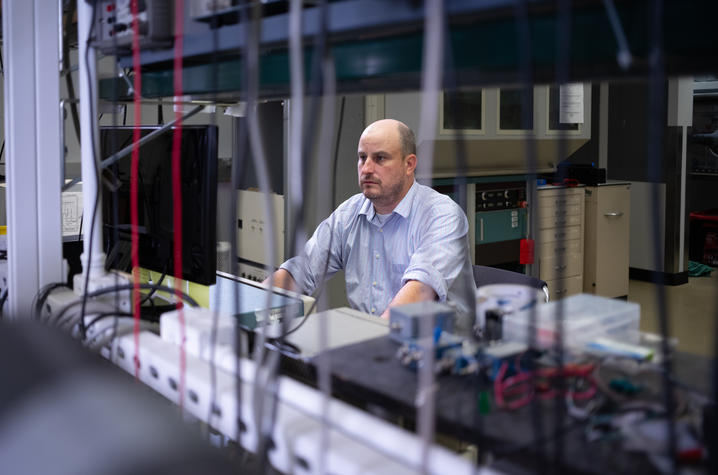
Helping make those possibilities a reality is William Gannon, Ph.D., assistant professor in the Department of Physics and Astronomy in the University of Kentucky College of Arts and Sciences, whose research focuses on the fundamental properties of magnetic materials.
Gannon recently received the prestigious U.S. National Science Foundation (NSF) Faculty Early Career Development (CAREER) Award with $651,751 over five years for his research.
Gannon studies materials that behave uniquely at the atomic level, research that could eventually lead to breakthroughs.
“My current research involves looking at interesting magnetic materials that we think will have quantum states that may be important for next-generation technologies,” Gannon said. “I think quantum computing is where the future applications are, but these are quite future applications. We’re very much doing fundamental science research.”
For Gannon, the appeal of experimental physics lies in studying materials up close and using precise measurements to better understand how they work.
“I really do enjoy the fact that the research that we do, it’s all stuff that we can hold in our hands," Gannon said. "So experimental physics on stuff that’s sort of very tangible and in front of you is what appeals to me.”
Gannon and his research team investigate how magnetic materials behave through carefully designed experiments. Their work starts with scientific questions and hypotheses, but the answers aren’t always what researchers expect.
“We’re doing science experiments here. And so, we have a hypothesis that we’re testing,” Gannon said. “Sometimes you measure something and it’s not what you thought was going to happen. It’s our job to try and understand what we measured, to see whether we measured something incorrectly or if this is just the nature of the thing that we’re studying, and our hypothesis was just wrong.”
Beyond the scientific discoveries themselves, Gannon hopes his work will help train the next generation of physicists and inspire students to pursue careers in science.
“The impact that I’m hoping to make is to come up with some fun experiments on interesting magnetic materials, learn a little something about quantum magnetic states in these materials and hopefully get my graduate students, Ph.D.s and maybe inspire an undergraduate or two to go on to continue to study physics,” Gannon said.
The CAREER Award is one of the “most prestigious awards in support of the early career-development activities of those teacher-scholars who most effectively integrate research and education within the context of the mission of their organization,” according to NSF.
This material is based upon work supported by the U.S. National Science Foundation under Award Number 2540812. Any opinions, findings, and conclusions or recommendations expressed in this material are those of the author(s) and do not necessarily reflect the views of the U.S. National Science Foundation.
As the state’s flagship, land-grant institution, the University of Kentucky exists to advance the Commonwealth. We do that by preparing the next generation of leaders — placing students at the heart of everything we do — and transforming the lives of Kentuckians through education, research and creative work, service and healthcare. We pride ourselves on being a catalyst for breakthroughs and a force for healing, a place where ingenuity unfolds. It's all made possible by our people — visionaries, disruptors and pioneers — who make up 200 academic programs, a $1.02 billion research and development enterprise and a world-class medical center, all on one campus.