


UK alum brings exercise science to thoroughbred racing
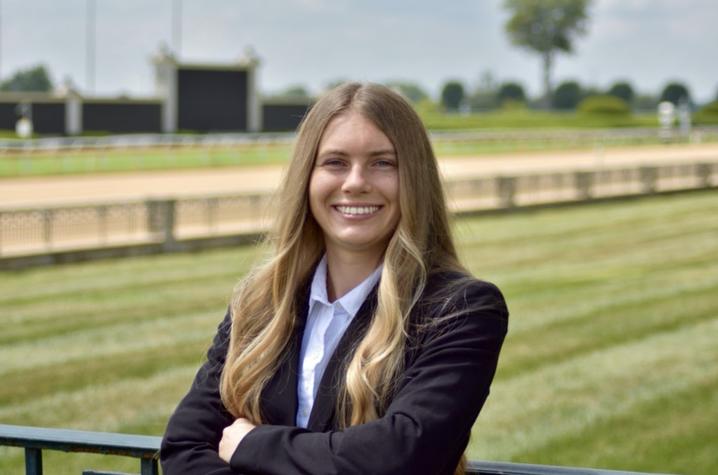
LEXINGTON, Ky. (Oct. 8, 2026) — Carly Schuerger’s interest in horse racing began in 2014, while watching California Chrome capture the Kentucky Derby.
Nobody in her family was involved with horses, let alone horse racing. But Schuerger began finding her own way into the thoroughbred racing world.
In May, she received her master’s degree in exercise physiology from the University of Kentucky College of Education Department of Kinesiology and Health Promotion. It’s a discipline she’s using to bring new scientific perspectives to the thoroughbred racing industry.
This fall, she will take that perspective around the world as a member of the prestigious Godolphin Flying Start program. She’s one of only 12 people selected for the international program, which will allow her to spend two years preparing for future leadership in the thoroughbred racing industry through coursework and experiences in Ireland, England, Kentucky, Australia and Dubai.
“Carly’s selection to the highly selective Godolphin Flying Start program is a great example of the possibilities our faculty members help students discover. It’s a reminder that UK, the College of Education and the Bluegrass are a go-to destination like no other — even for discovering passion areas we might not have anticipated,” said UK College of Education Dean Nick Pace, Ed.D.
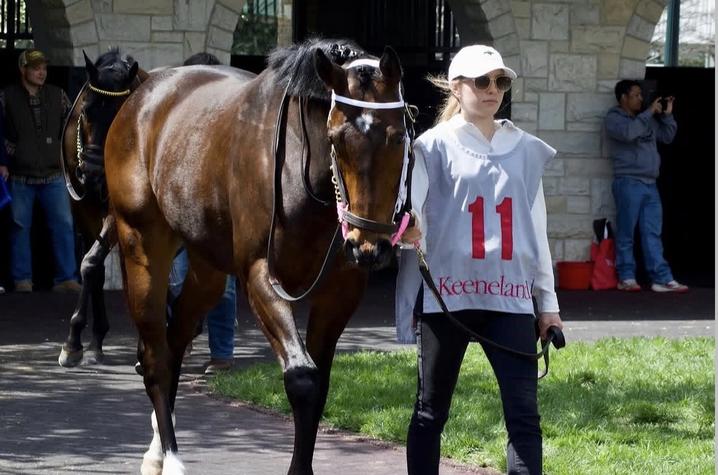
Schuerger completed her undergraduate degree in her home state, at California State University San Marcos, which is close to the Del Mar Thoroughbred Club seaside racetrack. She worked at a nearby training center as a stall cleaner and hotwalker for a small trainer, learning how to handle thoroughbreds. Over the years, she moved her way up to groom, rider and foreman positions.
“The deeper I worked within the industry, the more I loved it,” she said. “Early on I knew I wanted to become a racehorse trainer. I have always been confident that is something I really want to do as a career.”
For graduate school, she chose UK’s exercise physiology program after learning more about the faculty and discovering she could perform research on performance enhancing running shoes (“super shoes”), learn more about sports data analytics and broaden her exercise science knowledge.
Plus, UK’s location was a key factor.
“Lexington is arguably the heart of the racing industry within the United States,” she said. “Not only are there several racetracks and training centers within a few hours’ radius, but hundreds of thoroughbred farms. Additionally, Lexington hosts some of the largest thoroughbred sales auctions in the world. As an old horse racing saying goes, ‘If you want to be an actor, you go to Hollywood. If you want to be in the horse racing business, you go to Lexington, Kentucky.’”
The Department of Kinesiology and Health Promotion in the UK College of Education offers a range of master’s degrees, including biomechanics, sport leadership, exercise physiology, health promotion, teaching, coaching and a concentration in sport and exercise psychology.
“Graduate students can work with faculty to shape their program to fit their career goals,” said Jody Clasey, Ph.D., a professor in the department. “Carly and I spoke about the application of her knowledge concerning human performance to her career aspirations in the horse racing industry. She was a remarkable student and will excel in the Godolphin Flying Start Program.”
As a competitive distance runner herself, Schuerger’s time in college was a chance to study the science behind her own training and how it compares to how racehorses are conditioned.
“I found that human training and workouts tended to have more science-based justifications for their design, whereas racehorse training methods tended to be backed more by experiential knowledge and traditional methodology,” she said. “We are surprisingly very similar to horses in how we respond to different types of exercises. Many science-based principles found in both human and equine research studies can, and have been, successfully applied to racehorse training.”
Schuerger said you can give 100 people or horses the exact same training regimen with the same nutrition program, living environment and other factors. Yet, because everyone is different physiologically, they will all adapt to those same exercises differently.
“Understanding what those physiological differences are can help guide you in what training and nutrition each athlete really needs to maximize their own performance,” she said.
Schuerger sees many similarities between her experiences as an athlete and what racehorses experience in training and competition.
“I understand what it is like to train every day, the stresses of competition and, most importantly, how important it is to listen to your body when it’s time to back off training,” she said. “There were many instances throughout my athletic career when I ignored aches and pains because I wanted to keep training and racing. However, those eventually led to season-ending injuries.”
Racehorses, she said, can display the same drive to continue training even when they are not feeling their best.
“Racehorses want to keep training, too. They love to run,” Schuerger said. “Since horses cannot directly tell you what is bothering them, it is important to watch their movements closely, feel their legs for heat or swelling and watch their attitude and appetite to catch any developing problems.”
Devices such as heart-rate monitors and gyroscopes can help identify physiological stress and changes in biomechanics. Schuerger said her academic training helps her interpret the data those devices collect.
She has also come to appreciate the psychological side of athletic performance.
“Even with the most science-backed exercise and feeding program, if you do not have the horsemanship to listen to what the horse needs from a psychological perspective, a lot of horses may not reach their full potential,” she said.
As her work in the industry progresses, Schuerger wants to help the next generation gain opportunities to work with racehorses, particularly those like her who did not grow up around horses or have a connection to the racing industry.
“There is always a pathway,” she said. “It may not be the one you envisioned, but there is always a way, nonetheless.”
As she enters the Godolphin Flying Start program this month, Schuerger’s early experience of watching the Kentucky Derby as an outsider to the industry will give way to opportunities to network with industry leaders around the world and expand her learning of not just the equine sciences, but also business management and finance.
What began as curiosity from afar is becoming a career grounded in science and a growing space within the sport.
“I am extremely grateful for the opportunity to diversify my experiences within the global racing industry and expand my learning to become the best possible leader I can be,” she said.
As the state’s flagship, land-grant institution, the University of Kentucky exists to advance the Commonwealth. We do that by preparing the next generation of leaders — placing students at the heart of everything we do — and transforming the lives of Kentuckians through education, research and creative work, service and healthcare. We pride ourselves on being a catalyst for breakthroughs and a force for healing, a place where ingenuity unfolds. It's all made possible by our people — visionaries, disruptors and pioneers — who make up 200 academic programs, a $1.02 billion research and development enterprise and a world-class medical center, all on one campus.