


UK Teaching Excellence Symposium marks 15 years of CELT
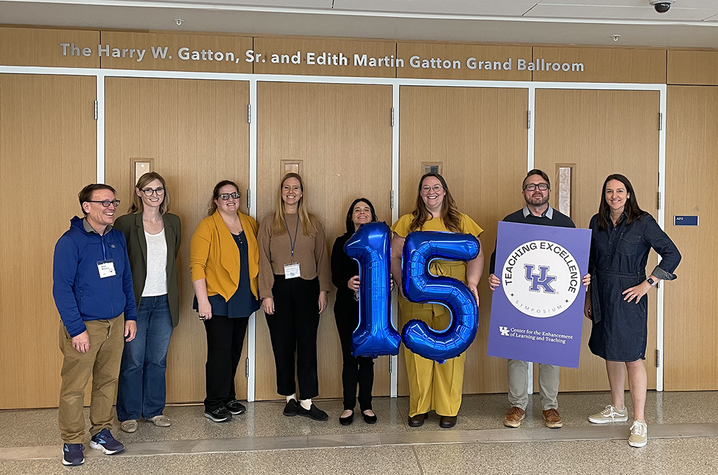
LEXINGTON, Ky. (Feb. 11, 2026) — Last fall, more than 300 faculty, staff and students gathered in the Gatton Student Center for the second University of Kentucky Teaching Excellence Symposium, a university-wide event organized and hosted by the UK Center for the Enhancement of Learning and Teaching (CELT). As an expression of UK’s educational mission, the symposium offered a space for sharing exceptional instructional approaches to fostering student learning, connection and success. Just as importantly, it provided an opportunity to recognize the integral work of scholarly teaching — and scholarly teachers — in the UK community.
Participants were invited to share reflections on the event.
“I am always inspired by the work of others,” wrote Chris Huggins, Ph.D., associate professor in the Department of Sociology. “The symposium gives me the chance to see new methods of teaching and reflect on my own practices.”
Similarly, Kristine Urschel, Ph.D., professor in the Department of Animal and Food Sciences, reflected that “we have so many faculty members doing such great things in the classroom. There is always something to learn from people working across the disciplines.”
“I go to a lot of conferences focused on teaching, and this is my favorite,” said Helen Bischoff, liaison coordinator in UK Libraries. “The variety I see in subjects, approaches and collaborations is unlike anything I experience at other teaching conferences. I walk away with so much in terms of how I can push my own teaching approaches and think creatively about how I can partner and teach with other faculty.”
The symposium featured 57 presentations representing 15 colleges and 45 departments or schools. Topics represented many of the most urgent and opportune issues in higher education today, including transdisciplinary courses, durable/career skills, artificial intelligence (AI), assessment and evaluation, technology-enhanced learning, creative and engaging approaches to teaching, and issues in specific disciplinary contexts from health care to the humanities. With 84 presenters throughout the day, many presentations involved teams of faculty, staff and students who engaged participants in dialogue and activities. There was even a live cooking demonstration.
AI keynote
Given CELT’s role in convening audiences across the university to learn about and develop skills around generative AI, the Teaching Excellence Symposium featured a keynote address from John Gallagher, Ph.D., professor in the University of Illinois Department of English, whose research investigates how writers use writing technologies to interact with different audiences. Among his specific interests are AI and machine learning communication, natural language processing and STEM/engineering communication. His latest book, “AI Through the Experts’ Eyes: Communicating Complex Ideas,” is scheduled for release this year.
Gallagher’s keynote, “A Spectrum of AI Use in the Classroom,” engaged an audience of more than 200 with research-based insights about how teacher-scholars can understand and leverage generative AI in coursework and, in particular, to continue centering students’ communication and critical thinking skills. Gallagher drew from his own experiences researching how writers and writing instructors both perceive and use AI tools, as well as perspectives from his forthcoming book project involving in-depth interviews with machine learning and AI experts.
Beyond the symposium, Gallagher’s keynote advanced CELT’s work to increase UK’s capacity for human-centered, critically informed and skillful engagement with AI.
“I loved the keynote speaker’s presentation,” said Emily Byers, Ph.D., postdoctoral scholar in the Kentucky Water Research Institute and former graduate instructor in the Department of Biosystems and Agriculture Engineering. “I will definitely utilize some of the ideas and information not only in the classroom but also to help me craft my teaching statements and respond to faculty interview questions.”
Brianna O’Boyle, a doctoral student in the Department of Linguistics, said the keynote inspired her to “think more about different perspectives on how to improve AI literacy.”
The keynote was co-sponsored by the Department of Writing, Rhetoric and Digital Studies and the UK Artificial Intelligence Literacy and Training Hub.
15 years of CELT
In addition to convening the UK community, the 2025 Teaching Excellence Symposium marked CELT’s 15th year of service and leadership on behalf of UK’s educational mission. Since fall 2010, CELT has advanced educational excellence at UK through support and collaboration with faculty and staff, partnerships and projects with academic and administrative units, and guidance on the challenges, opportunities and issues impacting higher education.
“I can’t stress enough how incredibly lucky I feel to work with CELT at UK,” said Diana Byrne, Ph.D., assistant professor in the Department of Civil Engineering. “When I started working at UK, I could have never expected the profound impact that CELT would have on my teaching and my overall sense of purpose at UK. I could rave about the different programs and activities, but most importantly, CELT is made up of individuals who are incredibly knowledgeable and so very passionate about what they do.”
“CELT has been the singular reason I am where I am today in my career,” said Lou Hirsch, Ph.D., assistant professor in the Department of Plant Pathology. “I started my position at UK from a 100% research background with absolutely no formal training in pedagogy or exposure to people who really cared about it. After I started attending CELT workshops, it was a major lightbulb moment for me because I realized that a classroom environment could be so much more than it traditionally is.”
Long-term partnerships are a major part of CELT’s identity.
“CELT has been a cornerstone of my development as a teacher since the first weeks I started at UK,” said Julian Dupuis, Ph.D., associate professor in the Department of Entomology. “I was brought into a community of folks who were passionate about teaching. Since then, I’ve participated in a ton of workshops, bootcamps, certificates, midsemester evals, etc., and every time I work with CELT I come away with some new nugget of information or an idea for something to try in my classes. The CELT team brings such great energy to what they do, and I look forward to many more years working with them.”
“I can say without a doubt that interactions with the CELT team have made me a more responsive instructor,” said Zitsi Mirakhur, Ph.D., assistant professor in the Department of Educational Policy Studies and Evaluation. “I feel that I am more equipped to teach students from a variety of disciplinary backgrounds and to adapt to the needs of my in-person and online/asynchronous students. This is thanks to strategies I learned through the Teaching Innovation Institute as well as midsemester feedback sessions. The resources that CELT puts out are so valuable, too. For instance, when I was looking for syllabus language for generative AI, I knew that I could look to CELT for help.”
Creating transdisciplinary spaces for proactively addressing emerging issues like AI has increasingly characterized CELT’s service and leadership over the years.
“CELT has been that group I always aspire to do more with,” said Kara Lee, Ph.D., assistant professor in the Department of Physical Therapy. “CELT support through COVID and now with AI are two ways I know I always have resources. SoTL [scholarship of teaching and learning] education and support are another way CELT has supported me, my college and our students’ learning.”
And the momentum continues. For the fall 2025 semester, CELT conducted midsemester feedback for nearly 200 course sections and held 576 consultations and 219 presentations, workshops and other events. Partnerships and programming will continue to bring the UK community together around issues such as transdisciplinary education, artificial intelligence, scholarship of teaching and learning, durable/career skills, assessment of teaching, accessibility, effective use of technology and student success.
“Teaching and learning are the cornerstone of any higher education institution,” said Martina Vasil, Ph.D., associate professor in the School of Music. “I am very grateful there is such an outstanding support system in place for us here.”
As the state’s flagship, land-grant institution, the University of Kentucky exists to advance the Commonwealth. We do that by preparing the next generation of leaders — placing students at the heart of everything we do — and transforming the lives of Kentuckians through education, research and creative work, service and healthcare. We pride ourselves on being a catalyst for breakthroughs and a force for healing, a place where ingenuity unfolds. It's all made possible by our people — visionaries, disruptors and pioneers — who make up 200 academic programs, a $1.02 billion research and development enterprise and a world-class medical center, all on one campus.