


Cancer research extends beyond the lab for public health student
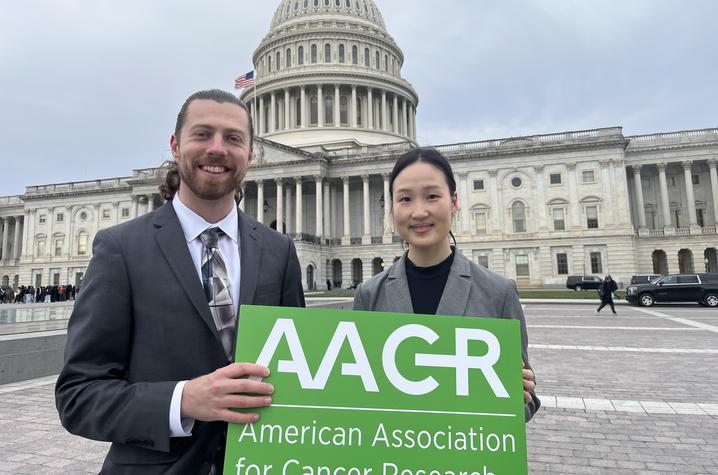
LEXINGTON, Ky. (April 15, 2026) — When Subin Kim learned she had been selected as one of just 20 early-career scientists nationwide to participate in the 11th Annual American Association for Cancer Research (AACR) Early-Career Hill Day, the moment carried both personal and professional weight. For Kim, whose work sits at the intersection of cancer research and public health, the opportunity to meet with federal legislators represented more than recognition — it was a chance to step into a broader role shaping the future of science.
“Being selected for the AACR Early-Career Hill Day was an incredibly exciting opportunity for me because of its direct relevance to my current work, academic interests and future career goals,” Kim said. “My current research with the University of Kentucky Markey Cancer Center on pancreatic neuroendocrine cancer depends on sustained federal funding, and this experience meant that I’d be able to better understand how advocacy shapes research support, regulatory decisions and training programs.”
Kim’s selection for Early-Career Hill Day placed her among a small cohort of scientists who meet with congressional offices to discuss ongoing research and the importance of sustained research funding. Paired with a fellow researcher, she met with multiple congressional offices, including those of Kentucky Sens. Mitch McConnell and Rand Paul, and Missouri Sens. Eric Schmitt and Josh Hawley, as well as Reps. Andy Barr of Kentucky and Wesley Bell of Missouri.
“We emphasized that National Institutes of Health and National Cancer Institute funding drives scientific discovery, all the way from basic science research to clinical trials, that expands patient treatment options,” Kim said. “This sustained investment is essential given the long timeline of research, where disruptions can undermine years of prior progress, and that the research supported by federal funding not only saves lives but also contributes to economic growth.”
Kim’s selection for Hill Day did not happen in isolation. It was the result of years of academic exploration, mentorship and a growing awareness of how research extends beyond the lab.
Long before she entered a research lab, Kim participated in an Advanced Placement U.S. Government and Politics course assignment at her high school that required students to contact their congressional representatives.
“While that experience was introductory, it made the idea of engaging with policymakers feel accessible,” she said.
That early exposure planted a seed — one that would later intersect with her scientific pursuits. As an undergraduate student at the University of California, Davis, pursuing a degree in neurobiology, physiology and behavior, Kim discovered oncology through an internship at the UC Davis Comprehensive Cancer Center.
“That experience sparked my interest in cancer research and led me to pursue opportunities focused on understanding cancer at a molecular level,” she said.
And while her current work with the Markey Cancer Center is deepening her understanding of cancer at the cellular level, Kim sought a broader lens — one that led her to pursue a Master of Public Health degree in Health Management and Policy at the University of Kentucky College of Public Health.
Her decision was shaped by both experience and perspective.
“I feel like I’ve always kind of been drawn to supporting underserved populations, whether volunteering at schools in underfunded districts or participating in initiatives like the Diaper Bank Project,” she said. “At the time, I hadn’t yet labeled this work as being in the realm of public health, but it planted the seeds for understanding systemic barriers to well-being.”
That understanding sharpened during her time working as an EMT, when she witnessed firsthand how social conditions influence health outcomes.
“As someone who hopes to become a physician, I realized that understanding these social determinants of health is essential for providing holistic care and supporting patients beyond their immediate medical needs,” she said.
The Master of Public Health program expanded her perspective even further, connecting scientific discovery to real-world systems.
“My public health training has helped me understand the broader systems that influence patient outcomes,” Kim said. “It has expanded my perspective beyond individual treatments to consider questions like who has access to those treatments, how resources are distributed, and what barriers patients may face when seeking care.”
Central to Kim’s growth has been a network of mentors across both research and public health. She credits individuals such as College of Public Health Associate Dean for Academic Excellence Paula Arnett, Dr.Ph., Experiential Education Director Nicole Barber-Culp, Markey Cancer Center faculty member Piotr Rychahou, M.D., and Markey Cancer Center Director B. Mark Evers, M.D., with encouraging her to think beyond traditional boundaries.
“Their guidance has pushed me to think beyond the bench and consider how policy decisions directly influence the trajectory of research and patient care,” she said.
In the lab, Evers’ mentorship has been particularly influential.
“He encourages autonomy while providing consistent support and clear communication,” Kim said. “In this way, I’ve learned a lot, not only from the research itself but also from observing how he leads his research group.”
Evers describes that balance as intentional.
“As they show that they are mastering the techniques and also gaining a better knowledge base, then they are given more independence and latitude to work and encouraged to suggest alternative strategies, approaches or directions based on their work and also their reading of the literature,” said Evers. “Mentors are always close by to provide support/guidance, but this encouragement provides them with the confidence and freedom to propose new ideas.”
That approach has been evident in Kim’s development.
“Subin was obviously very bright and knew very clearly what she wanted to achieve,” Evers said. “However, she had not had much basic laboratory experience, so she lacked some confidence in the beginning. However, it was wonderful to watch her mature and gain more confidence as she began to master techniques and grow into a thoughtful and careful investigator.”
Kim’s research at the Markey Cancer Center focuses on improving outcomes for patients with pancreatic neuroendocrine tumors — a rare but increasingly diagnosed cancer — by examining how cancer cells repair DNA damage caused by chemotherapy, often leading to treatment resistance. By targeting proteins like DNA-PK, she aims to enhance the effectiveness of treatment.
“This approach aims to prevent cancer cells from repairing DNA damage, potentially leading to longer-lasting responses with fewer side effects,” Kim said. “Our goal is to develop more targeted, personalized treatments that improve survival and ensure patients with rare cancers are not left behind.”
For Kim, the Hill Day experience reinforced the idea that scientific work does not end with discovery — it requires communication, advocacy and engagement.
“Overall, this opportunity to be on Capitol Hill showed me that contributing to cancer research and the healthcare field at large extends to the responsibility of communicating and advocating to ensure that the systems supporting innovation remain strong,” she said.
As she prepares to enter medical school, she hopes to continue bridging research, public health and policy.
“Research drives discoveries. Public health identifies systemic barriers. Policy ensures resources and infrastructure support both,” Kim said. “They all act on each other.”
Research reported in this publication was supported by the National Cancer Institute of the National Institutes of Health under Award Number P30CA177558. The content is solely the responsibility of the authors and does not necessarily represent the official views of the National Institutes of Health.
As the state’s flagship, land-grant institution, the University of Kentucky exists to advance the Commonwealth. We do that by preparing the next generation of leaders — placing students at the heart of everything we do — and transforming the lives of Kentuckians through education, research and creative work, service and healthcare. We pride ourselves on being a catalyst for breakthroughs and a force for healing, a place where ingenuity unfolds. It's all made possible by our people — visionaries, disruptors and pioneers — who make up 200 academic programs, a $1.02 billion research and development enterprise and a world-class medical center, all on one campus.