


Following the data: Terry Bunn’s public health mission in Kentucky
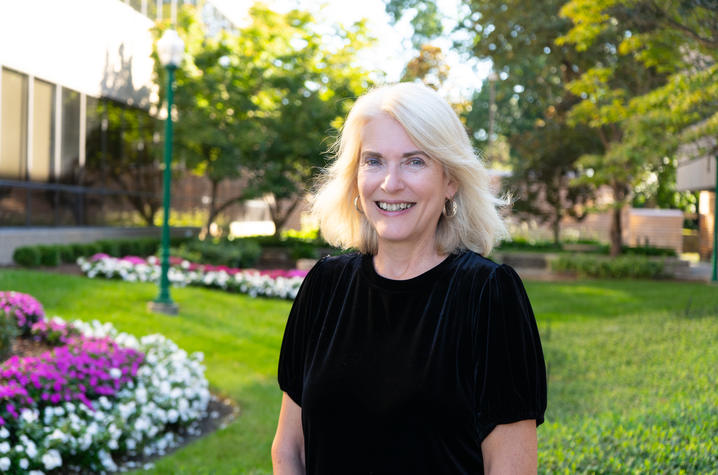
LEXINGTON, Ky. (March 6, 2026) — Terry Bunn has spent her career following the data. Repeatedly, that discipline — careful analysis, pattern recognition and an insistence on asking what comes next — has carried her into new territory. But beneath the charts, surveillance systems and peer-reviewed papers are two deeply personal life events that quietly redirected her path, first into epidemiology and occupational health and later into drug overdose prevention and recovery.
Bunn, a professor at the University of Kentucky College of Public Health and director of the college’s Kentucky Injury Prevention and Research Center (KIPRC) from 2010 until 2025, did not begin her career imagining she would one day help shape Kentucky’s response to the drug overdose crisis. In fact, her earliest scientific work focused on immunotoxicology was sparked not by a grant or job posting but by her own child.
While living in Peru in the mid-1990s, Bunn’s youngest son was exposed to lead, largely due to leaded gasoline that was still in use at the time. During a visit back to the United States, routine testing revealed elevated blood lead levels. Soon after returning to Peru, Bunn received a letter confirming the results — a moment that would permanently alter her academic trajectory.
“Trying to reduce any exposure to lead that was occurring due to the environment became a daily concern,” she said. “And that’s really what got me interested in that area of research in graduate school.”
At Cornell University, where she earned her Ph.D., Bunn began studying environmental exposures using animal models, examining the effects of lead exposure in utero. What began as a deeply personal response to a family health scare evolved into a professional commitment to understanding how environments, particularly work environments, shape health outcomes.
When she joined the UK faculty in 2005, her toxicology background made occupational safety and health a natural fit with KIPRC.
Bunn became involved in KIPRC’s Kentucky Occupational Safety and Health Surveillance program, initially focused on agricultural injury prevention. But as she would do throughout her career, she followed the data wherever it led. Analysis revealed that most fatal workplace injuries were no longer occurring on farms but on roadways.
“We switched from agricultural injury prevention because when we analyzed the data, most of the injuries were due to motor vehicle crashes,” she said. “And drilling down even more, it was semi trucks.”
As her team investigated fatal worker crashes, a troubling pattern emerged. Medical examiner and coroner reports increasingly noted the presence of drugs in drivers’ systems. In the mid-2000s, Bunn and her colleagues produced their first report listing drug involvement in occupational motor vehicle fatalities.
That report marked the beginning of a shift that would define the next phase of her career. From workplace crashes, her work expanded into broader analysis of drug involvement across emergency department visits, hospitalizations and death certificates. By 2010, Bunn’s team produced one of Kentucky’s first comprehensive reports examining drug overdoses across multiple data systems, bringing new awareness and urgency to the issue for state and local public health officials.
Still, it was another life event that deepened her commitment to drug overdose prevention and recovery systems — a former brother-in-law struggled with substance use disorder.
“There was just a lack of being able to link him to treatment and recovery support services at that time,” Bunn said. “That experience really stayed with me.”
By the mid-2010s, Bunn was already deeply embedded in drug overdose surveillance work, collaborating with the Office of Drug Control Policy, the Cabinet for Health and Family Services and Kentucky’s prescription drug monitoring program. In 2014, Kentucky was one of only five states selected for Centers for Disease Control and Prevention (CDC) funding through the National Center for Injury Prevention and Control to expand drug overdose prevention efforts. The funding allowed Bunn’s team to regularly publish actionable, data-driven reports — and to ask harder questions about what happened after someone was identified as having a substance use disorder.
One of those questions surfaced during a routine visit to her primary care doctor.
“I asked him, once a patient is identified as having a substance use disorder, what do you do?” she said. “He told me it could take his nurse eight hours to find a treatment facility with an opening that would take the patient’s insurance.”
That conversation — combined with a discussion with then CDC Director Tom Frieden — led to the development of FindHelpNowKY.org, a substance use disorder treatment locator designed to quickly connect individuals to facilities with available openings. Funded through supplemental CDC support in 2017 in partnership with the Cabinet for Health and Family Services, the tool addressed a glaring gap: knowing treatment existed was not the same as being able to access it.
But, as Bunn had learned repeatedly, solving one problem often revealed the next.
“Once they’re in treatment, they need support for their recovery,” she said. “Recovery housing is one of the best evidence‑based practices for achieving long‑term recovery.”
That realization led to FindRecoveryHousingNowKY.org, launched in 2022. Importantly, the site lists only certified or certification-in-process recovery homes, reinforcing quality and accountability. Around the same time, Bunn partnered with the Fletcher Group on a federally funded Rural Center of Excellence in Recovery Housing, helping develop a national directory of recovery houses and expanding the impact of Kentucky’s work.
Throughout it all, Bunn’s approach has remained consistent: analyze the data, identify the gap, build partnerships and design practical interventions.
“Data is like vegetables,” she said, quoting a Cabinet for Health and Family Services colleague. “You always want it fresh.”
Having near-real-time access to emergency department, EMS and death certificate data has allowed Kentucky to respond more quickly and precisely to emerging trends — whether targeting risk-reduction efforts, deploying care navigators or evaluating programs like the Kentucky Access to Recovery initiative, which Bunn’s team recently completed analyzing participant data.
Now, as she transitions toward retirement, Bunn remains deeply engaged. She continues work at KIPRC on the CDC’s Overdose Data to Action grant, recovery‑friendly workplace initiatives and evaluation of recovery support services. Consulting, writing and mentoring remain on the horizon, along with hopes for a voluntary faculty role.
“This work is still a passion for me,” she said. “That’s not going to go away.”
The Health Resources and Services Administration (HRSA), Department of Health and Human Services (HHS) provided financial support for the research projects described in this article. Awards provided 100% of total costs and totaled $17,280, $1 million, and $1.7 million. The contents are those of the author. They may not reflect the policies of HRSA, HHS, or the U.S. Government.
This project was supported by the Centers for Disease Control and Prevention (CDC) of the U.S. Department of Health and Human Services (HHS) as part of financial assistance awards totaling $7.9 million, $7.6 million, $3.7 million, $5.3 million, $4.7 million, and $2.2 million with 100% funded by CDC/HHS. The contents are those of the author(s) and do not necessarily represent the official views of, nor an endorsement, by CDC/HHS, or the U.S. Government.
As the state’s flagship, land-grant institution, the University of Kentucky exists to advance the Commonwealth. We do that by preparing the next generation of leaders — placing students at the heart of everything we do — and transforming the lives of Kentuckians through education, research and creative work, service and healthcare. We pride ourselves on being a catalyst for breakthroughs and a force for healing, a place where ingenuity unfolds. It's all made possible by our people — visionaries, disruptors and pioneers — who make up 200 academic programs, a $1.02 billion research and development enterprise and a world-class medical center, all on one campus.