


Perry County students join UK water monitoring research team
LEXINGTON, Ky. (Jan. 9, 2026) — University of Kentucky researchers — along with collaborators from across the United States — gathered at Buckhorn School in Perry County last month to work with high school students on a water-testing device developed at UK.
The visit offered a vibrant, hands-on learning opportunity, said Josh Baker, a Perry County Schools instructional supervisor .
“We want our kids to have the same opportunities as students in a bigger area, so this means a lot,” Baker said.
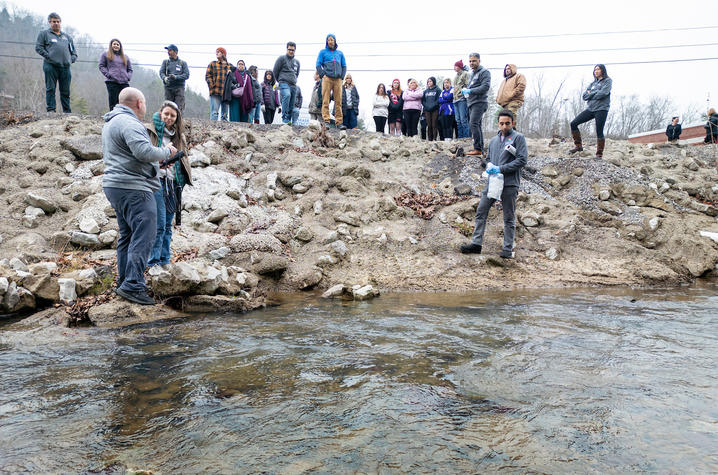
At most schools, water is something students walk past without a thought. It flows through pipes and up drinking fountain spouts, almost invisibly. But at Buckhorn School, water is never just background. In fact, Squabble Creek runs along the edge of campus. Its presence is one reason UK researchers contacted Buckhorn School leaders to partner on water-sampling research.
The students know Squabble Creek as a place to fish or cool off in the summer, but they also know what it can become. During the historic Eastern Kentucky flooding of 2022, the creek rose rapidly, wrecking the school and displacing classes for two years.
That event is only part of their complicated relationship with water. Buckhorn has long faced persistent water treatment and pipeline issues. As recently as January 2025, the school closed for six days when the community experienced days without running water. After years of struggle, hope is emerging. In September, officials broke ground on a monumental new water system for this region of Eastern Kentucky.
Against this backdrop, Buckhorn students had the opportunity to contribute to a research effort that aims to make water testing more accessible for citizens and scientists alike.
In a place where water has taken so much, students are learning how it can also reveal truths, protect communities and point toward stronger futures. And by working alongside university professors and scientists, Buckhorn School Principal Christie Stamper said she hopes students are also exposed to career possibilities.
“They may see something they take interest in and say ‘I’d love to go to college and do this,’” Stamper said. “Our biology teacher is also taking part, and they will be able to come back and have discussions about it in class.”
Advancing engineering solutions for community needs
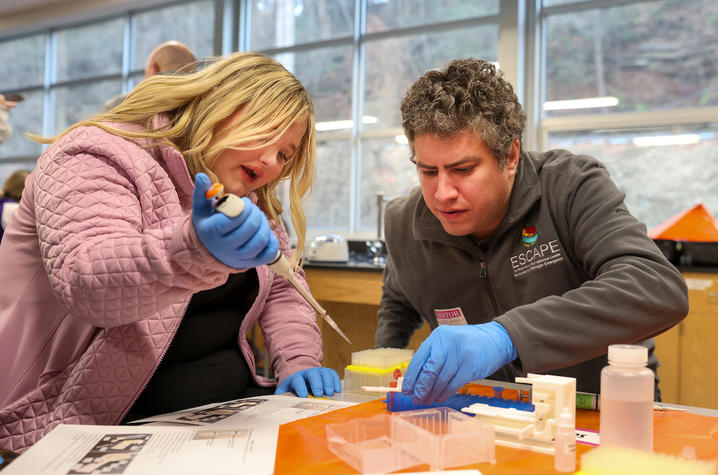
At the UK Stanley and Karen Pigman College of Engineering, a research team — like the community of Buckhorn — has been deeply focused on the power of water. They are developing a portable “lab on a chip” that enables water samples to be collected and tested for pathogens virtually anywhere. With results produced on site, the device reduces reliance on traditional laboratories and expands access to water monitoring in communities where such resources are scarce.
“We want to be sure the solutions we are developing are created in consultation with the communities they are designed to help,” said Scott Berry, Ph.D., an associate professor in the Department of Mechanical Aerospace Engineering. “In doing this, we hope to drive adoption of these important technologies in the communities that need them most.”
In December, the research team — along with collaborators from Arizona State University, University of Alaska Anchorage and Wildlife Conservation Society — traveled to Buckhorn School and, alongside high school students, collected and analyzed water from Squabble Creek. All are members of the U.S. National Science Foundation’s (NSF) Environmental Surveillance Center for Assessing Pathogen Emergence (ESCAPE).
The ESCAPE research is part of the NSF’s Predictive Intelligence for Pandemic Preparation program. Berry is principal investigator of the nearly $18 million NSF award, shared by the four institutions. He is leading the seven-year effort along with co-principal investigators Matthew Scotch, Ph.D., associate dean and professor in the Arizona State University College of Health Solutions; James Keck, Ph.D., a research physician at the University of Alaska Anchorage and the Alaska Native Tribal Health Consortium; Sarah Olson, Ph.D., the associate director of epidemiology for the Wildlife Conservation Society; and Sahar Alameh, Ph.D., assistant professor of STEM Education in the College of Education at the University of Kentucky.
By examining wastewater and environmental data to reveal community health trends, ESCAPE researchers are transforming society’s ability to forecast the likelihood of pandemic-scale events, detect outbreaks early and respond efficiently.
Preparing the next generation of scientists
ESCAPE researchers are seeking not only to create the next generation of technologies to detect pathogens, but also to prepare the next generation of scientists who will carry this work forward.
That is where Alameh, a faculty member in the UK College of Education, comes in. Alameh, a former high school teacher, focuses on building school and community partnerships that create meaningful entry points into real-world research.
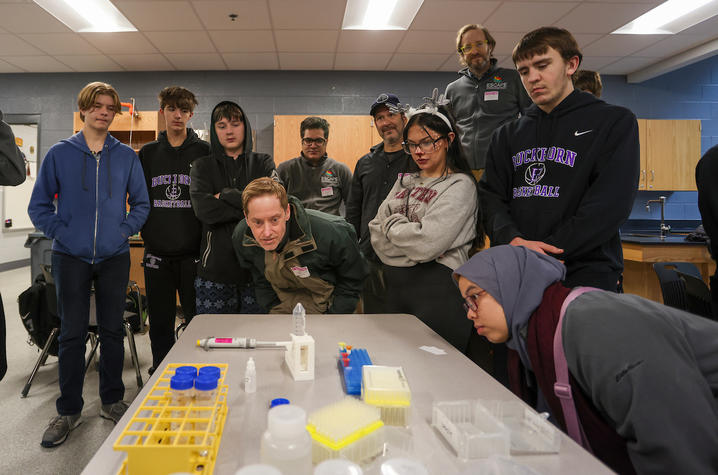
“As a STEM educator, this is a golden opportunity,” Alameh said. “The high school students are working side-by-side with university researchers to analyze samples, learn environmental monitoring techniques and experience how science and engineering can protect public health. Usually, teachers have to design a simplified activity to show how science works. This time, students are stepping into the real process.”
Last fall, as the team planned for collaborators from Alaska, Arizona and Indonesia to visit Kentucky, they wanted to conduct field testing together, like work they did in Uganda last summer. They needed a community where the “lab on a chip” could be put to use.
In 2022, Alameh had been poised to launch a project at Buckhorn School, but the week before it began, the Eastern Kentucky floods struck. When the ESCAPE team discussed potential field test sites, she suggested returning to Buckhorn. After reconnecting with leaders in the school and community, she was soon back in Perry County. During a meeting in the school’s science lab, about 25 students volunteered to join the research team. When Alameh asked how many of them had spent time in Squabble Creek, nearly every hand went up.
“They are going from seeing the creek as a place used for recreation to seeing it playing a role in helping society be better prepared for future pandemics,” Alameh said. “As they work alongside scientists, engineers, health specialists, environmental researchers and public health experts, they are noticing how much science depends on collaboration, shared judgment and careful procedures. They are also seeing that scientists and engineers must follow strict protocols to ensure reliability, but at the same time research is not just a step-by-step recipe. It requires interpreting evidence, adjusting to real conditions in the field and making decisions together as new information emerges.”
Ryan Spicer teaches chemistry, biology and anatomy at Buckhorn School and took part in the water testing experience with his students. He hopes the hands-on learning experience will help students see the benefits of being good stewards of their environment, for both current and future generations. He also saw it as an opportunity for students to prepare for their futures.
“For a 16-, 17-, 18-year-old, it’s hard to really know what you want to do with your life,” Spicer said. “Any time that we can provide exposure to them, I think it’s great to hopefully prepare them for their future and know what they want to do for a future career.”
This material is based upon work supported by the U.S. National Science Foundation under Cooperative Agreement Number 2412446. Any opinions, findings, and conclusions or recommendations expressed in this material are those of the author(s) and do not necessarily reflect the views of the U.S. National Science Foundation.

As the state’s flagship, land-grant institution, the University of Kentucky exists to advance the Commonwealth. We do that by preparing the next generation of leaders — placing students at the heart of everything we do — and transforming the lives of Kentuckians through education, research and creative work, service and healthcare. We pride ourselves on being a catalyst for breakthroughs and a force for healing, a place where ingenuity unfolds. It's all made possible by our people — visionaries, disruptors and pioneers — who make up 200 academic programs, a $1.02 billion research and development enterprise and a world-class medical center, all on one campus.