


Searching for the ‘super tomato’: UK lab advancing horticultural crop breeding for a healthier future
Video produced by the UK Martin-Gatton College of Agriculture. To view captions for this video, push play and click on the CC icon in the bottom right-hand corner of the screen. If using a mobile device, click on the gear icon in the same area.
LEXINGTON, Ky. (Oct. 1, 2026) — A lab at the University of Kentucky Martin-Gatton College of Agriculture, Food and Environment (CAFE) is at the forefront of breeding and genetics of fruits and vegetables.
The Sapkota Horticultural Breeding and Genetics Lab, located on campus and at the Horticultural Research Farm (South Farm), is led by Manoj Sapkota, Ph.D., assistant professor in horticultural crop breeding for nutrition in the Department of Horticulture. The lab’s mission is to enhance crop productivity, increase disease resistance and improve nutritional quality to meet the needs of growers, producers and consumers in Kentucky and beyond.
“We are trying to find genes and genetics that make fruits and vegetables more nutritious, increase the quality, enhance the shelf life, make fruit size bigger or smaller and disease resistant,” Sapkota said. “The big goal of the lab is developing new varieties, so growers here in Kentucky have different options that are well suited to Kentucky conditions and have all the best qualities.”
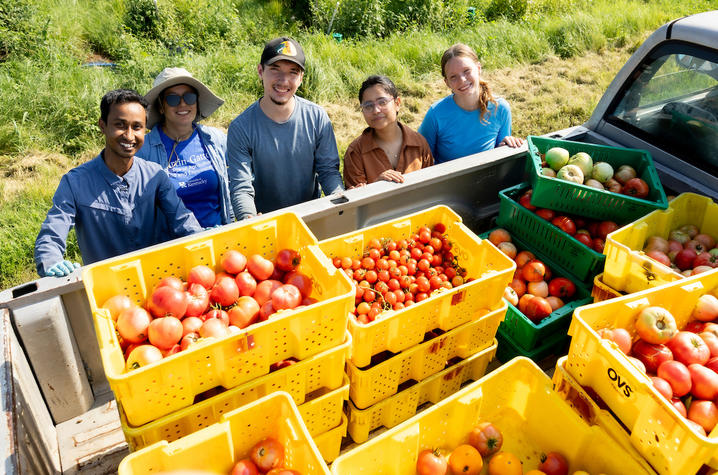
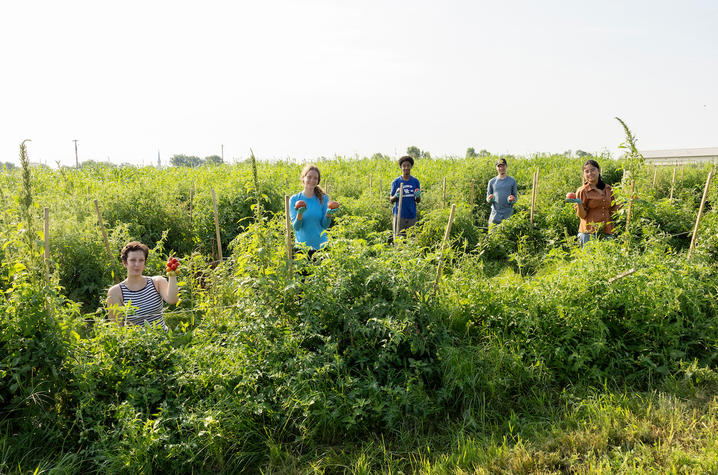
Sapkota works with a team of lab members — research staff, undergraduate and graduate students, and volunteers — on several research projects that include field-based tomato breeding and strawberry disease-resistance screening to seed morphology, herbicide resistance and computer vision-assisted phenotyping.
The student researchers who work in the lab have a range of UK majors, including agricultural and medical biotechnology, biology, computer science, data science, health sciences, horticulture and neuroscience.
Sapkota said leveraging the students’ different academic backgrounds is helping the lab create new breeding tools, and he is mentoring future leaders in this dynamic field.
“We are training the next generation of scientists, and I’m grateful that mentors and collaborators, both within the university and beyond, have supported me throughout my career,” Sapkota said. “Integrated science is very important right now and every student brings something new to the table. They are helping us build toolkits and develop new crop varieties down the line.”
One of those students is Caroline Potts, who is majoring in human health sciences at the UK College of Health Sciences.
Potts is working collaboratively with Sapkota and the other student researchers to measure crop improvement with nutrition, human health and consumer-focused research through sensory testing and surveys — starting with tomatoes.
The tomatoes are already receiving positive reviews in the community, according to Potts.
“I have people trying the tomatoes we are growing, and they love them so much they want to know the name and grow these tomatoes themselves,” Potts said. “When I talk with my family, friends and peers about social determinants of health and share what I know about breeding and genetics, I feel that I’m bridging the gap and helping to demystify the science.”
Searching for the ‘super tomato’
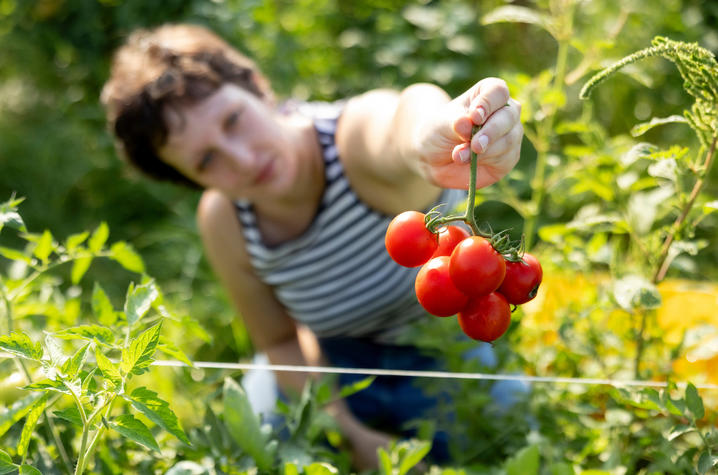
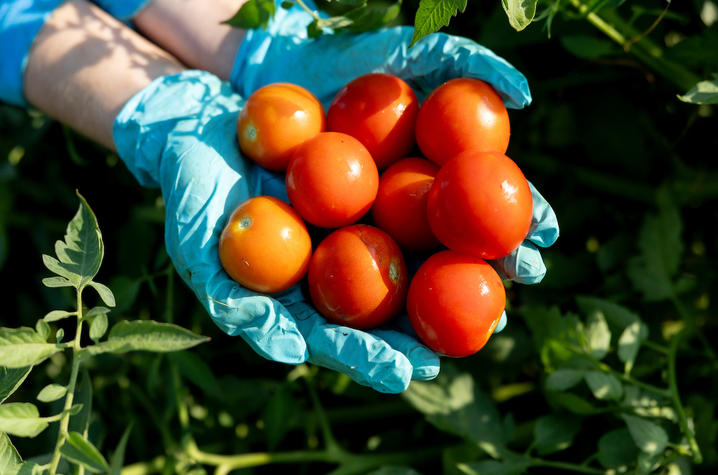
One of the lab’s current projects is working toward what Sapkota calls “super tomato,” a tomato that is delicious and healthy for consumers, offering agricultural advantages for both growers and producers. The goal is to develop tomatoes that are well adapted to Kentucky conditions and are flavorful and nutritious, while also producing strong yields and resisting diseases.
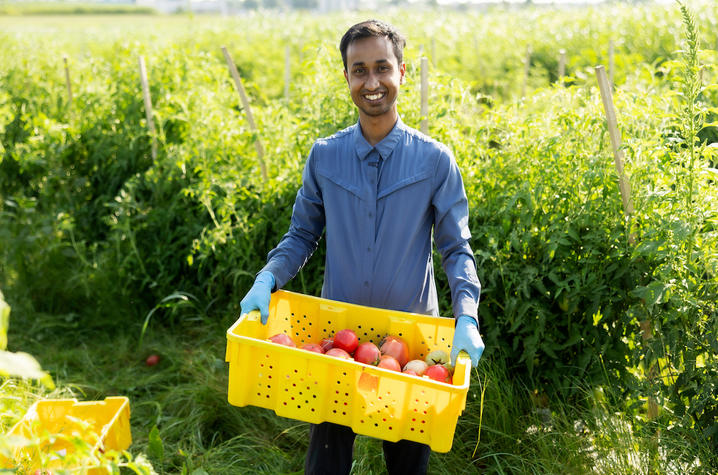
At UK’s South Farm, Sapkota and his student researchers are growing over 250 different tomato varieties, breeding lines and other genetic materials, searching for the right combination of tomato traits.
The tomato is a “model species” for this type of research, and Kentucky offers the ideal geographic location, according to Sapkota.
“Basically, the tomato is pretty simple — it’s a very common vegetable across different cultures and plays a huge role in nutrition,” Sapkota said. “Scientifically, tomatoes are also an important model crop for genetics and genomics. What we learn from tomatoes can provide insights into related crops and, more broadly, help us understand the genetic basis of important traits in plants. It’s also an important vegetable crop for many growers, especially here in Kentucky, which offers amazing weather conditions.”
According to Sapkota, creating one super tomato for everyone to enjoy is challenging.
“Flavor preferences are highly subjective, while nutritional quality is complex and involves many different compounds and traits,” Sapkota said.
After harvest at South Farm, selected tomatoes are brought back to the Sapkota Lab on campus for additional measurements and analyses, including quality, flavor and nutritional traits. Field evaluations and data analysis from the 2026 growing season will continue through the fall.
Sapkota is hopeful that in 2027 there will be new publications on this research, which he believes is extremely beneficial for his lab, the students and the university.
From Kentucky to global collaboration
When he arrived at UK in 2025, Sapkota was eager to get his lab established. His mission was clear: Develop improved horticultural crop varieties that are not only high-yielding and disease-resistant but also packed with better flavor and enhanced nutritional value.
According to Sapkota, helping to meet the evolving needs of Kentucky growers and consumers while contributing to food security on a global scale will put UK on the map as a leader in plant breeding and genomics.
“We need to go beyond the boundaries,” Sapkota said. “UK already has tremendous expertise and resources. The opportunity is to connect those strengths across disciplines and build collaborations beyond the university as well. Science is teamwork. As a growing breeding program, we want to collaborate across UK, with researchers throughout the country and with international partners, while keeping the needs of Kentucky growers and consumers at the center of our work. We want our research to have an impact statewide, nationally and globally.”
In the future, Sapkota is hopeful to establish a genomics and breeding consortium at UK, bringing together the best researchers, experts and scholars to advance this field of study.
Funding for the Sapkota Lab and its student research includes support from the Department of Horticulture, The Food Connection Student Opportunity Grant, Office of the Vice President for Research’s Celebrating University Research Across the Enterprise (CURATE) Program, UK Tracy Farmer Scholars Program, UK Sustainability Summer Research Fellowships and UK Office of Undergraduate Research Fellowship.
Learn more about the Sapkota Horticultural Breeding and Genetics Lab at sapkotalab.mgcafe.uky.edu and the Department of Horticulture at horticulture.mgcafe.uky.edu.
This material is based upon work that is supported by the Kentucky Agricultural Experiment Station (KAES), National Institute of Food and Agriculture, U.S. Department of Agriculture, Hatch Capacity Funding project under award number KY011063. Any opinions, findings, conclusions or recommendations expressed in this publication are those of the author(s) and do not necessarily reflect the view of the Department of Agriculture.
As the state’s flagship, land-grant institution, the University of Kentucky exists to advance the Commonwealth. We do that by preparing the next generation of leaders — placing students at the heart of everything we do — and transforming the lives of Kentuckians through education, research and creative work, service and healthcare. We pride ourselves on being a catalyst for breakthroughs and a force for healing, a place where ingenuity unfolds. It's all made possible by our people — visionaries, disruptors and pioneers — who make up 200 academic programs, a $1.02 billion research and development enterprise and a world-class medical center, all on one campus.