


‘Tick magnets’ guide UK ecology research, tool testing and student learning
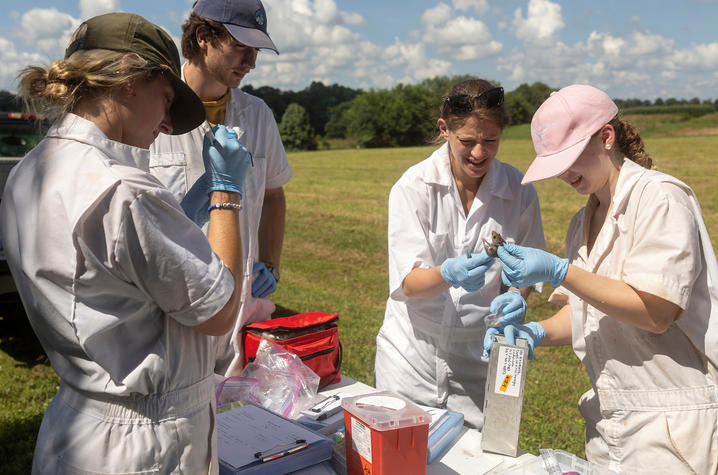
LEXINGTON, Ky. (Sept. 4, 2026) — White coveralls and tall boots are standard field gear for University of Kentucky research students as they drag white cloths and collect metal boxes at the Oran C. Little Research Center in Versailles, Kentucky. These tools and tactics will provide better baseline data for tick species, their host animals and the impact on various land-use types in Kentucky through a research project primarily funded by the UK Student Sustainability Council (SSC).
The study will fill an information gap in the Commonwealth by focusing on the role of wild mice in tick life cycles, said Hannah Tiffin, Ph.D., the students’ research advisor and assistant UK Extension professor of veterinary entomology at the Martin-Gatton College of Agriculture, Food and Environment.
“A lot of our Northeastern and Mid-Atlantic states have that data already, but we’re still lacking a lot of that information,” Tiffin said. “We’re really trying to establish that baseline and see what ticks the mice are moving around because they’re really important in a lot of different ways for tick ecology.”
Tick surveillance and land use
Tiffin is a primary investigator on the SSC-funded project with co-investigator Matthew Springer, Ph.D., associate UK Extension professor of wildlife management in the Department of Forestry and Natural Resources, and Ashley Russo, a graduate research assistant in the Department of Entomology. Russo also received funding from the Promoting Excellence in Research for Kentucky program and the Karri Casner Environmental Sciences Fellowship to support her work and studies on the project.
Russo explained that one part of the research looks at tick species dispersal across different land-use types. They monitor four sites within Woodford County: the Oran C. Little Research Farm with mixed-use livestock pastures, the Buckley Wildlife Sanctuary, a private cattle farm and a private horse pasture.
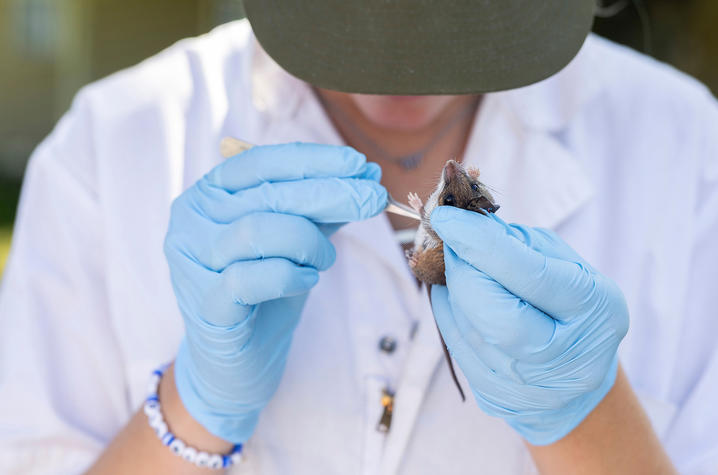
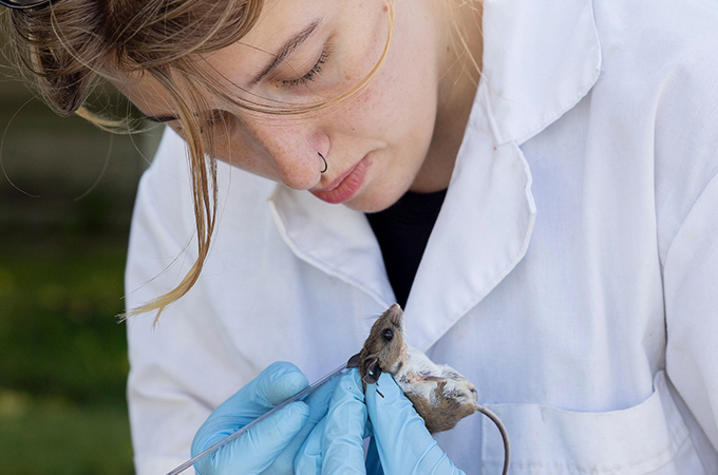
The research team uses different sampling methods to collect ticks at each location, including manually checking livestock, trapping and checking wild mice and artificial mouse nesting sites, and tick dragging, where ticks latch onto a white cloth dragged over pastures and vegetation.
The collected ticks are identified, then sent to a lab at Virginia Commonwealth University to determine whether they carry any disease-causing pathogens.
Testing mice and collection methods
Tiffin said trapping mice for tick surveillance matters for a few reasons.
“For one, they are just tick magnets,” Tiffin said. “They’re moving the ticks around in the environment, and there’s just a lot of mice. They’re generalist species, so you’re going to find them in a lot of places.”
Tiffin explained that mice move ticks from wilder areas into areas where they interact with people, animals and livestock.
“They also can harbor a lot of different pathogens,” Tiffin said. “The main one we think of when we’re thinking of mice is Lyme disease because they harbor Borrelia burgdorferi, which is the bacterium that causes Lyme disease. But they can harbor a whole bunch of other things and cause different diseases for humans and animals.”
Identifying ticks and the diseases they carry, according to Tiffin, requires a lot of time and specialized expertise.
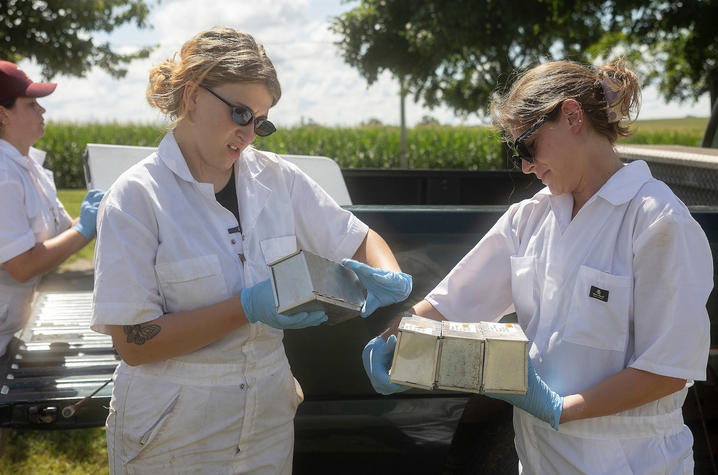
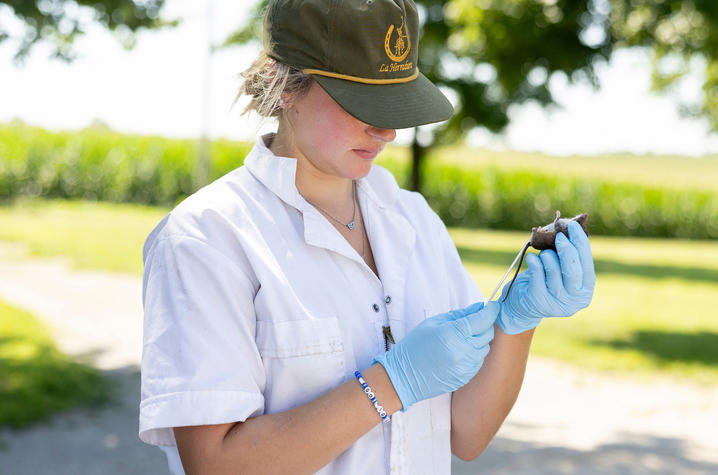
Russo and Tiffin have trained several undergraduate students in wildlife handling, tick removal and tissue collection, and the team works quickly to reduce stress on the mice they capture in traditional metal Sherman traps. The team checks the traps in the morning and makes a second trip to each research location in the evening to bait and reset.
To reduce field time and mouse handling, Russo is also assessing alternative mouse capture methods piloted at the U.S. Department of Agriculture’s Agricultural Research Service Center in Beltsville, Maryland. Mouse nesting boxes are mounted to trees or fence posts. The mice will visit this novel surveillance tool and, while resting, the ticks will either be groomed off by the mice or detach after their blood meal (a process by which ticks feed exclusively on the blood of their hosts) and are caught on sticky traps at the bottom of the nesting box.
“We’re hoping that the nesting boxes can help future tick research by putting less of a strain on the researchers,” Russo said. “The nesting boxes could help mitigate some of that labor effort, and instead of having these long days where we’re out trapping and handling these mice, we could just screw off the bottom and see those ticks in the bottom.”
Multidisciplinary research and learning
Several students are assisting Tiffin and Russo in the field.
Jason Killian, an environmental science major who transferred to UK to get more research experience, helps trap and process the mice Russo collects. He also manages 40 trail cameras across the four research sites to record additional wildlife and how they may impact mice and tick populations.
Erika Yurga, a preveterinary medicine junior, is a vector-borne disease intern for Tiffin’s Biting Insect and Tick Ecology (BITE) Lab, a position supported by the SSC grant. Her primary role for this research project is dragging the field locations and identifying the tick species found on the drags and mice.
Yurga knew from a young age that she wanted to be a veterinarian and study at UK, but she said working on the project has given her a love for research.
“I think I definitely want to pursue research as I continue here as a student at UK,” Yurga said. “And I think working with ticks has helped prepare me for vet school because obviously ticks affect our animals and our livestock. So, I’ve learned a lot that will be really helpful for my future career.”
The student team also includes BITE Lab student researcher Lily Tynan, who recently earned a bachelor’s degree in equine science and management, and wildlife ecology intern Carmen Tate, also supported by the SSC grant, who studies theatre and preveterinary medicine at UK.
“Through this experience, I have gained valuable skills and knowledge that have contributed to my personal and professional growth,” Tate said. “Working with a diverse range of animals and wildlife has allowed me to further explore and develop my interests as a preveterinary student at the University of Kentucky.”
Tiffin and Russo found that mouse-tick ecology is well suited to involving students.
“It’s a really great way to train students, especially the animal science or wildlife majors, on animal handling in a low-risk environment where we could do it as a team,” Tiffin said. “It really builds that team atmosphere, too, which I think is super critical for our students. They’re able to learn about vector-borne diseases and protecting themselves from ticks and take that home to their families or their friends. It’s been really cool to expose students to vector-borne diseases, but from different lenses.”
Russo previously worked with Tiffin at Penn State University, where Russo earned her bachelor’s degree in animal science and Tiffin did postdoctoral work. Russo said they mutually agreed that she would follow Tiffin to UK to continue collaborative research and her education.
“She’s a big part of why I wanted to be here,” Russo said.
Russo also said she enjoys being part of this tick ecology research because it allows her to explore the connection between the environment, wildlife and livestock.
“I get to do that ecology side and land-use side with tick dragging and vegetation surveys, and I also get to have my hands on some wildlife with these mice and work with livestock,” Russo said. “There is also a communication aspect with public health, and it all just kind of ties really nicely together in this little box where I can kind of do a bunch of different things that have an impact in a bunch of different areas.”
Tiffin said if the nesting box proves to be a useful tool for tick collection and identification, she hopes to expand it into a community-based science initiative.
“Where I foresee this going is that people could put this in their backyards and then they could take out the sticky trap at the bottom and send that in for identification. It would be a very easy way to look at tick distribution, tick seasonality across Kentucky at a very low resource level for people, and it involves the community, too.”
For more information on tick disease and prevention, visit the BITE Lab website at bitelabky.mgcafe.uky.edu.
As the state’s flagship, land-grant institution, the University of Kentucky exists to advance the Commonwealth. We do that by preparing the next generation of leaders — placing students at the heart of everything we do — and transforming the lives of Kentuckians through education, research and creative work, service and healthcare. We pride ourselves on being a catalyst for breakthroughs and a force for healing, a place where ingenuity unfolds. It's all made possible by our people — visionaries, disruptors and pioneers — who make up 200 academic programs, a $1.02 billion research and development enterprise and a world-class medical center, all on one campus.