


UK project aims to help Kentucky hay producers, horse owners meet in the middle
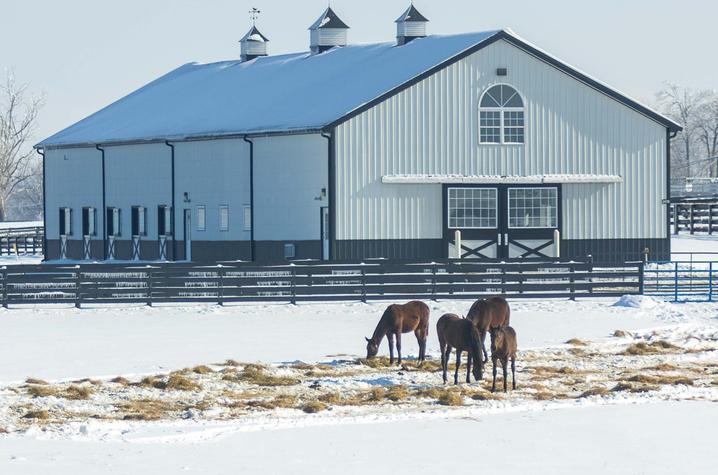
LEXINGTON, Ky. (Jan. 21, 2026) — A University of Kentucky team consisting of Bob Coleman, Ph.D., Ray Smith, Ph.D., and Krista Lea, along with the support of several county agents around the state, is starting a two-year research and educational effort to help hay producers sell more horse-quality hay. The research will also help horse owners buy hay with fewer surprises.
Kentucky has approximately 35,000 horse operations, affecting more than one million acres of farmland. Many of those farms buy hay, and project leaders say better communication between sellers and buyers can keep more hay dollars in Kentucky.
The Department of Animal and Food Sciences and Department of Plant and Soil Sciences partnership grew out of an earlier grant and a simple idea: connect the people who grow the commodity with the people who use it.
“What you’re trying to do is bring together the commodity producers with the commodity users,” said Coleman, associate professor in the Department of Animal Sciences at UK’s Martin-Gatton College of Agriculture, Food and Environment. “I believe that is extremely important.”
A key part of the project is helping hay producers describe their product in ways horse owners can trust and compare. Coleman said buyers often rely on advice and may reject hay that is safe and useful because it does not match a checklist they found online. He said basic details can change a buying decision, including the bale’s weight.
“You might have a 50-pound bale for $10 and a 40-pound bale for $8,” Coleman said. “That makes a huge difference. Horse owners need to know what they are getting. Also, you need to feed your horses high-quality hay, but what is that? Hay with the highest nutrient numbers is not always the best fit for every horse.”
The project will work through county Extension personnel, who often know local hay producers better than they know horse owners. The plan includes demonstration farms, publications and popular-press articles, educational programs and six regional field days.
The project leaders also plan to work with the USDA’s Natural Resources Conservation Service, the UK Regulatory Services Hay Testing Program and the Kentucky Department of Agriculture’s hay marketing efforts.
Early work has focused on outreach and hay sampling, including proper sample collection. The team also expects to teach about weed issues that show up in horse hay, such as foxtail, and to help horse owners recognize problem plants when they open a bale.
The effort comes at a time when hay prices and marketing opportunities matter for farm budgets. USDA data show Kentucky farmers received an average of $176 per ton for hay excluding alfalfa in 2024, a figure Coleman said can look very different when hay is packaged and marketed for the horse market.
“The goal is not to turn Extension agents into hay brokers,” Coleman said. “I don’t want to be the broker, and I know the agents don’t want to be the broker. But if we can come up with a way that makes it really easy and very user-friendly, I think that will help.”
The two-year project is funded by a $147,000 grant through the Kentucky Governor’s Office of Agricultural Policy.
As the state’s flagship, land-grant institution, the University of Kentucky exists to advance the Commonwealth. We do that by preparing the next generation of leaders — placing students at the heart of everything we do — and transforming the lives of Kentuckians through education, research and creative work, service and healthcare. We pride ourselves on being a catalyst for breakthroughs and a force for healing, a place where ingenuity unfolds. It's all made possible by our people — visionaries, disruptors and pioneers — who make up 200 academic programs, a $1.02 billion research and development enterprise and a world-class medical center, all on one campus.