


UK researchers study how sports may support autistic children
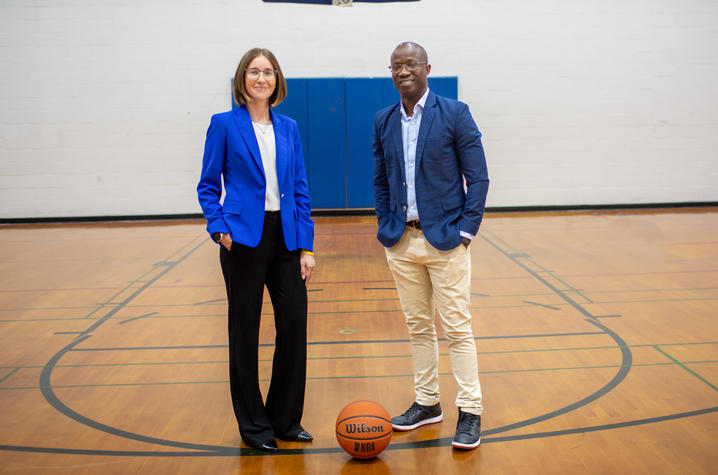
LEXINGTON, Ky. (Sept. 30, 2026) — A team of researchers in the College of Education at the University of Kentucky is studying how sports programs designed for autistic children may support social skills and physical fitness.
The research brings together two areas of expertise within the college through team members Amanda Duncan, Ph.D., and Tshepang Tshube, Ph.D.
Duncan studies ways to improve family functioning and quality of life for children with autism and their families, and Tshube’s work focuses on sport and sport leadership, including youth sport, life skills development, mental health and athlete career pathways.
“This study brings together expertise from different areas in an exciting way,” said College of Education Dean Nick Pace, Ed.D. “As a former teacher and coach, I know how impactful these discoveries are for young athletes and coaches. As dean of UK Education, I’m proud of yet another example of how our faculty members are collaborating to impact lives in Kentucky and beyond.”
Tshube, associate professor in the Department of Kinesiology and Health Promotion, was recently selected to write the International Olympic Committee Consensus Statement on mental health screening and elite youth athletes’ environments, work that reflects his broader expertise in how sport settings can influence young athletes’ development and well-being.
For Duncan, the study has a personal connection. As the parent of an autistic child, she saw firsthand the challenges her child faced while trying to participate in sports alongside peers. She eventually became his cross-country coach to help provide access to the same opportunities available to his neurotypical peers. Through that experience, Duncan saw the impact sports participation had on her child’s physical fitness, social skills and communication skills.
“This is the first study where I’ve really brought my personal and professional worlds together,” said Duncan, who recently published a study in the journal Autism examining stress and resilience among families raising children with autism.
By combining these perspectives, the team is examining how intentionally designed sports programs might support not only children’s participation and development, but also outcomes beyond the sports setting.
The study is enrolling children ages 8-12 who have been diagnosed with autism spectrum disorder, level 1 or 2. Participants will be randomly assigned to either a basketball-based program or a cross-country-based program.
Duncan said she hopes the study will make recreation more welcoming, accessible and meaningful for children with a range of abilities.
“Many autistic children experience challenges with movement and physical activity, and they may also face barriers to joining recreation programs that are not designed with their needs in mind. At the same time, families often are trying to support social communication and daily living skills through school or therapy services, which can be difficult to access because of long waitlists, high costs and workforce shortages,” said Duncan, an assistant professor in the Department of Early Childhood, Special Education, and Counselor Education.
According to the research, physical activity can offer important benefits for children — from building strength and coordination to creating opportunities for connection with peers.
“But many sports programs are not built around the communication, sensory and support needs of autistic children,” Duncan said. “We want to better understand how thoughtfully designed programs can help children participate, learn and feel successful.”
Tshube said skills developed through sports may carry over into other parts of a child’s life, including at home, at school and in the community.
“A group sport such as basketball gives children an opportunity to practice turn-taking, cooperation, verbal and nonverbal communication and shared goals. Those skills can support social development, and an important question is whether children are able to use what they learn through sport in other parts of their daily lives."
Sessions will be twice a week in the Lexington area beginning in January. Coaches will use activities that support social skills, everyday life skills and physical fitness. Children will complete assessments when they enroll, after five weeks and after 10 weeks so the research team can learn more about their progress.
“We hope this study helps us learn more about how different types of sports, both team-based and individual, can support autistic children’s physical development, social connections and everyday skills,” Duncan said.
The researchers hope the findings will help inform future recreation programs that are easier for families to access and better prepared to support autistic children in inclusive, strengths-based ways.
To learn more about the study, contact Duncan at aduncan@uky.edu. Funding for the research is provided by the College of Education Office of Research through PROJECT ENSPIRE (Encouraging Scholarly Productivity in Research).
As the state’s flagship, land-grant institution, the University of Kentucky exists to advance the Commonwealth. We do that by preparing the next generation of leaders — placing students at the heart of everything we do — and transforming the lives of Kentuckians through education, research and creative work, service and healthcare. We pride ourselves on being a catalyst for breakthroughs and a force for healing, a place where ingenuity unfolds. It's all made possible by our people — visionaries, disruptors and pioneers — who make up 200 academic programs, a $1.02 billion research and development enterprise and a world-class medical center, all on one campus.