


20 years of advancing cancer care in Kentucky — together
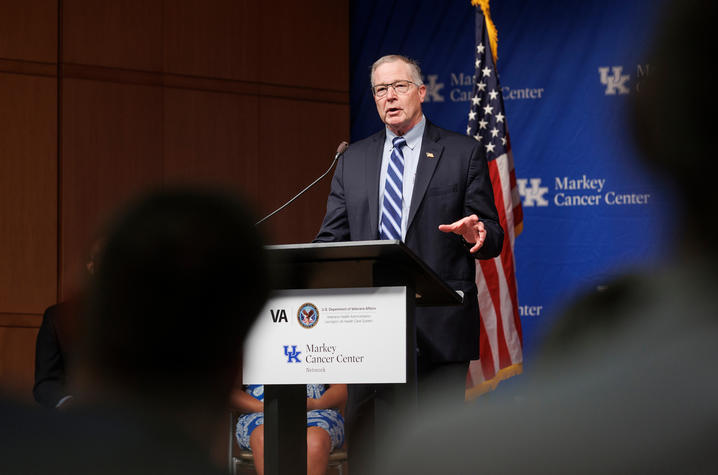
LEXINGTON, Ky. (Oct. 22, 2026) — When someone is diagnosed with cancer, getting the right care should not be dependent on where they live.
In 2006, the University of Kentucky Markey Cancer Center Affiliate Network (MCCAN) was developed with this idea in mind. Beginning with three community hospitals — Harrison Memorial Hospital, Rockcastle Regional Hospital and St. Claire Regional Medical Center — the network has grown to 20 sites statewide, connecting medical facilities and programs across Kentucky with the expertise and resources of the state’s only National Cancer Institute-designated Comprehensive Cancer Center.
The goal is not to replace the doctors and hospitals patients already know and trust. It’s to strengthen and grow local cancer programs across Kentucky while giving patients a clear path to more specialized care when they need it, said Tim Mullett, M.D., medical director for MCCAN.
“‘Higher-quality cancer care close to home’ is the catchphrase that we lean on,” Mullett said. “What we can do to make that happen in those communities is what the network is really focused on.”
The Markey difference
The UK Markey Cancer Center is crucial to cancer care in the state. As an NCI-designated Comprehensive Cancer Center, Markey combines patient care with a full spectrum of cancer research, prevention, screening, education and access to clinical trials, including first-of-their-kind trials. Its teams also provide highly specialized treatments and procedures that may not be available at smaller hospitals.
“The National Cancer Institute told us, ‘You are the only NCI-designated cancer program in the state,’” Mullett said. “‘Therefore, you have the responsibility of addressing cancer care across all of Kentucky.’”
However, that doesn’t mean every patient needs to receive all their care in Lexington. Community hospitals can provide much of the care a person with cancer may need, including some surgeries, chemotherapy, immunotherapy and radiation treatment. But it also offers something that can be difficult to replicate far from home: familiar doctors, nearby family members and trusted community support.
“If patients who need cancer treatment are having to make decisions about gas money, travel expenses, driving themselves or asking someone to take off work to drive them to Lexington, there are a lot of costs associated with that,” Mullett said. “That weighs on a patient not just mentally, but also financially. And ultimately, it delivers worse outcomes.”
Mullett describes MCCAN’s approach as “hybrid cancer care” and notes that MCCAN is a partnership with community hospitals — not a takeover. Those relationships require trust, not only among patients, but also between Markey and its affiliates. The goal is not to keep referred patients at Markey, but to get them back to their local providers.
“We’ve developed the network in a way that has really focused on getting patients back to their own communities,” he said. “We're not taking those patients. We are working with that local facility to deliver the care we need to do but then get that patient back to the community for the care that they can deliver.”
Today, more than 1,000 patients are referred to Markey each year for collaborative care through the network, with emphasis on collaborative: Markey and the local hospital share responsibility based on the patient’s needs and the services each program can provide.
That approach strengthens local hospitals rather than competing with them. It also helps Markey direct its most specialized resources to the people who truly need them.
“Patients from a rural community have opportunities for local treatment, but they may not have access to clinical trials or to some of the more advanced therapies, like CAR-T therapy or bone marrow transplant,” Mullett said. “Their local surgeons may not have experience in specialty surgical procedures like esophagus or rectal surgery, or other procedures that are frankly done 30, 40, maybe 50 times a year at the Markey Cancer Center.”
Raising the standard across Kentucky
Access is just part of the equation. Care close to home must also be high-quality.
MCCAN works with affiliate hospitals on education, quality improvement and nationally recognized standards. As a condition of joining the network, affiliate programs are tasked with earning accreditation from the Commission on Cancer (COC), which evaluates cancer programs based on established measures of quality and comprehensive care.
For hospitals that have not previously pursued accreditation, that can require significant work. The network helps local teams understand the standards, identify areas for improvement and strengthen their programs over time.
“Helping facilities achieve COC accreditation raises trust in the community,” Mullett said. “It raises value to the local institution, and patients feel more comfortable receiving care there.”
The benefit goes beyond a single patient’s treatment. Stronger local programs can improve cancer screening uptake, identify diseases earlier, support research and help communities better understand the importance of prevention and timely care.
Bringing NCI-level care to every corner of the Commonwealth
Over time, Markey has also created opportunities to expand cancer research and clinical trials into community settings through the Markey Cancer Center Research Network. A clinical trial can offer the latest, most effective new treatment options for cancer, but trials aren’t available everywhere. And through its NCI designation, Markey has access to trials only available at NCI-designated cancer centers.
“Since 2015, we’ve had the opportunity for some of our affiliates to be able to bring research programs and projects into their community — and run them from that community,” Mullett said. “The network really showed me that it can be a laboratory for research opportunities across the state.”
Bringing research closer to patients can make participation more practical for people who cannot travel repeatedly to Lexington, while helping studies better reflect Kentucky’s rural population.
The network has also supported statewide efforts to improve cancer screening, particularly in lung cancer. Though there is work to be done to increase screening numbers, Kentucky’s lung cancer screening rates have improved significantly since the U.S. Preventive Services Task Force first recommended these screenings back in 2013, and Kentucky’s rates of lung cancer screening also remain above the national average.
Kentucky has historically led the nation in lung cancer rates, but the statistics are turning around thanks to statewide efforts to engage more people in screening.
“We’ve seen dramatic changes in screening rates, and thus, early-stage diagnosis of lung cancer,” Mullett said. “We’re also seeing less late-stage disease. More Kentuckians can get effective treatment due to their cancer being found early, so we’re seeing an increase in survival rates.”
The next 20 years
The network’s first two decades have shown that improving cancer care statewide requires more than a single hospital, regardless of how advanced its treatments or research may be. It requires local knowledge, shared standards, open communication and long-term relationships with community healthcare providers. In other words, advancing Kentucky together.
As MCCAN enters its next chapter, goals include expanding access to clinical research, continuing to help local programs deliver contemporary, high-quality care, and increasing cancer screenings across the board.
“The top five cancers in Kentucky are lung, breast, colon, prostate and melanoma,” Mullett said. “And so when we look at these, we see that all of those are screen-eligible cancers, meaning that there are approved, proven screening methods for finding those cancers early. Yet we see high late-stage diagnoses in many of these areas. We’re really beginning to focus on research on screening and prevention, and how we can lower barriers to preventative care.”
Ultimately, MCCAN’s success will not be measured only by how many Kentuckians come to Markey, but by how many Kentuckians can access NCI-level care.
“Our expectation at the UK Markey Cancer Center is to decrease the burden of cancer across the entire state of Kentucky,” Mullett said. “We can't do that by working in Lexington alone. We have to do that by working with our communities.”
UK HealthCare is the hospitals and clinics of the University of Kentucky. But it is so much more. It is more than 10,000 dedicated healthcare professionals committed to providing advanced subspecialty care for the most critically injured and ill patients from the Commonwealth and beyond. It also is the home of the state’s only National Cancer Institute (NCI)-designated Comprehensive Cancer Center, a Level IV Neonatal Intensive Care Unit that cares for the tiniest and sickest newborns and the region’s only Level 1 trauma center.
As an academic research institution, we are continuously pursuing the next generation of cures, treatments, protocols and policies. Our discoveries have the potential to change what’s medically possible within our lifetimes. Our educators and thought leaders are transforming the healthcare landscape as our six health professions colleges teach the next generation of doctors, nurses, pharmacists and other healthcare professionals, spreading the highest standards of care. UK HealthCare is the power of advanced medicine committed to creating a healthier Kentucky, now and for generations to come.