


After shock: How the data from AEDs informs cardiac care
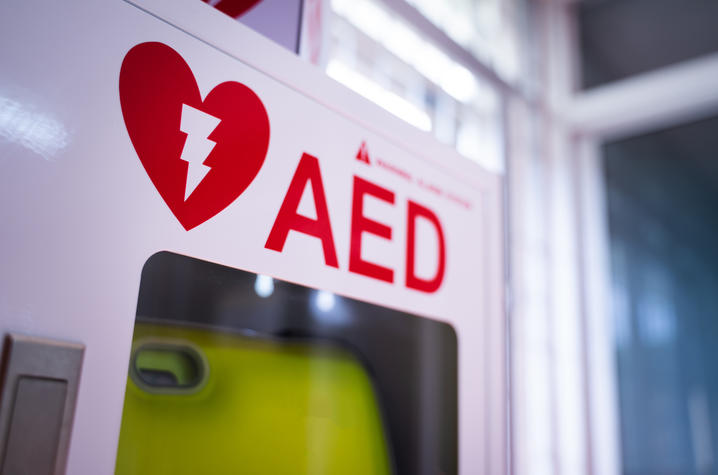
LEXINGTON, Ky. (Feb. 18, 2026) — Imagine you’re out in the community — in a school, at church or in the grocery store — and the unthinkable happens.
A person collapses; they’re not responding, and they don’t have a pulse. A quick-acting bystander starts CPR while another calls 911. Fortunately, this place is equipped with an automated external defibrillator (AED). Following the machine’s instructions, these helpers place the pads on the person’s chest, standing clear as it sends a shock to the heart. CPR resumes until emergency services arrive to whisk the patient away to a nearby hospital — taking the AED with them. As quickly as this ordeal begins, it seems to be over. Now what?
The job of the AED — a small, unassuming little box with a battery, cords and adhesive pads — is far from over. John R. Kotter, M.D., cardiologist at UK HealthCare’s Gill Heart & Vascular Institute and Shaun Mohan, M.D., electrophysiologist at Golisano Children’s at UK and medical director of its Project ADAM program talk about how an AED collects lifesaving data and continues to help patients long after the shock is delivered
UKNow: How exactly does an AED work?
Kotter: AEDs work by delivering an electric shock through the chest to the heart when it detects an abnormal rhythm and tries to restore the rhythm back to normal. The best thing about them is that they’re so easy to use. If you’re in a situation where somebody has a cardiac arrest and there’s a defibrillator around — and you’ve never seen it, you don’t know how to use it — you can figure it out. All you do is push the power button to turn it on, it will start talking to you and tell you what to do. It will tell you to stop CPR so it can analyze the heart’s rhythm. And if the person needs to be shocked, it will tell you to push the flashing button. Keep following the instructions until the ambulance arrives.
UKNow: After the person is taken away by the ambulance, what happens to the AED?
Mohan: The AED typically will go with the patient to the nearest emergency department after it is used. Most modern AEDs will store information — the cardiac rhythm of the patient during the resuscitation. Many are digital and do not always print the strips on paper, as is often depicted on TV shows.
UKNow: How is that data retrieved from the device?
Kotter: It depends on the vendor. The simplest way is to call the company who makes the AED and they can download and send the data. Or they’ll give you a security code to open the machine and access the data by inserting a flash drive to download an encrypted PDF. It’s pretty secure.
UKNow: How does that info help you make a treatment plan?
Kotter: Every time an AED is used, the physicians that are taking care of the person are going to want to know what the device recorded. There are a lot of possible reasons for a cardiac arrest. Probably one of the most specific reasons you worry about is a primary cardiac rhythm abnormality (arrhythmia). So, if you can tell that the person was having an arrhythmia at the onset of their cardiac arrest, you know the things to look for and what caused it.
The reason could be obvious, such as drowning. The heart stops because there’s no oxygen. Oftentimes, as the person is getting resuscitated, the rhythms that come back can be suggestive of a heart rhythm problem — but that really wasn’t the problem. The problem just was no oxygen to the heart muscle. There, context is easy. But if it’s somebody who just collapses, did they have a heart attack? Did they have a problem with their lungs? Did they have a blood clot? Was it some other thing that caused stress on the heart? And then the heart rhythm problem came second, or was this a heart rhythm problem that really came first?
Mohan: Obtaining the AED data can be very critical to management of a patient after the patient is brought to the hospital. It can tell the medical team about how long the resuscitation took place, and reviews of the electrocardiograms (ECG) from the AED can give an accurate rhythm diagnosis of the patient — was this a primary ventricular tachycardia, ventricular fibrillation? Or was the patient in another abnormal rhythm? In these instances, reviewing the ECG from the AED may clue in the cardiologists to a possible toxin ingestion, a blocked coronary artery or may even suggest an underlying genetic abnormality that predisposed the patient to the abnormal rhythm. The AED is just one piece of the puzzle when trying to determine the cause of a patient's cardiac arrest, but it is a critical piece if it was used in the field.
UKNow: What happens to the AED after that? Can it be used again?
Mohan: Once an AED is used, it is typically no longer able to be utilized again unless the previous data was downloaded and the pads are restocked and cleaned. Until the AED is serviced, downloaded and tested to ensure it is functional, it cannot/should not be used again.
Kotter: Somebody in the hospital will take care of getting the device back to wherever it came from. People want the device back, because once they’ve had to use it, they understand how important it is to have and want to be ready in case they have to use it again.
UKNow: For places that have AEDs, how often should they inspect them and how are they maintained?
Mohan: Typically, AEDs are supposed to last eight to 10 years, but that does not include the battery or the pads included in the AED. The battery may run low and need to be replaced if it is used on more than one occasion. The pads should be replaced after the AED is used; this is the responsibility of the personnel who should be maintaining the AED.
Most public places or venues that have an AED typically should be checking and maintaining their AEDs once a year. This includes ensuring the battery does not need to be replaced and the pads are replaced and ready for immediate use. However, in private businesses such as gymnasiums, sports arenas, restaurants there may not always be system in place to periodically check the AEDs.
UKNow: What else should people know about using AEDs?
Mohan: Many people in the community are worried about using “adult” pads on a child or infant. If there is only one set of pads in the AED — usually will be adult sized — it is fine to use those pads on a child and perform CPR, but EMS/911 should be contacted immediately.
Kotter: CPR with only chest compressions can be very effective. Using an AED as part of CPR makes it more effective. A lot of places have AEDs; you’ll notice they’re everywhere. But there can be hesitancy for somebody to use it. You look around and you’re like, “I don't know if this is right.” And then all of a sudden, everybody’s watching and nobody wants to be the person who takes initiative to say, “This is definitely the right thing to do.” We need people to feel confident and say, “Yes, we need to do something.”
***
More than 350,000 cardiac arrests occur outside of the hospital each year. Bystander CPR can double or triple the chance of survival. When an AED is applied by bystanders before EMS arrival, survival rates increase even more.
The Project ADAM program at UK Golisano Children’s helps schools and community centers throughout central Kentucky prepare for cardiac emergencies. Schools that work with Project ADAM earn a Heart Safe School designation, which indicates to the public that school staff are trained and prepared to respond to a cardiac emergency. The designation includes placement of AEDs within a school building, implementation of a cardiac emergency response plan, AED drills and education of school staff on the warning signs and prevention of sudden cardiac death.
UK HealthCare is the hospitals and clinics of the University of Kentucky. But it is so much more. It is more than 10,000 dedicated healthcare professionals committed to providing advanced subspecialty care for the most critically injured and ill patients from the Commonwealth and beyond. It also is the home of the state’s only National Cancer Institute (NCI)-designated Comprehensive Cancer Center, a Level IV Neonatal Intensive Care Unit that cares for the tiniest and sickest newborns and the region’s only Level 1 trauma center.
As an academic research institution, we are continuously pursuing the next generation of cures, treatments, protocols and policies. Our discoveries have the potential to change what’s medically possible within our lifetimes. Our educators and thought leaders are transforming the healthcare landscape as our six health professions colleges teach the next generation of doctors, nurses, pharmacists and other healthcare professionals, spreading the highest standards of care. UK HealthCare is the power of advanced medicine committed to creating a healthier Kentucky, now and for generations to come.