


From the classroom to the operating room and back again
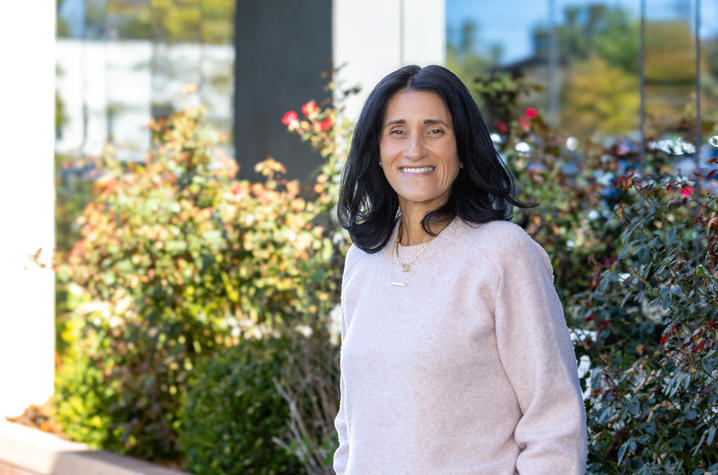
LEXINGTON, Ky. (Dec. 5, 2025) — It was an ordinary spring day at Knox Central High School, where Jen Riley works as a counselor.
Just before the school day wrapped up, she and her colleagues participated in their students’ mock trial. While sitting in the classroom, she suddenly felt sick and feverish. After finishing her part of the trial, she excused herself from the classroom and went back to her office. There, she felt a sudden and intense pain in her side. It felt familiar, like when she had an ovarian cyst rupture, resulting in ovarian torsion that required emergency surgery.
“It’s happening again,” Jen thought as she rested her head on her desk. She looked at her watch. It was 2:40 p.m. School would be dismissed in a few minutes; she wondered if she could bear the 45-minute drive back to her home in London. Soon the pain and nausea were intolerable. Something was different this time. Something wasn’t right. She asked her colleagues to call an ambulance. Jen looked at her watch as the ambulance headed toward the local hospital. It was just before 3 p.m.
The next thing she remembered was waking up five days later, 107 miles away.
‘The helicopter will be here in 12 minutes.’
Jen has no memory of being in her local hospital, or of the arrival of her husband, Shawn. He said he remembers how sick his wife looked, and how quickly the situation changed. After a series of imaging and tests, Shawn was told that a helicopter would pick up his wife. It was 12 minutes out, they said. Twenty-eight minutes after that, Jen would be at the University of Kentucky Albert B. Chandler Hospital, where a surgical team was waiting for her.
Shawn wasn’t allowed to ride in the helicopter with her, nor could he make the drive to Lexington to be there in time when it arrived. So, he called Jen’s son Hunter, who lived in Berea.
“I got a call from Shawn saying, ‘Your mom is flying to the hospital,’” Hunter said. “I got there pretty much when it landed. She’s out of it, but she’s still talking to me. Then a surgeon comes in and says, ’We’re going to do a surgery to save your mom’s life.’”
Until then, Jen, Shawn and Hunter believed the problem was with Jen’s remaining ovary, since the pain and symptoms were like her previous episode. Hunter realized this was something far more serious.
“I get a call at midnight saying mom needs surgery, I show up, and within five minutes they tell me that she could pass and be gone,” he said. “So, I had that window to see my mom. I was on my knees and prayed in the waiting room.”
Two surgeries followed by a long road to recovery
Several years prior, Jen had weight loss surgery at another hospital. Any surgical procedure comes with the risk of developing complications. With bariatric procedures such as gastric bypass, one potential complication is an internal hernia. The intestines are held in place by the mesentery, a fold of membrane that houses the blood supply to the intestines. Even though Jen was following her post-surgery protocol and nutritional regimen, a section of her small intestine was pushing through an opening in the mesentery, gradually twisting on itself and compromising the small intestine’s blood supply. It was like a ticking time bomb, threatening the surrounding organs, and ultimately, her life.
Shortly after arriving at UK Chandler Hospital, Jen was rushed into surgery just after midnight — and not a moment too soon. If anything had delayed her arrival, even by just a few minutes, doctors said Jen Riley wouldn’t be here to tell her story.
Her surgical team, led by William B. Inabnet III, M.D., the surgeon-in-chief at UK HealthCare who specializes in endocrine, metabolic and weight loss surgery, assessed the condition of Jen’s small intestine. Because it had become so twisted and compromised, the blood supply had become completely and irreversibly cut off, and a considerable section of her small intestine was dead. Acting quickly, they removed the damaged tissue.
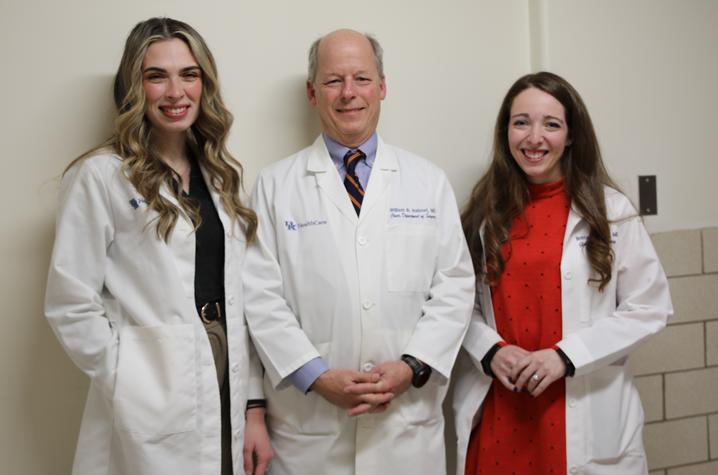
Inabnet and his team, including chief residents Brittany Levy, M.D. and Reagan Setser, M.D., had to remove around 60% of Jen’s small intestine in a procedure called damage control laparotomy (DCL). Jen was in critical condition, and the DCL would stabilize her — the repair of her digestive tract would have to come later. The remainder of her small intestine and the surrounding organs were so swollen that it was difficult to assess the scope of the damage. For three days, Jen was in “intestinal discontinuity,” meaning the two ends of her small intestines were left disconnected and her abdomen left open to allow the swelling to subside.
“The big difficulty was after that initial surgery to remove the necrotic bowel that had twisted on itself,” said Hunter. “They removed that, but she needed time to heal before they could connect the two ends. It was three days where her bowels weren’t connected, and they need to keep her under the whole time. That was the hardest part of it all for me — those three days of anticipation because if the swelling doesn’t go down, they wouldn’t be able to reconnect her, and that would be even more days she’s under anesthesia.”
In a real-life demonstration of teamwork and collaboration, Brittany N. Wheelock, M.D., an acute care surgeon and intensivist who was managing Jen in the ICU, worked with Levy to perform Jen’s second surgery. The team assessed the viability of her small intestine and then safely reconnected.
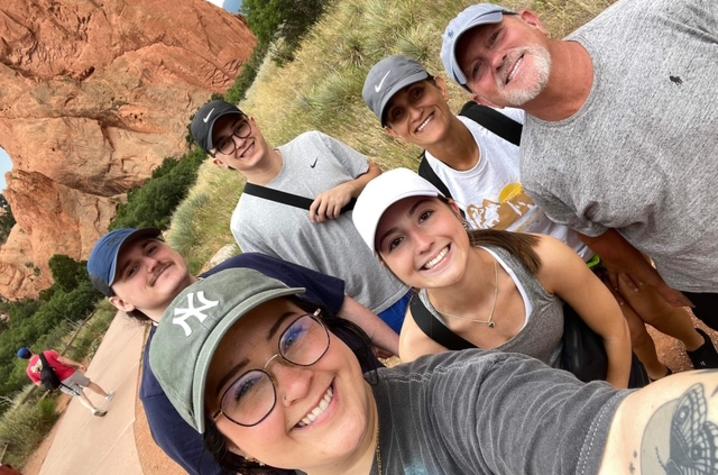
Five days after her emergency flight to Lexington, Jen woke up. Shawn and Hunter were there, along with her daughter-in-law Marissa, her other son Hayden and his wife Miranda. Her son Ty and his girlfriend Grace had just returned to their home in Georgia. Though Jen doesn’t remember them being there, she took immense comfort in knowing her whole family was together and there for her when she needed them the most.
Shawn and Hunter told her everything that had happened, as her last memory was of the local hospital near her school. She spent the next 10 days in the hospital, first taking fluid and nutrients through a feeding tube before her intestines were tasked with digesting and absorbing soft foods. Hunter stayed with her, helping her to the bathroom, communicating with her care team and researching the next phases of her recovery. Looking back on those days, Jen was overcome with gratitude.
“That’s what I really reflect on,” she said. “He came in at this age, a young adult who really hadn’t experienced any real trauma like this. And he’s had to make these quick decisions — ‘Yes, I’ll sign this. Yes, we’re gonna do this.’ And hand the care of his mom off to complete strangers.”
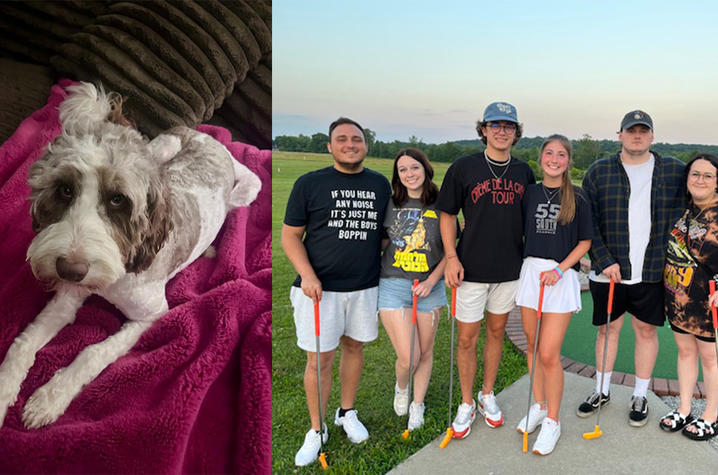
Aside from the physical ordeal, Jen struggled emotionally. She thought about her four dogs Willow, Tru, Polly and Mae, her job and when — or if — she could return to work. She thought about her son Ty, who just started a new job in Georgia and was desperate to come back to her bedside. And how Hunter worked his remote job from her hospital room while also researching what her new “normal” could look like, from the prospect of a colostomy bag to nutrition and home care.
“It was like a whirlwind, because all I could recall was sitting in that classroom, and I got sick,” Jen said. “I went from that to having 18 staples in my stomach and having to use the bathroom 5,000 times a day.”
She missed her home and her dogs. She was sick and tired of being sick and tired. One night, after watching a video of her dogs Shawn had sent, Jen broke down. She recalls one of her nurses holding her as she cried.
“I was like ‘I just gotta go home,’” she said. “And the nurse said, ‘We’re going get you home.’ She said, ‘First, you’re going to get a really good bath and your husband's going to bring you some clean clothes. Then we’re going to focus on walking and focus on your food. But the first thing we're going to do tomorrow is we’re going to change our mindset.’ And that just speaks to her as not just a nurse, but as a human. They’re not just providing that physical care; they could really say something that kind of shifts your thinking and promote your healing.”
Seeing her dogs on Facetime gave her the resolve she needed. It was time to get to work and go home.
Gradually, with her vast care team of surgeons, nurses, nutritionists, physical therapists and countless other providers and staff cheering her on, Jen got stronger. Fifteen days after the mock trial at Knox Central High School, the ambulance ride, the helicopter ride and the back-to-back surgeries that saved her life when she was hours from death, Jen Riley went home.
Reflection, gratitude, and a renewed purpose
“What I didn’t recognize at the time was that going home did not automatically mean ‘good as new.’ It just meant I was no longer critical,” said Jen. “It took me a while to come to terms with the fact that I still had a lot of healing to do once I made it home.”
Far from out of the woods, Jen still relied on medication and a careful nutrition program as her intestinal tract slowly healed.
About three months later, Jen was back at work, just in time for her students’ graduation. The warm reception from her students felt as medicinal as the care at UK Chandler Hospital, motivating her to follow her recovery plan to the letter.
“The moment I got back, kids were coming down, saying, ‘My gosh, Ms. Riley, we heard you were so sick,’” she said. “So that restored me. I’ve got to take this shot, eat what they’re telling me, take my vitamins because I do serve a purpose. I have kids that are dependent on me and who care about me. I have a responsibility to them, not just to myself.”
Jen is back at work full time, back with her dogs and back to her beloved hobby — painting. Her body is still healing, so she has to take it easy and follow a strict nutrition protocol. As traumatic as her ordeal was, she remembers with fondness every member of her care team and how every employee she interacted with — surgeons, nurses, nutritionists, other staff members — made her feel safe and her family feel at ease.
This wasn’t something any of them expected from a massive hospital system like UK HealthCare. Jen and her family had complete trust in her care team and the direction of her care. They, in turn, trusted Jen and her family, knowing their questions and concerns weren’t a challenge, but rather a genuine ask for understanding.
“We’re used to smaller hospitals,” she said. “It’s kind of amazing for a system so big. They do what they say they’re going to do. They genuinely cared whether I made it out or not. They were giving everything to a complete stranger.”
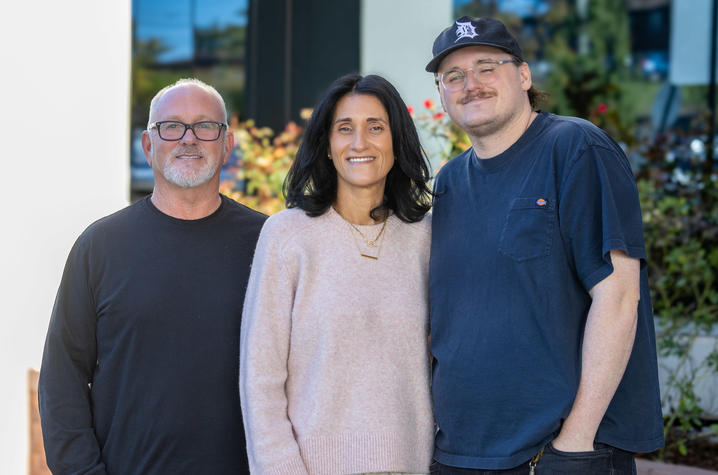
Hunter and Shawn, still active members of Jen’s care team who accompany her to her appointments, echo the sentiment. Hunter said whenever he had questions, his mother’s care team was very forthcoming.
“It was incredibly valuable when you have people like that, because it quells so much of the worry,” Hunter said. “Just being able to understand what’s happening is a huge part of it. There are a lot of moving parts, and they were more than willing to answer any and everything. It took a lot of people’s time, but everyone was fantastic.”
Jen has regular check-ins with Inabnet every few months. There are times when she feels frustrated with her recovery, but Inabnet and his team remind her of the incredible strides she’s made in such a short time.
“Jen is a model patient who is an inspiration to the UK team who had the privilege of caring for her,” said Inabnet.
“He gave me a lot of hope,” Jen said. “He could see even the smallest improvements and tell me that I was always better than the previous point. That really matters, because it’s easy to feel lost, especially at six months out where it feels I’m not making any progress. In my mind, I should be the active person I was six months ago, eating whatever I want with no problems. But he says looking back and looking at you now, what I see is completely different.”
UK HealthCare is the hospitals and clinics of the University of Kentucky. But it is so much more. It is more than 10,000 dedicated healthcare professionals committed to providing advanced subspecialty care for the most critically injured and ill patients from the Commonwealth and beyond. It also is the home of the state’s only National Cancer Institute (NCI)-designated Comprehensive Cancer Center, a Level IV Neonatal Intensive Care Unit that cares for the tiniest and sickest newborns and the region’s only Level 1 trauma center.
As an academic research institution, we are continuously pursuing the next generation of cures, treatments, protocols and policies. Our discoveries have the potential to change what’s medically possible within our lifetimes. Our educators and thought leaders are transforming the healthcare landscape as our six health professions colleges teach the next generation of doctors, nurses, pharmacists and other healthcare professionals, spreading the highest standards of care. UK HealthCare is the power of advanced medicine committed to creating a healthier Kentucky, now and for generations to come.