


From collapse to recovery: AED and teamwork save Lexington pastor’s life
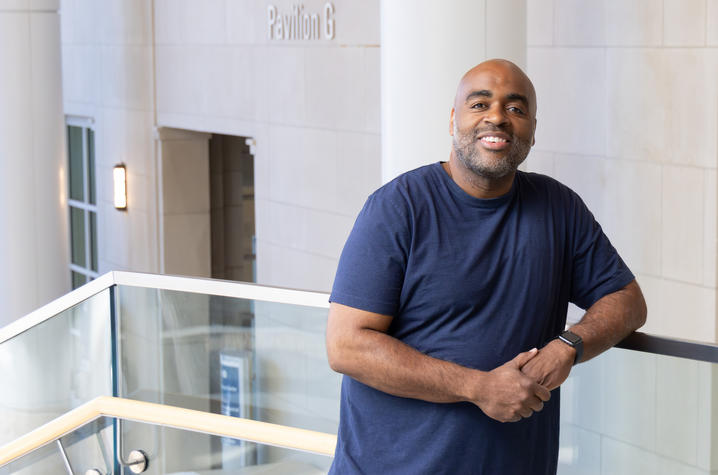

LEXINGTON, Ky. (June 17, 2026) — It was a busy December day for Tyrone Vinegar, a pastor at a Lexington church, but nothing about it seemed out of the ordinary.
His to-do list consisted of a trip to the Cincinnati/Northern Kentucky Airport to drop off a missionary. Then he was heading back to Lexington for a meeting at Cardinal Valley Elementary School.
When he arrived at the school, he was introduced to some of the staff. The next thing Vinegar remembers is waking up in an emergency room at the University of Kentucky Albert B. Chandler Hospital.
“It didn’t feel like anything was wrong earlier that day,” Vinegar said. “I walked through the front door of the school and remember shaking the hand of someone I was planning to meet with. Then I woke up in the hospital, it’s hard for me to remember anything else.”
The meeting Vinegar was attending was after-school hours, so there weren’t any students around. School staff recall Vinegar collapsing, falling straight back and hitting his head. They immediately jumped into action to help him and recognized Vinegar was in sudden cardiac arrest and didn’t have a pulse.
“I heard the fall from where I was and immediately ran over to him,” said Christina Tipton, an employee at Cardinal Valley Elementary. “His eyes were beginning to roll back and he was making gasping air noises. At that point, I announced to the office staff that they needed to get the nurses right away, we are very lucky to have the Health First Clinic located in our building.”
In most cases, sudden cardiac arrest can be identified by a person being unresponsive, not breathing normally or having no pulse.
“When he stopped responding to my voice, I checked for a pulse and could not locate one,” Tipton said. “I have renewed my CPR/First Aid training many times, most recently this past August, and I was so glad for that refresher. While I knew the situation was dire, I really wanted the medical expertise of the nurses to make the final call to start the AED. You never truly know when you are going to use those skills, but in that moment, the training just takes over.”
Tipton and the school nurses acted quickly beginning CPR, calling 911 and administering an automated external defibrillator (AED).
“The AED told the school nurse exactly what to do and they delivered two different shocks to Vinegar,” said John Kotter, M.D., cardiologist at UK HealthCare’s Gill Heart & Vascular Institute. “They revived him and his pulse returned by the time the ambulance arrived to take him to the hospital. The people at the school saved his life.”
Kotter was called in to meet Vinegar at the UK Chandler Emergency Department. His goal was to assess Vinegar to try and figure out what caused the medical emergency to happen.
“Once you know what happened and why it happened, it lets you treat patients more appropriately to prevent anything like this in the future,” Kotter said.
Once Vinegar regained consciousness at the hospital, he was confused at first but then he felt completely fine, almost as if nothing had ever happened.
“I felt like I could have been discharged,” Vinegar said. “But I knew something serious had happened and I needed to be monitored to figure out why this happened and what things would look like moving forward.”
Vinegar spent five nights at UK Chandler Hospital being monitored and meeting with doctors to decide the best treatment to get him back to his regular routines.
When an AED is used, data is saved to the system. This allows providers to access the data to help make decisions on the patient’s treatment.
From the AED data, Kotter and his team were able to see that Vinegar had an arrhythmia which caused cardiac arrest.
Vinegar explained he had just started taking the new medication three days before the cardiac arrest happened. When they were examining him, they also were able to diagnose an underlying heart condition called mitral valve preclusion.
The combination of the new medication and having an underlying heart condition is likely what caused the arrhythmia and sudden cardiac arrest.
Since the school acted quickly to begin CPR and using the AED, Vinegar doesn’t have any complications from his heart stopping. He didn’t require any major surgery or valve replacements.
“This is something that could’ve been tragic, not survivable or had lasting long-term impacts, but with the prompt CPR and defibrillation from the team at the school, he’s doing fantastic. It really is amazing,” Kotter said.
Vinegar’s care team decided the best option to make sure his arrhythmia is treated was to install an implantable cardioverter defibrillator, a small battery-powered device implanted into the chest to treat arrhythmias and prevent sudden cardiac arrest. Installing the device was a quick procedure with a fast recovery time.
“I’m just thankful people around me at the school jumped into action,” Vinegar said. “I got to go back and thank them and really let everyone know how much I appreciated them.”
For those who helped that day, the moment was a reminder of the power of teamwork and preparation.
“It is a very humbling feeling,” Tipton said. “I believe that God puts us in situations where we are needed, and I was simply in the right place at the right time. I’m just grateful that we were prepared and able to work together to give Tyrone a fighting chance.”
When Vinegar was released from the hospital, he needed to rest for a few days, but then he was able to get back to his normal routines.
“Even with my heart condition, life is just as rich as it was prior to,” Vinegar said. “The quality of life is not dropped because of what happened and I’m so grateful to be here. This gave me a new appreciation for life.”
Vinegar will continue to see his team of cardiologists at UK Gill Heart Institute for regular check-ups. He is now back to serving the Lexington community and doesn’t take his days for granted.
“We never know when our last day is,” Vinegar said. “But if we still have breath, we have the ability to make a change in our lives. I just want to encourage people who may feel like a medical issue has limited them or has stopped them, it may have stopped one thing, but it hasn’t stopped everything. We are able to make a perspective shift that can lead to a fuller life.”
UK HealthCare is the hospitals and clinics of the University of Kentucky. But it is so much more. It is more than 10,000 dedicated healthcare professionals committed to providing advanced subspecialty care for the most critically injured and ill patients from the Commonwealth and beyond. It also is the home of the state’s only National Cancer Institute (NCI)-designated Comprehensive Cancer Center, a Level IV Neonatal Intensive Care Unit that cares for the tiniest and sickest newborns and the region’s only Level 1 trauma center.
As an academic research institution, we are continuously pursuing the next generation of cures, treatments, protocols and policies. Our discoveries have the potential to change what’s medically possible within our lifetimes. Our educators and thought leaders are transforming the healthcare landscape as our six health professions colleges teach the next generation of doctors, nurses, pharmacists and other healthcare professionals, spreading the highest standards of care. UK HealthCare is the power of advanced medicine committed to creating a healthier Kentucky, now and for generations to come.