


Gill Heart helps patient ‘get over the hump’

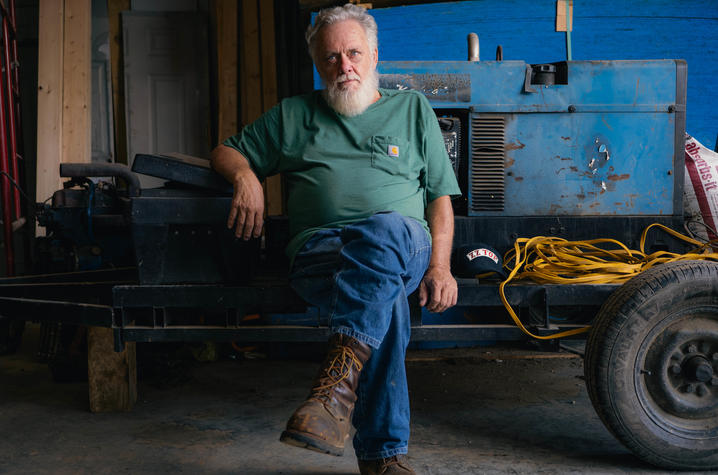
LEXINGTON, Ky. (Jan. 5, 2026) — Watching Stanley “Shorty” Carson climb into a massive bulldozer, drive it onto an industrial trailer and strap it down with nimble skill, you’d never guess he’s 69 years old.
You’d also never imagine that not long before, he was so run down by heart problems he could barely walk from his workshop to his pickup truck.
Carson has spent his life with a family history of heart disease hanging over his head.
His father died of a heart attack at age 56, leaving Carson and his four brothers wondering if they were destined for the same.
“Whenever we turned about 55 or 56, we went through a bad two years,” Carson said. “‘Are we going to get over this hump?’”
Carson wasn’t surprised when he began having serious heart issues in 2024, but he struggled to find answers.
That was until he got connected with cardiologist Navin Rajagopalan, M.D., and the experts at the UK Gill Heart & Vascular Institute.
‘I was basically drowning in my own fluid’
Carson is no stranger to hard work.
Following a long career as a coal miner, the Eastern Kentucky native retired and began an excavation business in Campton, Ky.
And business was good: there were plenty of opportunities for excavation work in the rapidly developing Red River Gorge area.
With his distinct drawl and straightforward demeanor, Carson proudly recalled numerous projects he’s undertaken since starting his business.
“If there’s a dollar to be made, I want to make it,” he said.
But Carson was forced to slow down when he began experiencing symptoms of congestive heart failure.
He was constantly fatigued, and his body was swollen all over.
Doctors prescribed several medications, but nothing was working.
“I was basically drowning in my own fluid,” Carson said.
Just as Carson began to fear the worst, a friend for whom he’d completed several excavation jobs suggested he seek help through UK HealthCare.
The friend helped Carson, who’d never been to a UK HealthCare clinic, ease his fears about being treated at a large academic medical center and helped him navigate getting an appointment.
“I thought, ‘Well, if I’ve got to go (to the hospital) I’d rather go there, because they should be some of the best,’” Carson said.
“And somebody said, ‘Well, they’re all young.’
“And I said ‘Yeah, but them young ones are training from an old one.’”
‘I'm here to aggravate you today’
When Carson arrived at Gill, Rajagopalan, whose patients often affectionately refer to him as “Dr. Raj,” worked with his team to determine some quick solutions.
They reassessed and streamlined Carson’s medication and remained in contact to assess how he was reacting to the new treatment. But Carson wasn’t responding.
Carson called registered nurse Stacy Ford — who stayed in touch directly with him — and told her, “This ain’t working.”
It became clear measures beyond medication were needed, and Ford helped Carson get admitted to UK’s Albert B. Chandler Hospital as quickly as possible.
The first step was draining more than 50 pounds of fluid from Shorty’s body with diuretics.
It was also clear that Shorty’s heart failure was worsened by episodes of atrial fibrillation, an irregular heartbeat that is quite commonly associated with heart failure.
Rajagopalan’s team consulted UK HealthCare electrophysiologist Kristin Ellison, M.D. Electrophysiologists are cardiologists who specialize in the treatment of heart rhythm disorders, of which atrial fibrillation is one of the most common.
Ellison performed a cardiac ablation procedure, which successfully restored Carson’s heartbeat.
“Our cardiology clinic values multidisciplinary care,” Rajagopalan said. “A team of doctors, nurse practitioners, nurses and pharmacists working together to make sure patients receive the optimal care is our priority. We make sure we have access so that when patients aren’t doing well or new patients need to be referred to UK, they can be seen quickly.”
Since his arrival at the Gill Heart & Vascular Institute, Carson has had “good days and bad days,” but the good days have exceeded the bad.
Those walks from his workshop to his pickup aren’t as taxing as they were a year prior, when Carson was worried his time was up.
Carson’s team at UK HealthCare is there when he needs it, and remains committed to helping him continue doing the things that give him joy.
“Fortunately, good people done good things,” Shorty said. “And I’m here to aggravate you today.
“I feel they have put me back to where I can finish up what I want to do in life and go on.”
UK HealthCare is the hospitals and clinics of the University of Kentucky. But it is so much more. It is more than 10,000 dedicated healthcare professionals committed to providing advanced subspecialty care for the most critically injured and ill patients from the Commonwealth and beyond. It also is the home of the state’s only National Cancer Institute (NCI)-designated Comprehensive Cancer Center, a Level IV Neonatal Intensive Care Unit that cares for the tiniest and sickest newborns and the region’s only Level 1 trauma center.
As an academic research institution, we are continuously pursuing the next generation of cures, treatments, protocols and policies. Our discoveries have the potential to change what’s medically possible within our lifetimes. Our educators and thought leaders are transforming the healthcare landscape as our six health professions colleges teach the next generation of doctors, nurses, pharmacists and other healthcare professionals, spreading the highest standards of care. UK HealthCare is the power of advanced medicine committed to creating a healthier Kentucky, now and for generations to come.