


Health Sciences outreach program helps amplify the voices of people with aphasia
LEXINGTON, Ky. (Aug. 11, 2026) — For many people living with aphasia, a trip to a coffee shop, restaurant or retail store can come with an added layer of anxiety.
Aphasia, often caused by stroke or brain injury, affects a person’s ability to communicate through speaking, understanding, reading or writing. It does not affect intelligence, but communication challenges can make everyday interactions more difficult.
In the UK Aphasia Lab at the University of Kentucky College of Health Sciences (CHS), students and community members are working together to help people with aphasia feel more confident re-engaging in a communicating society.
The Aphasia Lab’s community outreach program helps people with aphasia feel more confident returning to places they enjoy while educating local businesses and organizations about communication accessibility. The initiative has reached more than 25 community locations across Central Kentucky, from coffee shops and restaurants to first responders, churches and public transportation services.
The idea for the program began with a simple, but powerful, conversation.
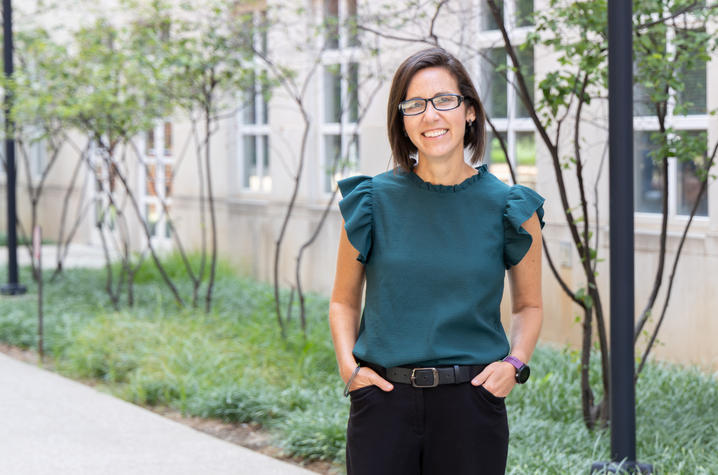
Christen Page, Ph.D., associate professor in the CHS Department of Communication Sciences and Disorders, leader of the Aphasia Lab, remembers meeting with a client who was frustrated after a negative interaction while shopping.
The woman, who has aphasia and apraxia of speech following a stroke, struggled to verbally provide her ZIP code during a credit card transaction. The cashier, unfamiliar with aphasia, became impatient.
“I realized this cashier had not been trained,” Page said. “They do not know about aphasia and apraxia of speech or the best techniques to assist someone who is finding communication challenging. So how can I expect her to act any differently? And then I thought, ‘I’m going to work on educating the community.’”
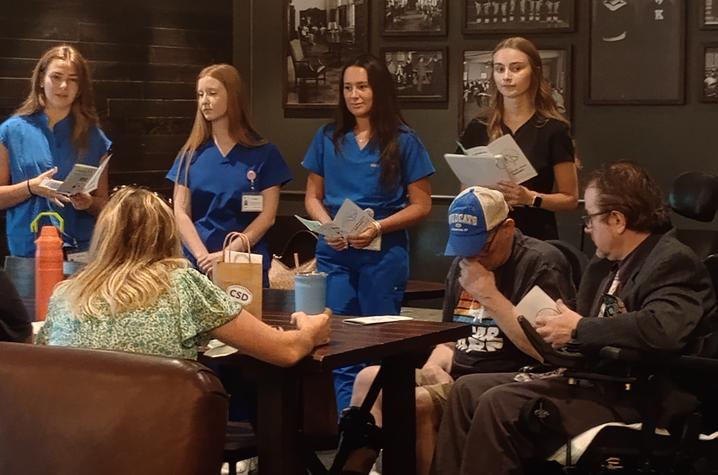
That moment sparked an academic-based service-learning project that pairs first-year graduate students with people living with aphasia. Together, they identify places in the community where communication barriers exist and create customized educational training for employees and staff.
The model is built around a simple philosophy: people with aphasia are the experts in their own experiences.
“Each of these projects involves a person with aphasia,” Page said. “They’re the experts related to their aphasia.”
Students meet with their partners multiple times, learning about their lives, communication needs and goals before helping develop training materials tailored to specific settings. The trainings cover what aphasia is, common communication challenges and practical strategies employees can use to support conversations.
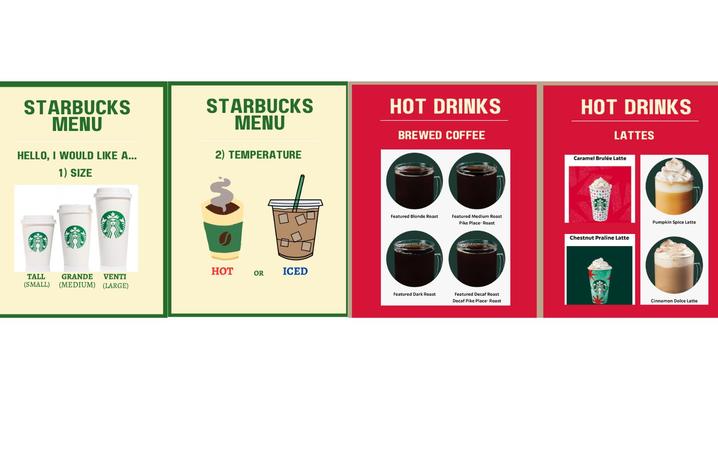
At Starbucks locations, for example, students and community members collaborated to create aphasia-friendly menus featuring pictures, larger print and additional white space to make ordering easier. The menus allow customers to point to items or use visual supports if speaking is difficult. Starbucks remains one of the outreach program’s most frequent partners because it is a favorite destination for many Aphasia Lab participants.
“For many people, Starbucks is much more than a coffee shop. It’s a place to meet friends, part of their routine and part of the community,” said Olivia Stevens, a communication sciences and disorders graduate student. “For my client, ordering at Starbucks represented participation in everyday life. Communication barriers shouldn’t prevent someone from enjoying those experiences. Supportive strategies can help those interactions become much more accessible.”
The Starbucks employees were incredibly welcoming and engaged throughout the training, Page said. The teams were open to implementing simple communication strategies, and they recognized that many of these techniques could benefit a wide variety of customers.
“Simple changes can have a big impact,” Stevens said. “Visual menus, written choices, allowing extra time to respond and using supportive communication techniques can reduce communication barriers and make someone feel understood rather than rushed. These strategies not only improve communication but also help individuals maintain a sense of belonging.”
Another student partnership focused on Keeneland Racecourse, where a participant wanted to continue enjoying race days despite communication challenges.
Working together, the team developed visual tools that simplified the betting process through photos and key words. They then trained Keeneland staff on strategies to support guests with aphasia.
“We’ve actually prepared a way for individuals with aphasia to bet using photos and just single words,” Page said. “We went to Keeneland where they used the strategies.”
The impact extends well beyond individual locations.
Research conducted through the program found that community members leave training with a stronger understanding of aphasia and practical communication techniques they can use in everyday interactions. The most frequently reported strategies include speaking more slowly, allowing extra response time, using visual supports and practicing patience.
For people with aphasia, those small changes can make a significant difference.
Communication barriers often contribute to social withdrawal, isolation and reduced participation in activities people once enjoyed. By creating more aphasia-friendly spaces, Page hopes individuals feel safer and more comfortable engaging in their communities.
“Everybody wants a safe place,” said Page. “They want to feel welcome, whether it be in the classroom or out in the community. You just want to feel safe, and that’s what I hope we’re starting to create.”
The outreach effort is also shaping the next generation of speech-language pathologists.
“This experience reinforced that our role as speech-language pathologists goes beyond the therapy room,” Stevens said. “Creating communication-friendly communities can have a very meaningful impact on a person’s quality of life. It reminded me that advocacy and education are essential parts of our job.”
According to Page’s research, students who participate in the program develop a deeper understanding of aphasia, stronger advocacy skills and a greater appreciation for person-centered care. Rather than focusing solely on communication impairments, they learn to see individuals first.
“When they meet a person with aphasia, they learn that this person is a person,” Page said. “They’re not only focused on the aphasia aspect. They’re focused more on the person and how they can help them participate in life despite aphasia.”
Looking ahead, Page hopes to expand the outreach program through online training modules and additional partnerships with restaurants and businesses across Kentucky. She also envisions creating aphasia-friendly business recognition stickers so participants can easily identify locations where staff have received training.
Ultimately, her goal is simple: ensure people with aphasia feel heard, valued and included wherever they go.
“We live in a communication society, and I couldn’t imagine someone taking my voice,” Page said. “I just want everyone to feel welcome.”
The Aphasia Lab exemplifies the College of Health Sciences’ commitment to improving lives through education, research and community engagement. The lab will continue to empower people with aphasia and equip students to become compassionate advocates.
“What makes the Aphasia Lab so special is its commitment to putting people first,” said Phillip Gribble, Ph.D., dean of the College of Health Sciences. “This work reflects the mission of the college and demonstrates how UK can help build stronger, more welcoming communities throughout Lexington and across Kentucky. I’m very proud of this team and the difference they are making.”
Communicating with someone with aphasia
Page said a few simple strategies can help make conversations more successful:
-
Give the person extra time to respond — often five to 10 seconds.
-
Speak clearly and at a comfortable pace.
-
Write down key words or use pictures and visual supports.
-
Confirm understanding throughout the conversation.
-
Most importantly, remember that aphasia affects communication, not intelligence.
As the state’s flagship, land-grant institution, the University of Kentucky exists to advance the Commonwealth. We do that by preparing the next generation of leaders — placing students at the heart of everything we do — and transforming the lives of Kentuckians through education, research and creative work, service and healthcare. We pride ourselves on being a catalyst for breakthroughs and a force for healing, a place where ingenuity unfolds. It's all made possible by our people — visionaries, disruptors and pioneers — who make up 200 academic programs, a $1.02 billion research and development enterprise and a world-class medical center, all on one campus.