


Keep kids’ vision in focus with screen-time balance
The University of Kentucky Public Relations and Strategic Communications Office provides a weekly health column available for use and reprint by news media. This week’s column is by Angela D. Houchin, M.D., assistant professor of pediatrics at Golisano Children’s at UK.
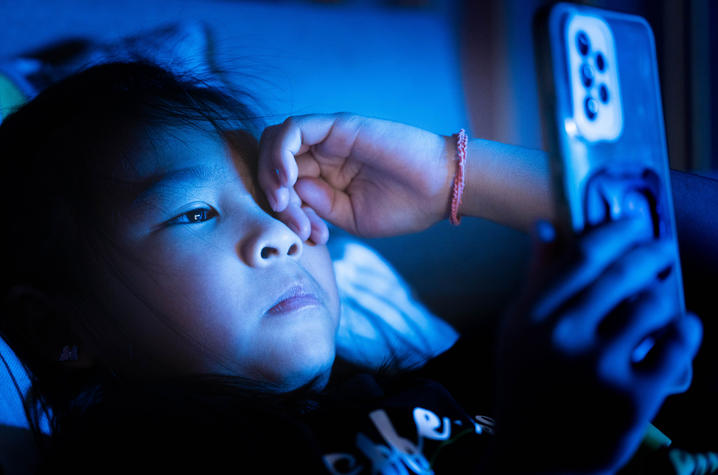
LEXINGTON, Ky. (Sept. 28, 2026) — In today’s world, screens are nearly impossible to avoid. They’re in our hands, in our cars and even in our household appliances. Screens help us stay connected, and children use them every day for learning, playing and communicating with others. But as screen time becomes part of daily life, it’s important to understand how it can affect children’s vision — and what families can do to help protect young eyes.
The American Academy of Pediatrics recommends no screen time for children younger than 2, and no more than one hour a day for children ages 2 to 5. But for older children, especially those who use school-issued laptops, it can be harder to set limits on screen time. After school, they may come home and spend additional hours staring at phones, tablets and TVs. Studies have shown excessive screen time is detrimental to sleep, brain development (including language and social skills), attention and focus, executive functioning, and physical activity. But there can be visual effects as well.
A study published by the American Academy of Ophthalmology found that rates of myopia, also known as nearsightedness, have nearly doubled since 1971. Evidence suggests the increase can be attributed to “near work” activities — tasks that require the eyes to focus on objects within arm’s reach. The growing amount of close-up screen use is one reason health care providers are paying closer attention to children’s vision. Myopia makes it harder to clearly see things far away and often requires corrective lenses. For many families, access to eye exams and the cost of glasses can be an added burden.
Too much screen time can also lead to eye fatigue, headaches, blurry vision, dry eyes and increased sensitivity to light. Gazing at the same distance for an extended time can cause the eye’s focusing system to spasm or temporarily “lock up,” a condition called accommodation spasm. When this happens, a person’s vision may blur when they look away from the screen. Constant exposure to blue light from screens can also make it harder to sleep.
Additionally, the development of stereoscopic vision — or 3D depth perception — can also be adversely impacted. Stereoscopic vision develops quickly during the first few years of a child’s life; the eyes learn to work together as a team, aligning and focusing on objects to visually map their world. As the eyes fatigue, it is harder for them to work together to focus and see things three dimensionally.
While it’s nearly impossible to avoid screens completely, there are easy steps to take to reduce the impact that screens can have on your child’s vision:
-
Set limits. Monitoring and limiting your child’s screen time is one of the best ways to reduce eye strain. Set clear boundaries, encourage regular breaks and avoid screens close to bedtime.
-
Model good habits. If you’re glued to your phone, your child will be too. Try to reduce your own screen time. Activities such as family walks or game night will give everyone’s eyes — and minds — a much-needed break.
-
Give your eyes a break. Try the 20/20/20 rule. After every 20 minutes of screen time, focus on something 20 feet away for at least 20 seconds.
-
Go outside. Studies have found that spending time outdoors — especially in early childhood — can prevent or slow the progression of nearsightedness. Outdoor play also gives children a break from screens while supporting physical activity, sleep, and overall health.
Screens may be part of modern life, but simple changes and clear boundaries can help children build healthy screen habits while protecting their vision for the future.
UK HealthCare is the hospitals and clinics of the University of Kentucky. But it is so much more. It is more than 10,000 dedicated healthcare professionals committed to providing advanced subspecialty care for the most critically injured and ill patients from the Commonwealth and beyond. It also is the home of the state’s only National Cancer Institute (NCI)-designated Comprehensive Cancer Center, a Level IV Neonatal Intensive Care Unit that cares for the tiniest and sickest newborns and the region’s only Level 1 trauma center.
As an academic research institution, we are continuously pursuing the next generation of cures, treatments, protocols and policies. Our discoveries have the potential to change what’s medically possible within our lifetimes. Our educators and thought leaders are transforming the healthcare landscape as our six health professions colleges teach the next generation of doctors, nurses, pharmacists and other healthcare professionals, spreading the highest standards of care. UK HealthCare is the power of advanced medicine committed to creating a healthier Kentucky, now and for generations to come.