


Tiny heart, big rescue: Pediatric heart team races to save newborn’s heart

LEXINGTON, Ky. (Sept. 9, 2026) – Parents always know when something’s not quite right.
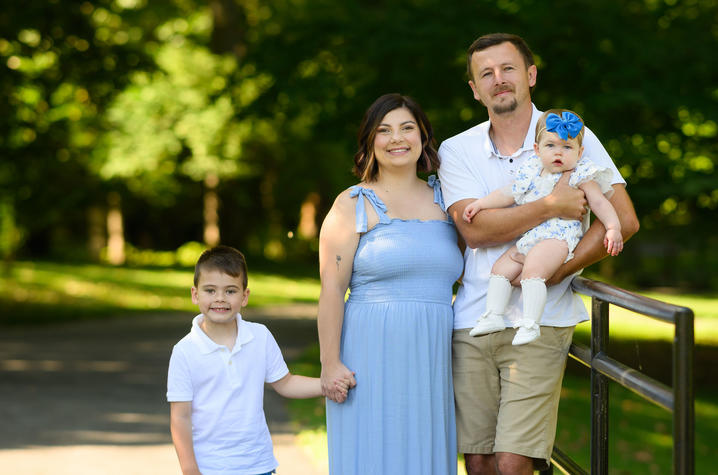
When Millie Wiseman was born in October 2025, her parents, Hannah and Justin, were told she had a heart murmur that should be checked out as soon as possible. Heart murmurs in newborns aren’t uncommon, but the Wisemans knew this was something else. Millie was acting very differently than her big brother Gunner did when he was born. She slept a lot, even for a newborn. Hannah struggled to wake Millie for feedings.
Just a few days after her birthday, Millie’s pediatrician put a stethoscope to her little chest. What she said next made Hannah and Justin’s blood run cold.
“She said it was the loudest murmur she’d ever heard,” said Hannah. “She was like, ‘You’ve got to get scheduled with UK as soon as possible.’”
The Wisemans made an appointment at the UK Joint Pediatric and Congenital Heart Program, a collaborative program between Golisano Children’s at UK and Cincinnati Children’s Hospital Medical Center. The program was created to give Kentucky families access to advanced pediatric and congenital heart care close to home, combining local convenience with the expertise of nationally recognized heart specialists. By bringing together physicians and resources from both hospitals, the program ensures children can receive exceptional, coordinated care without having to travel far from their communities. Tests revealed a chilling diagnosis: severe aortic valve stenosis.
Aortic valve stenosis is a rare but serious congenital heart defect. The aortic valve carries oxygenated blood out of the heart so it can circulate throughout the body. With aortic valve stenosis, that valve is very narrow, limiting blood flow. As a result, the heart has to work harder to squeeze blood through the narrow valve. Left untreated, the limited flow of oxygenated blood to vital organs can lead to organ dysfunction and, ultimately, organ failure.
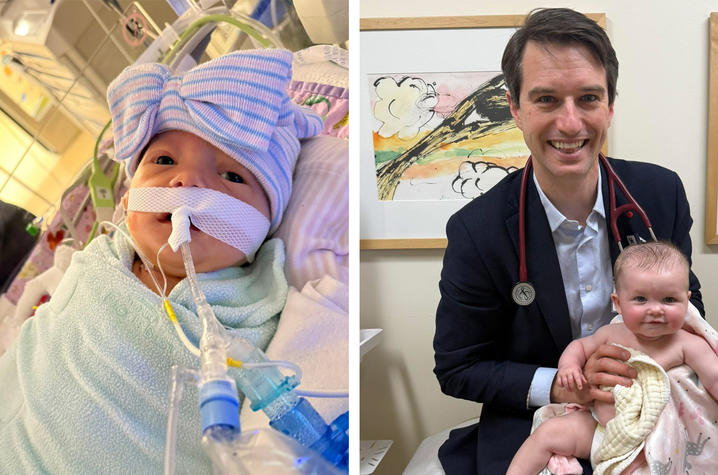
The Wisemans met Jess Randall, M.D., interim director of pediatric cardiology at Golisano Children’s at UK. Hearing the Wisemans describe how lethargic Millie had been, he decided she should be admitted right away for additional monitoring. Hannah and Justin were stunned.
“We went to this appointment, thinking we’d be in and out,” Hannah said. “We didn’t leave for six days.”
‘She looked perfectly healthy.’
Once admitted, Millie, now only seven days old, was hooked to a myriad of machines that monitored every strained heartbeat. For Hannah, the turn of events was overwhelming.
“It was a pretty serious thing to be hit with,” she said. “I was postpartum, just had a C-section. I’m still recovering myself. And we had a 4-year-old at home who thought we were just going to the doctor and coming right back. He was so upset. It was a lot at one time. Within days, our lives flipped upside down. I think I cried every tear that I had.”
Hannah’s mind raced back through every moment of her pregnancy and Millie’s birth. Everything had gone smoothly; nothing in her prenatal exams had shown that anything was wrong. But deep down, Hannah knew otherwise.
“I had a successful pregnancy, but I swear, I had a motherly instinct that something was wrong. I had a lot of anxiety leading up to the delivery, just a gut instinct that something wasn’t right. But we delivered her and everything seemed to be fine. She looked perfectly healthy.”
Hannah’s fears weren’t unfounded. When she and Justin met with Randall, he didn’t mince words about how serious Millie’s condition was.
“He was very kind and to the point, which I appreciated,” Hannah said. “He was very upfront about her needing surgery, what the risks were and that this was needed for her to survive.”
“Hearing that your baby — quite literally the most precious thing in the world to a parent — has a heart problem that can lead to severe complications and even death within the first year is terrifying for anyone,” said Randall, who estimates that of the approximately 50,000 children born in Kentucky each year, he sees two or three babies with severe or critical aortic stenosis. “To then have to tell them that we have to perform a procedure within the next few days, without much time to prepare, is another challenge. Hannah and Justin not only absorbed this massive load of frightening information with grace, they asked all the right questions and were clearly looking for the best next steps to keep Millie safe.”
In the hospital, Millie’s heart was in distress. When the monitors showed that she was experiencing symptoms not unlike a heart attack, Randall and the congenital heart team at Golisano Children’s at UK knew it was time to act. Millie needed a balloon aortic valvoplasty, an intensive procedure that requires two cardiac catheterization specialists in children her size. Randall consulted with his Cincinnati counterpart, Shabana Shahanavaz, M.D., medical director of Cincinnati Children’s Cardiac Catheterization Laboratory, and performed the procedure alongside Russell Hirsch, M.D., pediatric interventional cardiologist at Cincinnati Children’s. Typically, in a balloon aortic valvoplasty, a catheter is fed through the femoral artery in the leg into the heart. There, a balloon at the end of the catheter is inflated, pushing open the narrow aortic valve to allow blood to flow adequately. However, since Millie was only 11 days old and weighed just 6 pounds, Randall fed the catheter through the larger and more accessible carotid artery in her neck.
After a few harrowing hours, Randall came into the room where Hannah and Justin waited anxiously.
“He said, ‘She made it, and she’s doing great.’”
‘I’m going to take care of you.’
The joint pediatric heart care at Golisano Children’s at UK is among the top in the country, but Hannah and Justin describe a level of care that can’t be measured or ranked. Noticing that Hannah struggled to walk or sit comfortably following her C-section, one nurse scoured the hospital for a cot and pillows to prepare Hannah a makeshift bed in Millie’s room. When the patient family laundry units were temporarily out of service, another nurse helped ensure Hannah had clean clothes. These small touches brought the Wisemans immense comfort during a stressful time. But the gesture that stayed with them happened just as Millie was being prepared for surgery.
“We had a prayer cloth that we wanted Millie to have when she went down for surgery, but they’re particular about having things in there that aren’t sterile, which I understand,” Hannah said. “Our nurses put the cloth in a biohazard bag and taped it to her little incubator so it would be with her the whole time. So, things like that — the extra mile. They didn’t have to do that.”
‘He’s our superhero.’
Despite being so critically ill and requiring such a delicate and complex intervention, Millie only spent six days in the hospital. Three days after her catheterization procedure, Millie went home to Irvine where her big brother was waiting with open arms. Almost immediately, the baby who had previously been so sleepy and quiet showed her true personality: a smiley, happy little girl.
“She’s happy all the time,” Hannah said. “We say that she smiles all the time because she’s happy to be alive. I think she knows she’s a miracle and she’s happy because of it.”
Thinking back on that emotional week, Hannah and Justin recall the support they had from friends, neighbors — even total strangers. Every church in their community had their family on their prayer list, and people from all over Kentucky and beyond reached out to let them know Millie was in their prayers. To the Wisemans, those prayers felt like a powerful force — one that supported not only their family, but also the hands and hearts of the team caring for Millie.
“I felt God was in the room and guided their hands to make the best outcome for her,” said Hannah. “God sent the best providers.”
“The whole thing changed me,” said Justin. “It brought me closer to God.”
Nearly a year later, Millie is hitting her growth and developmental milestones. Randall says she’ll need to follow up with her cardiologist for the rest of her life and may need another procedure in the future.
“We said from the start that the aortic valve she was born with is unlikely to be the only one she has for the rest of her life, but the longer we can wait to intervene on it again, the better,” he said. “There are more options for therapies as she gets older, but we would hope that she will act very much like any other kid on the playground for a long time.”
The Wisemans are grateful for the providers who made them feel like family. Whether it was a hug, a shoulder to cry on or a makeshift bed so they could get some rest, Hannah and Justin felt like they were cared for as much as their daughter. But mostly, they are grateful that some of the best pediatric heart care in the country is so close to home — and for the expertise of Randall and his team who gave Millie the chance to grow, thrive and smile.
“He’s our superhero, honestly,” said Hannah. “We feel if it wasn’t for him, she wouldn’t be here.”
As the state’s flagship, land-grant institution, the University of Kentucky exists to advance the Commonwealth. We do that by preparing the next generation of leaders — placing students at the heart of everything we do — and transforming the lives of Kentuckians through education, research and creative work, service and healthcare. We pride ourselves on being a catalyst for breakthroughs and a force for healing, a place where ingenuity unfolds. It's all made possible by our people — visionaries, disruptors and pioneers — who make up 200 academic programs, a $1.02 billion research and development enterprise and a world-class medical center, all on one campus.