


UK Sports Cardiology helps marathoner back to chasing 50-state goal
LEXINGTON, Ky. (Dec. 11, 2025) — Two years ago, Brian Rice’s heart stopped while he was running a marathon in Kansas.
He collapsed on a red-brick road and suffered a cardiac arrest. Rice was just days away from his 56th birthday and was wearing a costume from the Netflix series “Squid Game.”
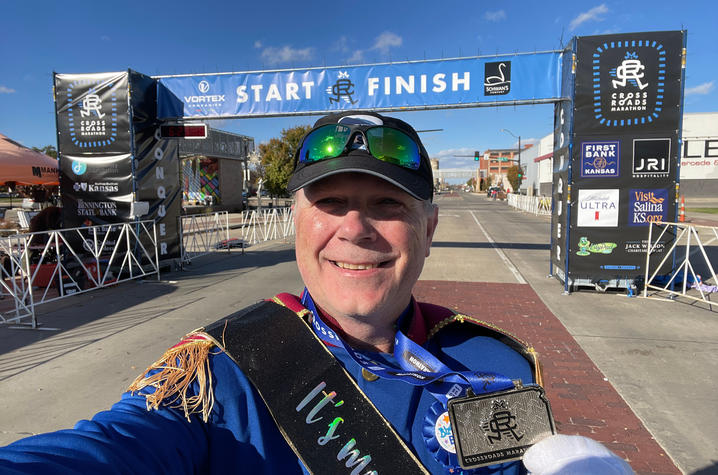
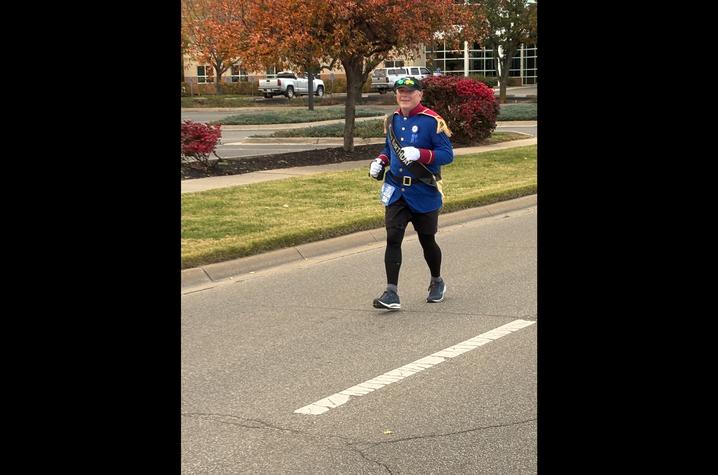
This past November, on his birthday, the now 58-year-old Rice was back at the starting line of the same marathon — the Salina Crossroads Marathon in Kansas. He was dressed as Prince Charming and added a sash that proclaimed, “It’s my BIRTHDAY."
“About 1,000 people wished me a happy birthday, and three people actually sang ‘Happy Birthday,’ to me,” said Rice, who this time crossed the finish line instead of waking up in a hospital bed.
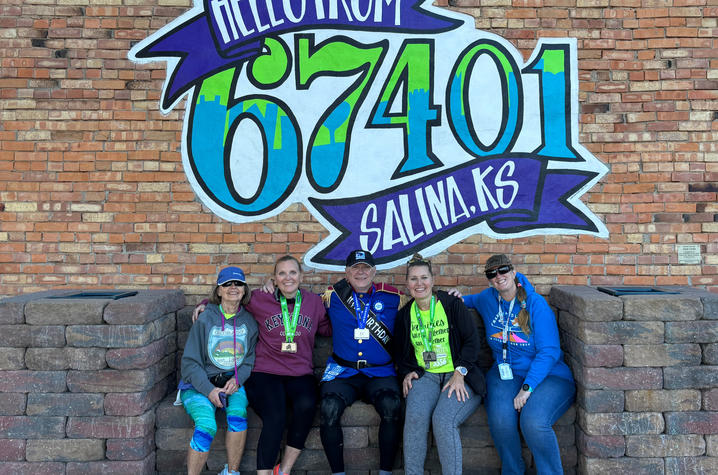
After he finished the race, Rice posed for photos with the two nurses who saved his life two years prior. In another nod back to that near-fatal moment, he laid down on the red bricks near the finish line and kissed them while holding up his finisher medal.
‘Don’t give up’
Back in 2023 — the last time he was face down on the ground in Salina — Rice fell near two other runners, who happened to be the nurses Tami Roets and Stephanie Lindsay. They administered CPR until paramedics arrived and took Rice to a nearby hospital, just a few blocks away.
At the hospital, Rice received an implantable cardioverter-defibrillator (ICD), an implanted device that serves as a pacemaker and can deliver a life-saving electric shock. A local TV station even interviewed Rice from his hospital bed. His takeaway from the ordeal: “Don’t give up.”
For several years Rice has been on a mission to run a marathon in every state. But when he got back home to Kentucky, he was worried his dream may elude him. Rice’s regular cardiologist told him that he should stop running.
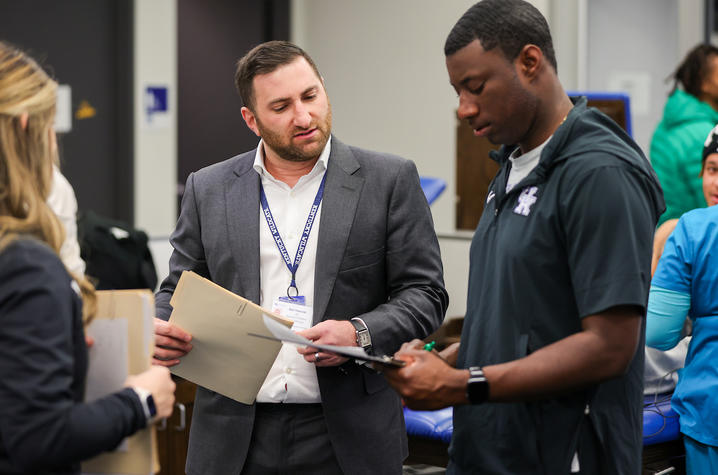
Rice sought a second opinion from Marc Paranzino, D.O., a cardiologist who established UK HealthCare’s Sports Cardiology Program, part of the Gill Heart & Vascular Institute. Paranzino worked to learn more about his new patient.
“We started from the beginning, and I looked at all of his risk factors for heart disease,” Paranzino said.
A plan comes together
Rice’s cardiac arrest in Kansas was not his first “run in” with heart trouble. Rice had a heart attack in 2010.
A blood test showed Paranzino that Rice’s genetic cholesterol marker — which is not tied to lifestyle or diet — was high. Then a cardiac MRI showed that Rice’s heart had a scar in the territory of where his old heart attack was.
“That is likely the reason why he had cardiac arrest,” Paranzino said. “The heart muscle does not like scarring. It likes healthy, electrically active tissue.”
Testing showed that one of Rice’s arteries was blocked, but because of the amount of running he was doing, his heart naturally formed its own bypass called a collateral.
“Running may have almost killed me, but it also saved my life,” Rice said.
Rice participated in a cardiopulmonary stress test. He exercised under medical supervision while wearing a mask that measured gas exchange and heart rate zones. With that data, physician and patient worked toward building a safe plan.
Rice could run, but just at a generally lower intensity with the aim of keeping his risk as low as possible.
“I think our job is to educate patients,” Paranzino said. “I don’t have a crystal ball, but I can tell you what I think your risk is and what we can do to lower it. It’s never going to be zero, but let’s find something that’s tolerable for you.”
For Paranzino, it’s rewarding to be able to help someone do something that is purpose-giving.
“Everybody who is running that much is doing it for a reason,” said Paranzino, an avid endurance athlete himself. “I think that’s part of the benefit of seeing a sports-specific cardiologist. I think patients just don’t want to be treated as just a cardiac patient. I think he sees himself as a runner who also happens to have heart disease.”
And running probably saved his life, Paranzino said.
A running journey
Rice started running with his wife, Leah, and eventually that developed into the goal of running 26.2 miles all at once — a single marathon. On mile 20 of his first marathon, tornadoes in the area of the course stopped the race before he could finish. He tried another race a few months later, was successful, and caught the running bug along the way.
“You don’t know what your body can do until you’ve done it,” Rice said.
He did the Disney Marathon in back-to-back years and just kept looking for races that sounded fun. Rice had heard about others trying to run a marathon in every state and after a marathon in Mississippi, decided that he wanted to attempt the challenge too.
“I thought there was no way I could run 50 marathons,” Rice said. “But I used to think it’d be impossible to run one marathon, but once you run one, you know you can do it.”
In 2018, he tackled 13 marathons in 13 different states. The next year he crossed off another dozen. A marathon in Louisiana had a costume contest, which Rice entered and won.
“I felt like I’d won the race,” Rice said, adding that it started a tradition for him to run every race in costume. “Running in costume makes people smile, and I like to bring miles of smiles.”
The pandemic and a bad ankle injury sidelined Rice for much of 2020, but he was still able to cross a couple states off the list.
“Running gives me life, it gives me purpose, and it just makes me feel good,” Rice said.
Now, at the end of 2025, Rice has finished a marathon in 37 different states. He has doubled up in some states and has totaled 48 marathons –— more than 1,200 miles raced, not including countless hours of training.
“A challenge like that is sometimes hard for people to wrap their heads around,” Paranzino said. “A lot of people just want to run one and done, but he’s trying for every state with heart disease on top of it. It’s something that I’m inspired by for sure.”
UK HealthCare is the hospitals and clinics of the University of Kentucky. But it is so much more. It is more than 10,000 dedicated healthcare professionals committed to providing advanced subspecialty care for the most critically injured and ill patients from the Commonwealth and beyond. It also is the home of the state’s only National Cancer Institute (NCI)-designated Comprehensive Cancer Center, a Level IV Neonatal Intensive Care Unit that cares for the tiniest and sickest newborns and the region’s only Level 1 trauma center.
As an academic research institution, we are continuously pursuing the next generation of cures, treatments, protocols and policies. Our discoveries have the potential to change what’s medically possible within our lifetimes. Our educators and thought leaders are transforming the healthcare landscape as our six health professions colleges teach the next generation of doctors, nurses, pharmacists and other healthcare professionals, spreading the highest standards of care. UK HealthCare is the power of advanced medicine committed to creating a healthier Kentucky, now and for generations to come.