


UK students partner with Shaker Village to explore design, landscape and place
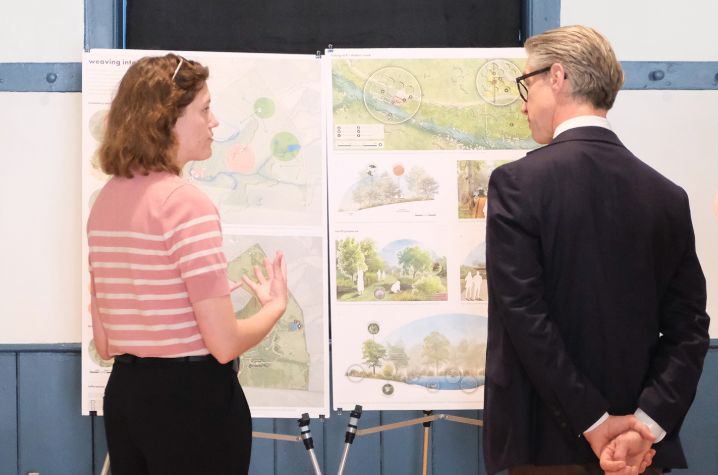

LEXINGTON, Ky. (May 26, 2026) — Students from the University of Kentucky College of Design and the Martin-Gatton College of Agriculture, Food and Environment (CAFE) recently shared design proposals created in partnership with Shaker Village of Pleasant Hill, one of Kentucky’s most significant historic and cultural landscapes.
The partnership involved students in the Senior Capstone Studio course, led by Jordan Phemister in the Department of Landscape Architecture at Martin-Gatton CAFE, and Design Studio VI course, directed by Jordan Hines, senior lecturer and design-build program coordinator in the School of Architecture. The studios explored how architecture and landscape architecture can reveal stories embedded in the land while supporting the future of the 3,000-acre site.
Students presented their work during “The Architectural Symposium at Shaker Village: Exploring Design, Landscape & Place,” which brought together students, design professionals and preservation experts to examine the connection between architecture, landscape and cultural history. The symposium also featured expert-led discussions and a keynote lecture by internationally recognized landscape architect Thomas Woltz.
“Shaker Village’s unique combination of historic architecture, conservation efforts, agricultural practices and public access makes it one of Kentucky’s most remarkable properties,” said Billy Rankin, president and CEO of Shaker Village of Pleasant Hill. “It also requires constant examination and strategic planning to provide a balanced approach to management. The students and faculty from the University of Kentucky have provided fresh insights through their thoughtful study of the village’s 3,000-acre property. During their spring studio projects, they have challenged norms, questioned approaches and provoked the types of discussion that lead to increasingly creative responses to the challenges of a diverse landscape.”
In the landscape architecture studio, students worked from a draft cultural resource management plan created by Liz Sargent Historic Landscape Architects. Using the plan’s character area analysis, Phemister identified six project sites outside the Historic Centre and asked students to develop creative, forward-thinking proposals that honored Shaker Village’s history while exploring new opportunities for visitation, education, exploration and sustainability.
“I am incredibly proud of the growth and work produced by these students over the semester,” Phemister said. “Senior spring is busy, hectic and bittersweet, and I have been impressed and inspired by their commitment to and investment in their projects.”
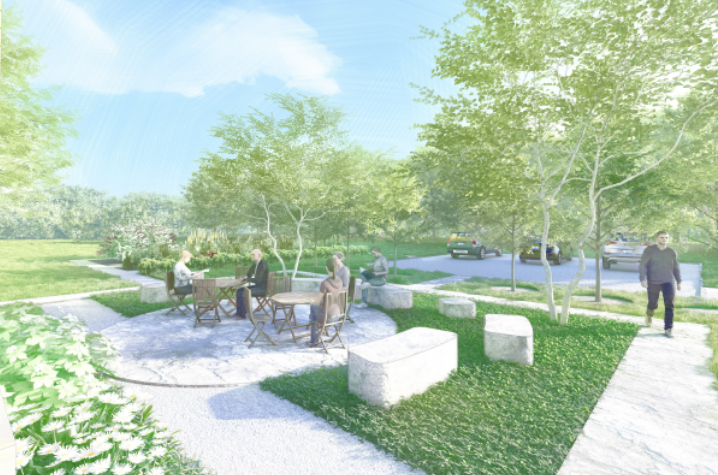
One landscape architecture proposal, developed by May 2026 graduate Tate Harberson, focused on the North Lot and Shaker Landing area. The design, titled “A View for All,” proposed a three-tiered trail system connecting the North Lot to the Historic Centre while expanding access to historic and cultural viewsheds. The trail network ranged from wide ADA-accessible paved paths to narrower foot trails, with interpretive signage and ecological restoration zones designed to make the site’s stewardship visible to visitors.
For Harberson, the project connected professional design training with a place he had known since childhood.
“This project allowed me to connect those early experiences with my skills I have developed the last four years at UK to create a really fulfilling and enriching project to work on,” Harberson said.
The architecture studio approached the partnership through a different but complementary lens. Students in the capstone course designed shared housing for seasonal employees, exploring how architecture could support community, collective responsibility and the daily life of those who help care for Shaker Village. Located adjacent to the historic village rather than within the preserved core, the site allowed students to engage Shaker ideas through contemporary methods while avoiding disruption to protected land.
May 2026 architecture graduate Ethan Smith’s “Post-Shakerism: South Dwelling Seasonal Employee Housing” reinterpreted Shaker philosophy for contemporary use. Preserving and grafting onto an existing barn, his proposal used light wells, rainwater collection, a social greenhouse and terraformed program areas to balance private living, shared gathering and connection to the agricultural landscape.
The project also challenged students to think about Shaker history as a living source of design inspiration rather than a fixed aesthetic to preserve or replicate.
“My hope is that the project inspires a more Shaker perspective on the future of Shaker Village,” Smith said. “To me, that means understanding Shaker methodology not as something fixed in the past, but as a radical and innovative way of responding to the needs of a particular time. I hope this approach invites new ways of connecting with Shaker Village through processes that are as forward-thinking today as the Shakers were in their own time.”
Working with a real-world client allowed Smith to practice community-based design, developing a space that worked not only as an architectural form, but also as a practical response to the daily needs of the people who would live and work there.
“We were able to have a very dynamic dialogue with the client regarding the programs and operations of the residents’ lives,” Smith said. “Where does land management equipment go? What about transport vehicles? In communal living, where do the public and private sectors depart one another? These questions became central through our engagement with the client and site.”
Harberson said conversations with Shaker Village staff also helped students understand both the organization’s current needs and its long-term vision.
“Working with Billy Rankin, Ben Laffew and the rest of the Shaker Village staff to understand and develop our idea made this one of the most realistic projects I have been able to work on in school,” Harberson said. “It really allowed us to understand the perspectives of the people who work and take care of Shaker Village, now and into the future.”
The partnership also gave Shaker Village a broad range of student-generated ideas to consider as it continues to balance preservation, public access, ecological stewardship and future development.
“My hope is that projects like this open more people’s eyes to the uniqueness and history of this place and that it pushes the boundaries for what Shaker Village could be in the future,” Harberson said. “Allowing students to explore and share big ideas for the site, from each of our unique perspectives, enriches the design process for the Shaker Village staff and donors moving into the future.”
Together, the studios offered Shaker Village more than speculative design. They created a shared conversation about how architecture and landscape architecture can honor the past, respond to present-day needs and help imagine a more sustainable future for one of Kentucky’s most treasured places.
To learn more about the UK College of Design and the Martin-Gatton College of Agriculture, Food and Environment, visit design.uky.edu and mgcafe.uky.edu respectively.
As the state’s flagship, land-grant institution, the University of Kentucky exists to advance the Commonwealth. We do that by preparing the next generation of leaders — placing students at the heart of everything we do — and transforming the lives of Kentuckians through education, research and creative work, service and healthcare. We pride ourselves on being a catalyst for breakthroughs and a force for healing, a place where ingenuity unfolds. It's all made possible by our people — visionaries, disruptors and pioneers — who make up 200 academic programs, a $1.02 billion research and development enterprise and a world-class medical center, all on one campus.