


‘Before your worst day’: UK’s CODE RED program offers new approach to suicide prevention
LEXINGTON, Ky. (Sept. 14, 2026) — Did you know suicide claims nearly 50,000 lives in the U.S. each year?
That’s one life every 11 minutes.
Behind that staggering statistic are individuals, families, friends, classmates, colleagues and communities — each left to navigate the devastating impact of suicide.
September is National Suicide Prevention Month — a time to raise awareness, reduce stigma and remind communities that suicide prevention is something everyone can be part of.
It also serves as a reminder that prevention can begin before a crisis occurs.
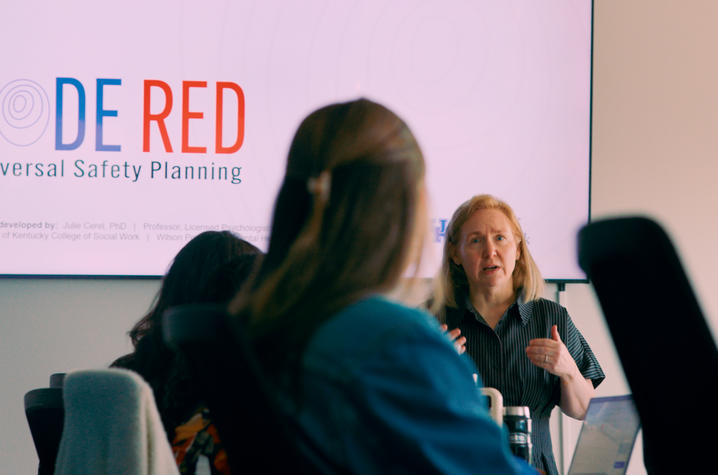
That’s the idea behind CODE RED — a universal safety planning program launched by the University of Kentucky College of Social Work’s Suicide Prevention and Exposure Lab (SPEL).
Created by Julie Cerel, Ph.D., an internationally recognized suicide prevention expert and director of SPEL, CODE RED uses evidence-based strategies to prevent suicide by helping people feel grounded, safe and supported.
“I created CODE RED, so anyone can develop a safety plan before their worst day,” Cerel said. “The plan is built around four simple — but powerful — strategies: contact, delay, relax and distract. Together, those elements form the CODE RED approach and provide practical steps people can turn to when they need support most.”
A plan before the crisis
At the heart of CODE RED is a simple premise: Preparation can save lives.
During a CODE RED session, participants use the four simple strategies to create their own step-by-step safety plan. This gives them practical, personalized steps to turn to when they begin to feel overwhelmed or experience a crisis.
- CO-ntact focuses on identifying people and resources a person can reach out to for support.
- DE-lay encourages creating space between a moment of crisis and acting on suicidal thoughts or urges.
- RE-lax helps participants identify strategies that can calm their bodies and minds.
- D-istract provides ways to shift attention away from distress and create time for the intensity of a difficult moment to pass.
Designed for adults and children 12 and older, CODE RED can be implemented in a variety of settings, including schools, workplaces, and community and faith-based organizations.
For Leah Murphy, Ph.D., SPEL lab manager and CODE RED coordinator, creating a CODE RED plan is no different than preparing for a fire or severe weather emergency.
“I think there is a misconception that suicide is just a problem for people who have a mental health diagnosis or psychiatric disorder. That is not the case,” Murphy said. “I see CODE RED as another tool in the suicide prevention toolbox — one that can be used by anyone.”
From research to practice
The development of CODE RED builds on years of suicide prevention research conducted through SPEL, as well as Cerel’s work as a researcher, educator and advocate in the field.
SPEL’s research examines the complex realities of suicide from multiple perspectives, while its outreach and education efforts work to raise awareness, reduce stigma and empower individuals and communities to take meaningful steps toward prevention.
That work now extends to CODE RED, which has been accepted into the Suicide Prevention Resource Center’s Best Practices Registry. The registry recognizes evidence-based suicide prevention programs and interventions that meet established standards for quality and effectiveness.
“Being included in the Best Practices Registry is an important milestone, because it demonstrates that CODE RED is grounded in evidence and has the potential to make a meaningful difference in communities,” Cerel said. “Our goal has always been to create a practical, accessible program that anyone can use and that organizations can confidently implement to support suicide prevention.”
Turning preparation into action
There are two ways to get involved with CODE RED: by participating in a workshop or becoming a certified CODE RED facilitator.
CODE RED workshops introduce participants to universal safety planning and guide them through creating their own personalized plan. Sessions are available in person or virtually and are designed to be interactive, engaging and accessible.
Organizations and professionals can also become certified CODE RED facilitators, allowing them to deliver the program within their own communities.
The goal is to put another practical tool into the hands of people who may one day need it — whether for themselves or someone they know.
“Suicide prevention doesn’t have to be complicated,” Cerel said. “Sometimes, having a simple plan and knowing what steps to take can make all the difference.”
To learn more about CODE RED, participate in a workshop or schedule an information session about facilitator certification, visit the CODE RED website.
CODE RED plans center on 988, the Suicide & Crisis Lifeline, which provides free, confidential support 24/7 by phone, text and chat. Participants are encouraged to call or text 988 if the other strategies outlined in their plan are not working or they need additional support.
As the state’s flagship, land-grant institution, the University of Kentucky exists to advance the Commonwealth. We do that by preparing the next generation of leaders — placing students at the heart of everything we do — and transforming the lives of Kentuckians through education, research and creative work, service and healthcare. We pride ourselves on being a catalyst for breakthroughs and a force for healing, a place where ingenuity unfolds. It's all made possible by our people — visionaries, disruptors and pioneers — who make up 200 academic programs, a $1.02 billion research and development enterprise and a world-class medical center, all on one campus.