


BBN Tackles Plastic expands to all UK residence halls

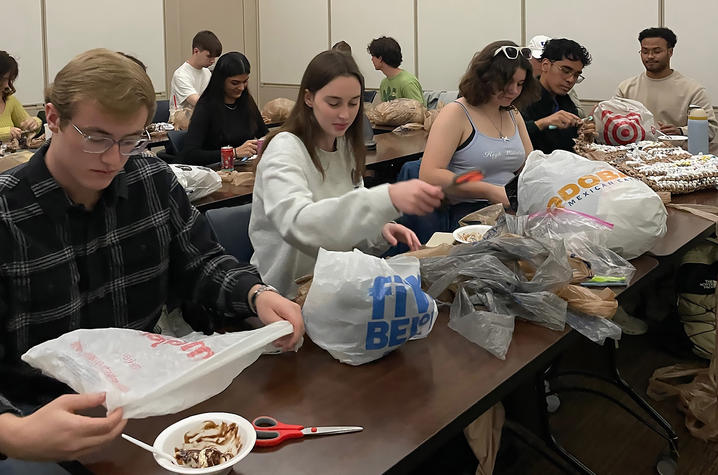
LEXINGTON, Ky. (Oct. 15, 2026) — BBN Tackles Plastic, a UK Recycling initiative aimed at reducing campus plastic waste through the collection of plastic bags, has expanded into all University of Kentucky residence halls this fall. The collected plastic bags are donated to Sustainability Future Leaders, an on-campus student organization, where members transform the bags into sleeping mats which are distributed to Lexington’s unhoused population through a partnership with The Hope Center.
The program includes collection bins in residence hall lobbies and was expanded this semester after a successful pilot program in University Flats, Lewis, Holmes, Jewell, Haggin, Donovan and Lyman T. Johnson residence halls.
“Sustainability is a real passion for me. I’ve been involved in many environmental efforts since high school, so this initiative was something I knew I wanted to be a part of,” said Misa DeVries, a senior biology major in the College of Arts and Sciences, a Lewis Honors College student and director of Sustainability Future Leaders.
The program was started by Shayna Bassi, a May 2026 UK College of Health Sciences graduate, when she was a UK Recycling intern her senior year. During the pilot program, 850 bags were collected. Since then, the program has collected an estimated 1,800 additional bags.
“This year, we are focused on expanding student organization outreach,” DeVries said. “We want to bring the projects to the student body and show that service is for everyone.”
The UK community doesn’t have to live in a residence hall to participate. Plastic bags can also be dropped off outside The Thrifty Cat located in the Blazer Dining Basement, Room 5, or on the eighth floor of Patterson Office Tower.
“My favorite part is seeing people have fun and watching friendships form around service,” DeVries said. “Service can be simple, focused on intentionality and contribution — giving what you can while you can. I like that the mats make service approachable.”
It takes 500 plastic bags to create one mat, and the group has completed nearly 30 mats since the project began. So far, 18 mats have been donated to The Hope Center, four more have been completed and will be delivered soon, with eight currently in progress.
“I’ve enjoyed watching Sustainability Future Leaders expand and evolve,” DeVries said. “In my sophomore year, it kind of was just a friend group working together and now the growth in the club — seeing this many students involved in sustainable action and making a difference in our community is inspiring.”
In addition to supporting The Hope Center, the project also strengthens connections across campus, including UK Recycling’s relationship with Residence Life.
“Plastic bags are commonly misunderstood as recyclable, so this program helps us prevent them from contaminating our recycling bins without sending them to the landfill,” said Ryan Lark, UK’s zero-waste specialist.
Lark is excited the program has expanded into all residence halls this fall as well as new locations.
“We’ve seen an increased interest in this program from employees,” Lark said. “After the success in the residence halls, we are piloting employee collection with the College of Arts and Sciences’ Geography Department, and if that goes well, we may offer these bins to any office interested in collecting plastic bags.”
As the state’s flagship, land-grant institution, the University of Kentucky exists to advance the Commonwealth. We do that by preparing the next generation of leaders — placing students at the heart of everything we do — and transforming the lives of Kentuckians through education, research and creative work, service and healthcare. We pride ourselves on being a catalyst for breakthroughs and a force for healing, a place where ingenuity unfolds. It's all made possible by our people — visionaries, disruptors and pioneers — who make up 200 academic programs, a $1.02 billion research and development enterprise and a world-class medical center, all on one campus.