


Kentucky faculty, students support science learning in Malawi
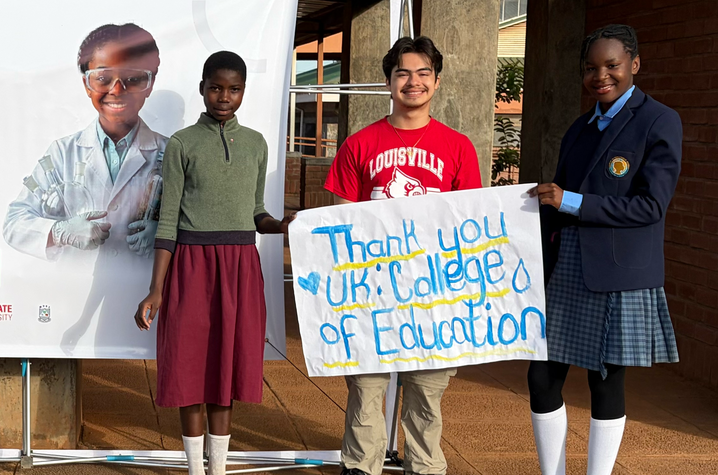
LEXINGTON, Ky. (Oct. 26, 2026) — When Sahar Alameh, Ph.D., teaches future science educators at the University of Kentucky, she encourages them to move beyond having students memorize facts. Her teaching and research focus on helping students make sense of science through curiosity and hands-on discovery.
That same approach is reaching classrooms half a world away.
This summer, Alameh, an associate professor of STEM education in the UK College of Education Department of Teaching and Learning, worked alongside faculty and students from the University of Louisville and Mzuzu University in Malawi to host a day of hands-on science learning in Africa for more than 250 elementary and middle school students. This work is supported by the U.S. National Science Foundation (NSF) Environmental Surveillance Center for Assessing Pathogen Emergence. Alameh is a co-principal investigator on the NSF award and the center’s head of Education, Training and Outreach.
To help prepare for the day of learning in Malawi, Alameh met virtually with university students who would facilitate the activities and modeled ways to involve students in the lessons. She had the support of students, faculty and staff in the UK College of Education who rallied to donate new and gently used items to help with the event in Malawi.
The Malawi initiative reflects the same approach Alameh teaches future educators in Kentucky, where they learn to create classrooms where students actively investigate meaningfully relevant scientific ideas.
“Research consistently shows that engaging students in authentic, hands-on STEM experiences — especially activities where they actively ‘do science’ and think like scientists — can positively impact STEM attitudes, confidence, engagement and science identity,” Alameh said.
The work in Malawi builds on Alameh’s broader research exploring how science instruction becomes more meaningful when it connects to students’ own communities and lived experiences.
That research was the focus of an “Innovation to Practice” article Alameh published in the journal School Science and Mathematics with collaborators Rochelle Holm, Ph.D., associate professor at the Christina Lee Brown Envirome Institute at the University of Louisville School of Medicine; Petros Chigwechokha, Ph.D., senior lecturer at Malawi University of Science and Technology; Brighton A. Chunga, Ph.D., senior lecturer and dean of faculty at Mzuzu University; and Anna G. Hoover, Ph.D., associate professor and assistant dean for public health practice programs at the UK College of Public Health.
The article, “Integrating Wastewater Surveillance Into Science Education: Implementing the 5E Learning Cycle and Storyline Approach in Rural Schools,” examined how adapting science lessons to be interactive and to reflect local communities can make emerging topics, such as wastewater-based epidemiology, more relevant and engaging for students.
That same philosophy guides Alameh’s work across Kentucky.
Earlier this year, she joined a UK team at Buckhorn School in Perry County, where high school students tested water from a creek running alongside their school using a water-testing device developed at UK. By investigating a water source familiar to them, students experienced firsthand how science can help answer questions about their own community.
UK College of Education Dean Nick Pace, Ed.D., said the work of engaging students and future teachers in STEM learning is a prime example of the reach of faculty members’ knowledge, passion and expertise.
“From testing water quality in Squabble Creek to impacting students across the globe, our College of Education scholars are making lasting impacts on teaching, learning and lives,” Pace said.
Whether in Eastern Kentucky or Malawi, Alameh’s research is showing students learn best when connected to the world around them.
“Whether students are testing a creek in Eastern Kentucky or exploring community health challenges in Malawi, authentic science learning begins with questions that matter locally,” Alameh said. “By engaging students in meaningful investigations connected to their own communities, we help them develop the knowledge, confidence and problem-solving skills needed to contribute to healthier and more resilient communities.”
This material is based upon work supported by the U.S. National Science Foundation under Cooperative Agreement No. 2412446. Any opinions, findings, and conclusions or recommendations expressed in this material are those of the author(s) and do not necessarily reflect the views of the U.S. National Science Foundation.
Research reported in this publication was supported by the National Institute on Drug Abuse of the National Institutes of Health under Award Number U01DA053903. The content is solely the responsibility of the authors and does not necessarily represent the official views of the National Institutes of Health.
As the state’s flagship, land-grant institution, the University of Kentucky exists to advance the Commonwealth. We do that by preparing the next generation of leaders — placing students at the heart of everything we do — and transforming the lives of Kentuckians through education, research and creative work, service and healthcare. We pride ourselves on being a catalyst for breakthroughs and a force for healing, a place where ingenuity unfolds. It's all made possible by our people — visionaries, disruptors and pioneers — who make up 200 academic programs, a $1.02 billion research and development enterprise and a world-class medical center, all on one campus.