


UK companion animal studies program explores the human-animal bond
LEXINGTON, Ky. (March 31, 2026) — An undergraduate program at the University of Kentucky Martin-Gatton College of Agriculture, Food and Environment (CAFE) invites students from all majors to explore the symbiotic connection between humans and animals.
The Higgins-Neyland Companion Animal Studies(CAS) program is a pillar of The Bill Gatton Foundation gift and aligns with Gatton’s appreciation of the human-animal bond, and represents one of the Four Pillars of The Bill Gatton Foundation’s $100 million gift to the university.
Students in the program will have the opportunity to take up to four courses: Animals and Society; Caring for Companion and Working Animals; Companion Animal Studies Experience; and Advanced Seminar in Companion Animal Studies. Upon completion of all four courses, along with two guided electives, students earn their undergraduate certificate in companion animal studies.
“The Companion Animal Studies program aims to go above and beyond just animal care, production and husbandry, and embrace all roles that animals play in our society and with humans,” said Kristine Urschel, Ph.D., assistant dean for instruction at Martin-Gatton CAFE and instructor in the Caring for Companion and Working Animals course (CAS 302). “Previously, there wasn’t a program that emphasized this interrelationship between all our human-related initiatives and existing animal programs at the University of Kentucky. In this program, we are going beyond just talking about how we care for animals and humans in isolation, but more about how they interact and support each other.”
Roger Brown, Ph.D., associate professor of agricultural economics and instructor in the Animals and Society course (CAS 301), believes that his students’ interest in the program has been driven by their desire to further understand the human-animal connection and explore answers to important questions.
“Almost everyone has had a formative experience with animals before they get to this class, and that experience is meaningful to them,” Brown said. “In this program, students can take that experience and now study, make sense of it and fuel new ideas over time. The questions that are sometimes the most meaningful often take the longest to answer.”
The CAS program will examine people’s interaction with animals, moral conflicts and choices. Furthermore, students will explore animal care and management practices, complete projects in documenting animal-related experiences, and apply their knowledge to current contemporary issues, research and challenges.
‘A unique experience’
Addison Brown, a sophomore majoring in civil engineering at the UK Stanley and Karen Pigman College of Engineering, believes that the CAS 301 course was the perfect fit to expand her creativity and obtain skills that will be useful in the future.
“As a civil engineer, many of our classes are very technical — what’s right, what’s wrong,” Addison Brown said. “I was a little nervous at first when enrolling in the CAS course but discovered that it’s good for me to use the other side of my brain. We are learning about important relationships between humans and animals, community and values. We will be building infrastructures for people in the future, and we should be able to understand people’s values that we are building for and serving.”
In her CAS class project assignment, Addison Brown chose a dilemma in which a local animal shelter was euthanizing healthy dogs due to overcrowding — which covered a wide range of research and narrative topics including philosophy, history, law, art and science.
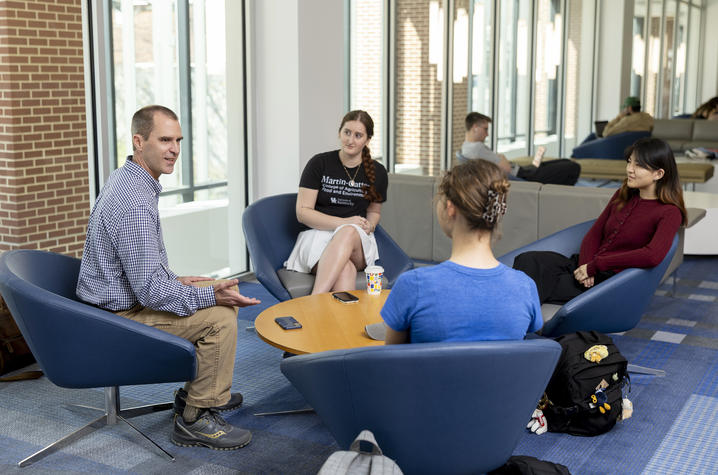
Roger Brown encourages thoughtful discussion in his courses.
“It’s important to take classes where you can interact and collaborate with people,” Roger Brown said. “This is more than working on groups projects where you just get it done and get the right answer. One thing that I did like is that there’s no wrong answer — there’s nothing wrong with what you choose as your answer in the end.”
Some career fields that pair well with the CAS certificate include working in health care, animal-assisted therapy, agriculture and social work.
Ian Seward, a junior in the landscape architecture program at Martin-Gatton CAFE, said the CAS 301 course is helping him be more thoughtful when designing spaces for communities after he graduates in 2027.
“In landscape architecture, so much of what we are designing is building or adding on to existing wildlife areas,” Seward said. “I wanted to learn more about the history of how humans and animals interact and coexist, and how we can take that information to better our designs for both humans and animals.”
For his class project, Seward examined a proposal to build a park on an existing wildlife corridor. He debated the value of a green space for people to interact outside versus canceling the project and keeping the habitat in its natural state for animals. Being able to interact and bounce ideas around with other majors has made Seward a “better communicator.”
“What I learned is that there’s a bunch of laws that protect people and a bunch of laws that protect animals,” Seward said. “It’s been great having different majors in the program, because landscape architects will work with civil engineers a lot in our professional careers. Interacting with other majors and learning how they think is very helpful. This has been a unique experience that no other class has been able to replicate.”
How to apply
The CAS program and certificate, which is open to all UK majors, initially launched in Fall 2025. There are approximately 475 students currently enrolled in the CAS 301 and 302 courses.
For the next class registration cycle, beginning in Fall 2026, the program plans to open additional course sections for students.
For UK students interested in taking CAS courses or pursuing the certificate, talk to an academic advisor or apply to the Companion Animal Studies program at Martin-Gatton CAFE.
As the state’s flagship, land-grant institution, the University of Kentucky exists to advance the Commonwealth. We do that by preparing the next generation of leaders — placing students at the heart of everything we do — and transforming the lives of Kentuckians through education, research and creative work, service and healthcare. We pride ourselves on being a catalyst for breakthroughs and a force for healing, a place where ingenuity unfolds. It's all made possible by our people — visionaries, disruptors and pioneers — who make up 200 academic programs, a $1.02 billion research and development enterprise and a world-class medical center, all on one campus.