


2026 Ford Lecture to address policy challenges, prediction markets
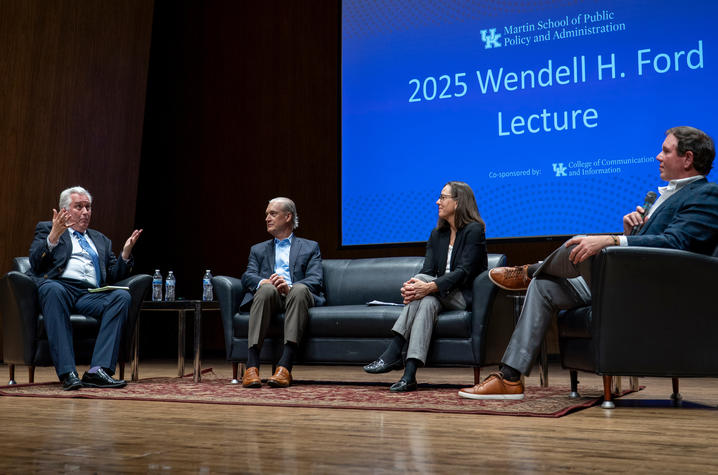
LEXINGTON, Ky. (Oct. 2, 2026) — The explosion of prediction markets — platforms where participants trade on the outcome of future events — and the debate over the role of government oversight will be the subject of the University of Kentucky's 2026 Wendell H. Ford Public Policy Lecture at 4 p.m. on Nov. 2 at the W.T. Young Library Auditorium.
Hosted by UK's Martin School of Public Policy and Administration, the program will feature Robin Hanson, a professor at George Mason University, who is considered the intellectual pioneer of prediction markets. First writing about prediction markets in 1988, Hanson has received widespread recognition for his academic research on the application of idea futures to business and policy. His personal blog, "Overcoming Bias," has more than 39,000 subscribers.
Hanson will head a panel of policy experts that will explore the implications of prediction markets for society and public decision-making, including what role, if any, government should play as these markets continue to grow. The panel includes Michelle Woods, a Martin School graduate who is vice president, state-federal affairs for the National Conference of State Legislatures (NCSL) in Washington, D.C.; and Alan Kluegel, a professor at UK’s J. David Rosenberg College of Law, who will address legal and regulatory issues of prediction markets.
"Prediction markets have moved from academic curiosity to widespread use," said Spiro Maroulis, director of the Martin School. "Platforms like Kalshi and Polymarket now let users trade on everything from the outcome of elections to whether or not UK will win its next football game. Inevitably this raises hard questions about manipulation, regulation and who should ultimately set the rules governing these activities."
Coming on the eve of the 2026 midterm elections, the panel is also expected to consider how trading on prediction markets affects political races and results. Concerns have been raised that trading on political races will impact democracy in unpredictable ways and further damage confidence in election outcomes and public policy; opposing views suggest the trading will lead to outcomes that more closely reflect voters' preferences. The panel will offer insights into these diverging arguments and their policy implications.
First held in 2014, the Ford Lecture is in honor of the late Wendell H. Ford, the former Kentucky Governor and four-term U.S. Senator who lectured at the Martin School after retiring from the Senate in 1999. The program is free and open to the public.
As the state’s flagship, land-grant institution, the University of Kentucky exists to advance the Commonwealth. We do that by preparing the next generation of leaders — placing students at the heart of everything we do — and transforming the lives of Kentuckians through education, research and creative work, service and healthcare. We pride ourselves on being a catalyst for breakthroughs and a force for healing, a place where ingenuity unfolds. It's all made possible by our people — visionaries, disruptors and pioneers — who make up 200 academic programs, a $1.02 billion research and development enterprise and a world-class medical center, all on one campus.