


Lung cancer journey gives Markey patient renewed purpose
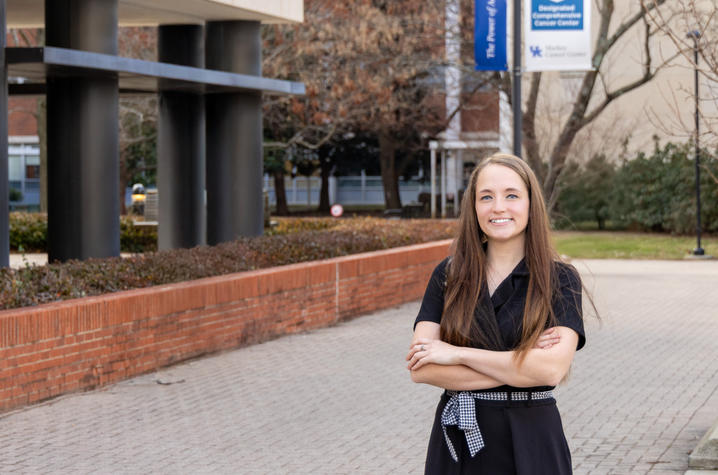

LEXINGTON, Ky. (Jan. 26. 2026) — Gabby Morrison was 11 weeks into her third pregnancy in early 2023 when she learned she had miscarried. Days later, the emotional weight of the loss triggered a panic attack so severe the 27-year-old from West Liberty thought she was having a heart attack. Morrison went to UK St. Claire in Morehead, where a chest scan revealed a mass in her lung.
After two biopsies, she was diagnosed with lung cancer. The news was a shock — she was young, healthy and had never smoked.
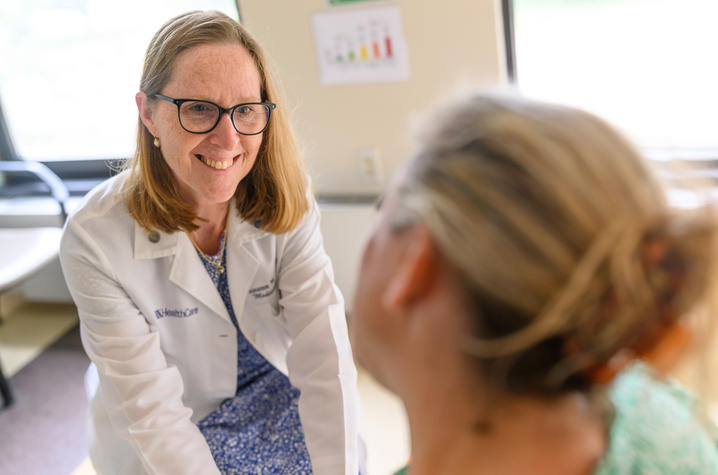
Morrison was referred to the University of Kentucky Markey Cancer Center, where medical oncologist Susanne Arnold, M.D., oversaw her treatment. She had been diagnosed with Stage 2b invasive mucinous adenocarcinoma (IMA), a rare form of nonsmall cell lung cancer that accounts for about 5% of all lung adenocarcinomas. This type of lung cancer is unique because its cells contain mucin, the proteins that make mucus. This can make IMAs harder to detect, says Arnold.
“Because IMAs can sometimes appear benign on small biopsies, they can be missed on initial testing,” Arnold said. “Gabby was fortunate it was caught when it was.”
The standard treatment for Morrison’s diagnosis was surgery followed by 12 weeks of chemotherapy. After Markey Cancer Center thoracic surgeon Clinton Morgan, M.D., Ph.D., removed the small tumor in her lung, Arnold offered her the opportunity to enroll in a clinical trial that would add immunotherapy to the standard chemotherapy treatment.
“We both felt a cutting-edge clinical trial was the right thing to do to help prevent the cancer from coming back,” Arnold said.
“If I can help someone else later on down the road by being part of something that can improve treatments, I’m definitely going to do it,” said Morrison.
As part of the Adjuvant Lung Cancer Enrichment Marker Identification and Sequencing Trial, she received the combination treatment for one year.
Today, officially in remission, she has found meaning in the loss that led to her diagnosis.
“I believe my baby saved my life,” she said. “Because the loss led to finding cancer when it was still treatable, it was a blessing in disguise. I didn’t feel that at the moment… but that’s how I look at it now.”
***
Morrison’s cancer journey also brought her a new purpose: helping others.
After her diagnosis, she began researching what might have caused it. People who have never smoked have different risk factors, including exposure to radon, air pollution and inherited genetic risks. With genetic testing ruling out hereditary factors, the more she learned about radon, the more the pieces fit together.
The naturally occurring radioactive gas seeps into buildings from the ground and is the second leading cause of lung cancer in the U.S., and the leading cause among people with no smoking history. Colorless and odorless, radon cannot be detected without testing.
During her research, she connected with a nonprofit organization called Citizens for Radioactive Radon Reduction (CR3), which works to raise awareness and advocate for policy changes around radon exposure. She recently joined the CR3 team, and visits schools and other community locations to share her story and teach others about radon.
“I learned that so many people just don’t know about radon at all… and you can’t really do anything about something you’re not aware of,” Morrison said. “Just having a conversation about this topic is needed in so many communities.”
Morrison is currently focused on advocating to make radon testing and mitigation mandatory in schools, where children spend much of their time.
“That’s where I want to start, because children don’t have anyone to speak for them,” she said. “But when adults learn about the issue and know that it exists, they can be equipped to make the necessary changes.”
Beyond advocacy, Gabby has found other ways to help others in her community. She joined a K-9 search and rescue team in Eastern Kentucky, where she responds to calls of missing people and assists with the use of K-9s.
“When I got this diagnosis, I realized I just want to start doing things that matter,” she said.
Arnold has been proud to see Morrison arm herself with information and channel her experience into advocacy.
“She has been very brave through her cancer journey, probably because she has a lot to fight for,” Arnold said. “Her positive response to this crisis is really impressive — she is definitely one of my heroes.”
Morrison notes that her positive mindset has made all the difference.
“I tell people that I’m thankful for my diagnosis and that it actually changed my life for the better,” she said. “I plan on making an impact and making changes for other people — to help them get earlier diagnoses or even never get a diagnosis at all.”
UK HealthCare is the hospitals and clinics of the University of Kentucky. But it is so much more. It is more than 10,000 dedicated healthcare professionals committed to providing advanced subspecialty care for the most critically injured and ill patients from the Commonwealth and beyond. It also is the home of the state’s only National Cancer Institute (NCI)-designated Comprehensive Cancer Center, a Level IV Neonatal Intensive Care Unit that cares for the tiniest and sickest newborns and the region’s only Level 1 trauma center.
As an academic research institution, we are continuously pursuing the next generation of cures, treatments, protocols and policies. Our discoveries have the potential to change what’s medically possible within our lifetimes. Our educators and thought leaders are transforming the healthcare landscape as our six health professions colleges teach the next generation of doctors, nurses, pharmacists and other healthcare professionals, spreading the highest standards of care. UK HealthCare is the power of advanced medicine committed to creating a healthier Kentucky, now and for generations to come.