


‘Not just basketball’ — Transplant patient redefines what UK means to him


LEXINGTON, Ky. (Feb. 11, 2026) – Ralph Napier is a living legend. Just ask anyone in Harlan County.
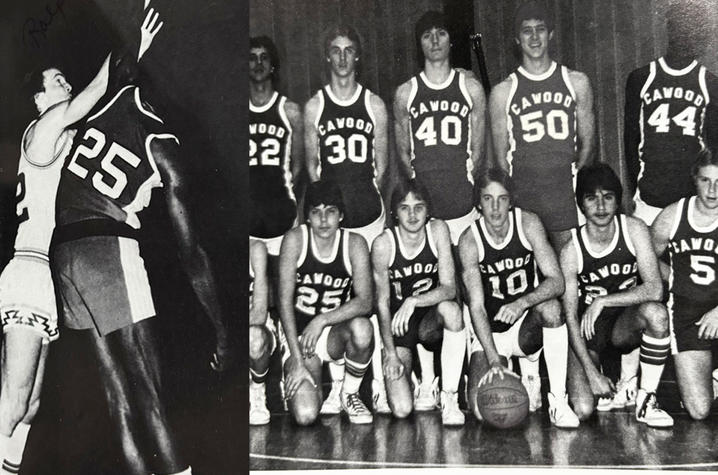
Recently retired from Rosspoint Elementary School where he taught math for 20 years, Ralph coached the boys’ basketball team through a record 88 straight wins and four straight championships. On and off the court, the kids of Baxter, Kentucky, knew they could always count on him.
“He was a role model for a lot of kids in Appalachia who needed that,” said Ralph’s wife Debbie. “For the boys and girls to model after him and be a safe environment. He was everyone’s favorite teacher.”
Others in the community know Ralph as a master of all trades. Teaching was his second career; before that, Ralph worked in the coal industry for 15 years, operating the machine that cuts coal. Retired from both careers, he now spends his days as doting grandfather to his two grandchildren. The Napier family is close — both figuratively and geographically. His son lives at home and his daughter’s family lives about a half-a-mile down the road from them.
“We cleared off a mountain and built a house, so they have the whole run of the mountain,” said Debbie. “We’re very hands-on grandparents. Our daughter teaches at the school Ralph retired from, and our son took over his position as a math teacher.”
After seeing the devastation caused by flooding in his native Eastern Kentucky, as well as catastrophic damage in North Carolina following Hurricane Helene, Ralph was set to launch his third act — owning an excavation business. He had the skills, equipment and passion to help friends, families — even strangers in another state — rebuild what Mother Nature took away.
“I was in the classroom for 20 years — I loved it,” Ralph said. “But to get to go outside and go somewhere different every day with the excavator, that was something. For me to retire from teaching and get to do something that I really love, it can’t get no better.”
Ralph had just filed the paperwork to start his business when a routine lung screening revealed a nodule on his lung.
‘Anywhere else, I would have died.’
A surgeon at a nearby hospital, suspecting the nodule to be cancerous, insisted it had to be removed. The surgery didn’t go as planned, resulting in a large hole in Ralph’s lung. Subsequent procedures to repair the hole compounded the problem. To further complicate Ralph’s serious condition, he developed pneumonia. By the time he was transported to the University of Kentucky Albert B. Chandler Hospital, both of his lungs were inflamed and severely damaged. He was placed on venovenous extracorporeal membrane oxygenation (VV ECMO), a life-support machine that took over for his lungs, giving them time to rest while providers raced to evaluate his condition.
The Napiers were frustrated to learn that the nodule the first surgeon insisted was cancer, was in fact, not. However, the damage from trying to remove it and the ensuing pneumonia caused irreparable damage. Ralph’s only remaining option was a double lung transplant.
During his transplant evaluation, Naureen Narula, M.D., medical director of the UK Transplant Center, made an incidental finding. Although it didn’t change the course charted for his recovery, it did explain the presence of the nodule. After 15 years of working in the coal mine, Ralph developed coal workers’ pneumoconiosis, more commonly known as black lung. Those with the disease experience a gradual loss of lung function over several years, with some ultimately requiring a lung transplant. It will never be known whether Ralph’s pneumoconiosis would have progressed to that point.
“While many lung transplants occur after years of known chronic lung disease, Ralph’s situation was a bit different,” said Narula. “He did have an underlying condition, coal workers’ pneumoconiosis, but he was not aware of it. His acute illness and subsequent complications brought that underlying disease to light.”
On Feb. 20, 2025, after 45 days on VV ECMO and nine days on the waiting list, the transplant surgical team, led by Matthias Loebe, M.D., performed Ralph’s double lung transplant. But the journey wasn’t over yet. Shortly after his transplant, Ralph required four more surgeries, as well as treatment on his hands and feet for limb ischemia, a condition caused by VV ECMO in which the tissues of the extremities are damaged from insufficient oxygenated blood. Loebe, Narula, Lung Transplant Program Medical Director Michael I. Anstead, M.D., and a cadre of health care providers helped Ralph navigate his post-surgical complications, bringing a level of care the Napiers knew Ralph wouldn’t get at any other hospital.
“Anywhere else, I would have died,” Ralph said.
A knack for building communities
The Napiers were adept at making friends and attracting advocates wherever they go. Ralph didn’t go a single day without a visitor. Up until the week of his transplant, friends and family made the three-hour drive from Harlan to be with Ralph and Debbie. While in Lexington, Debbie visited the East End Church of Christ and told her new fellow congregants about Ralph. Soon, they had an influx of visitors — strangers who were touched by Ralph’s story stopped by to offer prayers and comfort.
“A visitor would pop up a couple times a week,” said Debbie. “It was really sweet. And a bunch of them came, like four or five people from that church came and sat with me at lunch.”
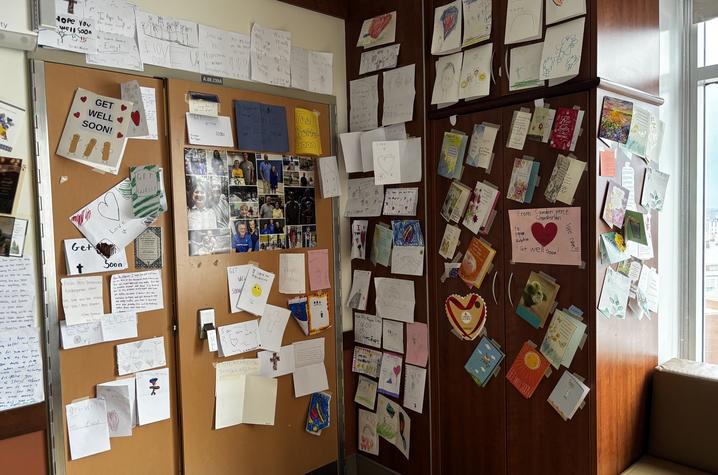
Back in Harlan County, the news about Ralph traveled fast. Cards, letter and posters poured into Ralph’s hospital room. His nurses helped to hang them where he could see them, reminders that he had the support and prayers of thousands of people in eastern Kentucky and beyond.
“We got cards from so many people that we didn’t know who said their church was praying for him,” said Debbie. “We heard from people who had moved away to Florida, Missouri and Arkansas.”
Back home, a fundraiser was started to help the Napiers with travel expenses. T-shirts sold in support of Ralph raised more than $1,000. Even though his coaching days were behind him, the impact he had on young players still resonated through the community. The boys basketball team at Rosspoint wore ‘RN’ armbands at the tournament they dedicated to Ralph.
“It’s not ‘Everybody loves Raymond,’” said Debbie. “It’s ‘Everybody loves Ralph.’”
On April 11, Ralph was discharged from UK and spent a few weeks at Cardinal Hill Rehabilitation Hospital, where he continued to build his strength. In total, he spent 151 straight days in three different hospitals. When he was finally home in Harlan County, he was embraced by a loving, supportive community. Since transplant recipients are susceptible to infection, Ralph had to minimize his interactions with crowds, which meant he couldn’t immediately go back to church.
“They said they were ready for me to come out,” said Ralph. “They said, ‘Listen, we’ll wear a mask, we’ll do whatever we gotta do’. But I would never ask them to do that. But the fact they were willing to do it, that’s the heartwarming part.”
As Ralph and Debbie reflect on the support of friends, family and strangers, they realize that words can never fully convey the gratitude they have for Ralph’s donor and their family. Ralph was one of 14 patients to receive a life-saving lung transplant at UK HealthCare in 2025; 14 Kentuckians have a second chance thanks to the selfless souls who joined the organ donor registry. Ralph remembers his uncle who received a liver transplant in the 1980s. The science and logistics of organ transplant has evolved, but what hasn’t changed is the divine alignment of the helpers with those in need, forming an impossible juxtaposition of grief and joy, loss and life.
“It eats away at me sometimes to think that somebody had to put a parent in the ground or if some grandkids had to lose their grandparent,” said Ralph. “But they stopped some other kids from having to lose their dad. In the greatest time of grief, you give somebody else the greatest gift that they could ever ask for — their loved one.”
“Our son-in-law lost his dad five weeks ago in a car accident,” said Debbie. “My daughter’s mother-in-law, she couldn't hardly talk to me for crying. She said, ‘We donated all of his organs because somebody saved Ralph, and we wanted to save somebody.’”
Ralph’s ‘Dream Team’
One year after his transplant, Ralph is settled into his new job. Even though this isn’t the third act he envisioned — digging his way through Eastern Kentucky with his excavator — he found that recovery is nearly a full-time job. On top of a calendar full of post-transplant follow-up appointments with Narula and Anstead, he goes to respiratory therapy and physical therapy four times a week, building the strength and stamina necessary keep up with his grandchildren. He’s going to need it; he promised to take them to Hawaii.
“It keeps you occupied,” said Ralph. “Running back and forth with all this stuff, it takes more time to do than you realize. I’m not complaining; it is what it is. Beats the alternative.”
For Ralph, as long there is breath in his body, he’s using it to talk about basketball. There’s no bigger fan of the sport than Ralph Napier. He talks fondly of the UK Wildcats, the great John Wall and seeing Mark Pope play before he became head coach. For years, UK was always synonymous with basketball. But now, UK means something different — something deeply personal.
“You remember the Dream Team?” Ralph said, referring to the 1992 U.S. Olympic men’s basketball team. “I have my own Dream Team here — Dr. Narula, Dr. Loebe, Dr. Anstead, Dr. Meyerson and Dr. Hollar. UK ain’t basketball anymore. UK is the family that saved me.”
UK HealthCare is the hospitals and clinics of the University of Kentucky. But it is so much more. It is more than 10,000 dedicated healthcare professionals committed to providing advanced subspecialty care for the most critically injured and ill patients from the Commonwealth and beyond. It also is the home of the state’s only National Cancer Institute (NCI)-designated Comprehensive Cancer Center, a Level IV Neonatal Intensive Care Unit that cares for the tiniest and sickest newborns and the region’s only Level 1 trauma center.
As an academic research institution, we are continuously pursuing the next generation of cures, treatments, protocols and policies. Our discoveries have the potential to change what’s medically possible within our lifetimes. Our educators and thought leaders are transforming the healthcare landscape as our six health professions colleges teach the next generation of doctors, nurses, pharmacists and other healthcare professionals, spreading the highest standards of care. UK HealthCare is the power of advanced medicine committed to creating a healthier Kentucky, now and for generations to come.