


UK landscape architecture faculty, students contribute to success of Town Branch Commons
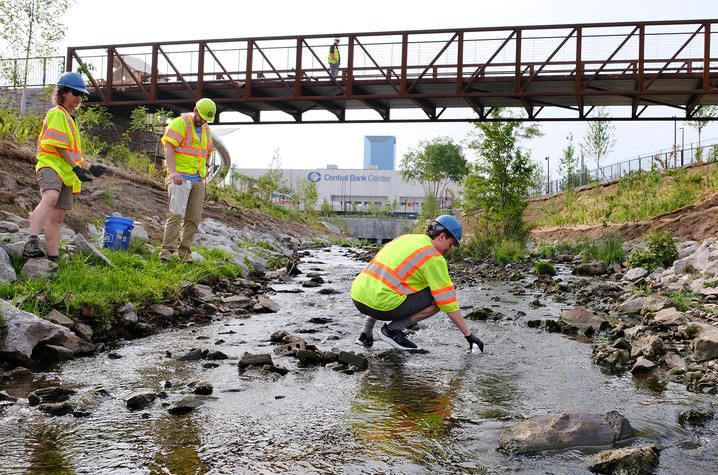
LEXINGTON, Ky. (April 24, 2026) — University of Kentucky Department of Landscape Architecture faculty and students contributed to a national case study documenting more than 20 environmental, social and economic benefits provided by Town Branch Commons, an innovative linear park that connects Lexington’s downtown to diverse neighborhoods and the surrounding Bluegrass landscape.
The research was funded through the Landscape Architecture Foundation’s Case Study Investigation (CSI) program, which pairs faculty-student research teams with leading practitioners to document exemplary landscape architecture projects and helps bridge the gap between academia and practice.
In the late 1700s, Lexington was founded on Town Branch, a fork of Elkhorn Creek and the city’s original water source. Due to flooding and sanitation concerns, Town Branch was gradually covered over and constricted within a system of culverts. Today, it runs beneath Midland Avenue, Vine Street and Rupp Arena.
In the early 2000s, a grassroots community idea began to take shape to reimagine downtown Lexington, its public spaces, and their relationship to Rupp Arena and the buried Town Branch. Led by local non-profit organization Town Branch Trail, Inc., this effort created momentum and culminated in an international design competition that led to the construction of Town Branch Commons.
The 2.2-mile-long corridor, completed in 2022, features a network of bike and pedestrian trails bordered by dense native plantings, connects to eight public parks and fills a gap in a 22-mile regional trail network. Tracing the historic path of Town Branch, this complex urban infrastructure project provides a wealth of sustainability benefits to Lexington, including reducing and treating stormwater, leveraging financial investments in the public realm and supporting community health, well-being and quality of life.
“I have walked, run and biked the corridor countless times with my family, friends and students, and it has changed the way people move through downtown,” said Jordan Phemister, lecturer at the Martin-Gatton College of Agriculture, Food and Environment (CAFE) and research fellow.
Phemister has enjoyed taking her students downtown each fall to see the progress being made. The research assistant on the project, Mitchell Kubera, received a Martin-Gatton CAFE undergraduate research grant for his collaboration with Phemister. They first visited the site in 2020 when construction began.
“Town Branch Commons has long been an incredible teaching resource for the landscape architecture program,” Phemister said. Being selected to participate in CSI to evaluate the prestigious array of sustainability benefits provided by Town Branch Commons was an honor and has strengthened my understanding of landscape performance and ability to share that knowledge with my students.”
The research team documented many environmental, social and economic benefits for Lexington. A “road diet,” a reduction in vehicular travel lane widths, along Vine Street and Midland Avenue dedicates more space for walking, biking and native plantings, and contributes to reduced vehicular speeds and collisions. The rain gardens, carefully engineered and interspersed along the corridor, capture and treat approximately 25,000 cubic feet of stormwater and reduce annual runoff by 29%. Wider sidewalks that are separated from vehicular traffic by plantings help people feel safer and more connected to one another, and they increase bike and pedestrian activity downtown.
The study states that Town Branch Commons encourages people to visit local businesses along the corridor, contributing to increased visitor spending and helping catalyze over $110 million in municipal, grant and philanthropic investments in newly developed or renovated parks and a new Fayette County Public Schools building.
Gresham Smith, an innovative multi-disciplinary design and engineering firm that oversaw design and construction of Town Branch Commons, was integral to the success of the research effort. As the firm representative, they helped connect the research team to a wide range of local and state partners who helped guide the research, provide context and share data.
“Gresham Smith was proud to be the firm representative and support the University of Kentucky during the Town Branch Commons CSI Program,” said Erin Masterson, senior landscape architect at Gresham Smith and a 2008 UK graduate. “Working closely with UK has been incredibly rewarding. The extensive number of people involved throughout the life of this project truly embodies what it means to be community-driven. By using Town Branch Commons in this research project, we were able to raise awareness in Lexington and beyond, highlighting the impact of our profession and demonstrating the lasting value of these investments.”
Town Branch Commons transformed a car-dominated, ecologically barren stretch of Lexington into a complete streetscape that weaves together safer streets, green infrastructure and bike and pedestrian trails. This corridor is easy to navigate for visitors and residents and brings a vibrant green ribbon of the Bluegrass region into Lexington’s downtown.
“The research and findings from Town Branch Commons and similar projects help all of us — students, educators, practitioners, communities — understand the breadth of our profession and enrich our vocabulary and ability to advocate for the value of landscape architecture in designing the public realm,” Phemister said.
Read about all the findings of the case study and learn more about Landscape Architecture at UK.
The research reported in this article was made possible by a grant from the Landscape Architecture Foundation. The views expressed are those of the authors and do not necessarily reflect the views of the Landscape Architecture Foundation.
As the state’s flagship, land-grant institution, the University of Kentucky exists to advance the Commonwealth. We do that by preparing the next generation of leaders — placing students at the heart of everything we do — and transforming the lives of Kentuckians through education, research and creative work, service and healthcare. We pride ourselves on being a catalyst for breakthroughs and a force for healing, a place where ingenuity unfolds. It's all made possible by our people — visionaries, disruptors and pioneers — who make up 200 academic programs, a $1.02 billion research and development enterprise and a world-class medical center, all on one campus.