


Turning a second chance into hard-won success

LEXINGTON, Ky. (May 4, 2026) — Growing up in rural Taylorsville, Kentucky, Jonathan Antonelli understands firsthand many of the challenges rural Kentuckians face — living paycheck to paycheck, long commutes for basic necessities, access to healthcare.
In fact, he says, his county was one of the several Kentucky counties without a local physician until last year.
These issues compounded his father’s poor health. But despite multiple medical scares and hospitalizations over the years, his own well-being was the furthest thing from his mind.
“My dad was like so many dads, I’d say, who were just blue-collar working guys trying to provide for their family,” Antonelli said. “And I remember the last time he was hospitalized before he passed away, he was begging to see the doctor every 10 minutes to get discharged. And I was like, ‘Why?’ And he said, ‘I need to go to work. My mortgage is due next week.’”
Losing his way — then finding his purpose
As a kid, Antonelli had a natural curiosity about human physiology and entertained the idea of pursuing medicine.
In high school, he applied and was admitted to the Craft Academy for Excellence in Science and Mathematics at Morehead State University, an on-campus, residential program that lets high school juniors and seniors earn college credit while earning their high school diplomas. Once here, he admits he experienced a feeling common among high achievers: imposter syndrome.
“I remember specifically when I got to the academy, everyone there felt much smarter than me, more hardworking and more dedicated,” he said. “I just remember talking to some of my classmates and they're like, ‘I want to be a surgeon, I’ve never doubted that.’ And I thought I couldn’t compete against these people, so I just naturally drifted toward other things.”
Antonelli took political science courses and began working as a Senate page clerk in Frankfort. When he completed his high school diploma through the Craft Academy, he decided to stay at Morehead State because he had earned a full ride scholarship for the university’s honors program.
However, he struggled — a lot.
“It’s just not where I was supposed to be,” he said. “My mental health pretty much plummeted. I think I just got complacent, and prideful, and just stopped [working]. And what ended up happening was I failed out with straight Fs.”
Antonelli lost his scholarship and says his honors program director had a blunt conversation with him — but it was something he needed to hear to get himself back on track.
“I talked to him about a year ago,” he said. “And I told him, that’s what I needed. You know, a kick in the behind.”
Antonelli then used his summer break to work in the office of Kentucky Congressman Thomas Massie as a congressional intern. In an unexpected twist, the experience would lead him back to his true calling: medicine. After meeting with healthcare lobbyists, he realized he wanted to be helping people on an individual level.
“I’m a people person,” he said. “And I realized right then and there that the responsibility I wanted to carry was to be close to the people who are actually going to be affected [by healthcare]. I wanted to sit next to a patient and talk to them, not just talk about them on a federal legislative policy scale.”
A new start at UK
“UK by and far was my dream school,” Antonelli said. “But I just didn’t think I could afford it. But I was like, I might as well just try. I didn’t feel like I had anything to lose at that point.”
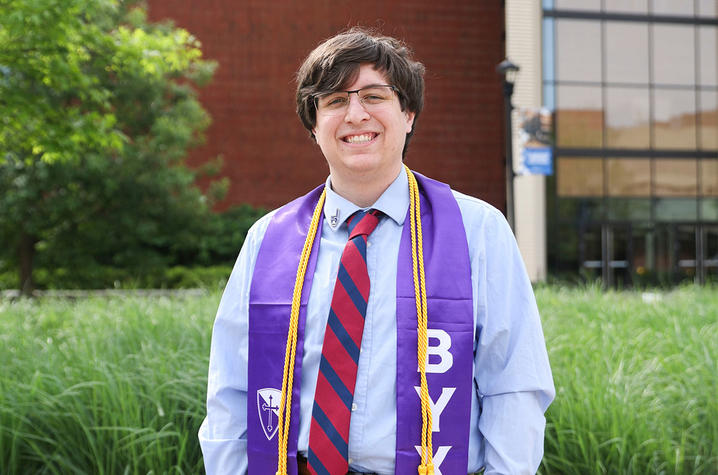
With his sights now set on medical school, Antonelli returned to Morehead State for a year, working hard — and succeeding — to improve his GPA. In 2023, he transferred to UK, choosing the UK College of Arts and Sciences. He decided to live on campus, joining the Beta Upsilon Chi fraternity and becoming part of UK’s first-year transfer Living Learning Program (LLP).
LLPs place students with similar interests into smaller groups within specific residence halls. The programs build a feeling of community on a large campus, helping students adjust to college life at UK while meeting and working with like-minded peers and faculty.
The concept worked: Antonelli was placed with a fellow transfer student who also was interested in medical school — and the two immediately clicked.
“He’s still my roommate right now.” he said. “He’s one of my best friends. I found many of my best friends through that LLP.”
Antonelli majored in liberal studies with a natural and mathematical sciences track, focusing on pre-med courses and continuing to improve his GPA. The “build it yourself” degree, as he described it, helped lay the foundation for future medical school but also allowed him the flexibility to take a wide range of courses he enjoyed.
One elective even led to him finishing a Distillation, Wine and Brewing Studies Undergraduate Certificate from the Martin-Gatton College of Agriculture, Food and Environment along with his Arts and Sciences degree. After taking a “Spirit Chemistry” course just for fun, he became fascinated by the science behind alcohols like bourbon, gin, vodka, tequila.
“I think it was such a real-world application of the concepts I’d been taught in general and organic chemistry,” he said. “Seeing it brought alive like that, I was like, man, that is awesome. I’ve learned a lot [from the certificate] and for me, it’s been really valuable just for the intellectual curiosity.”
‘The hardest hurdle was being able to believe in myself’
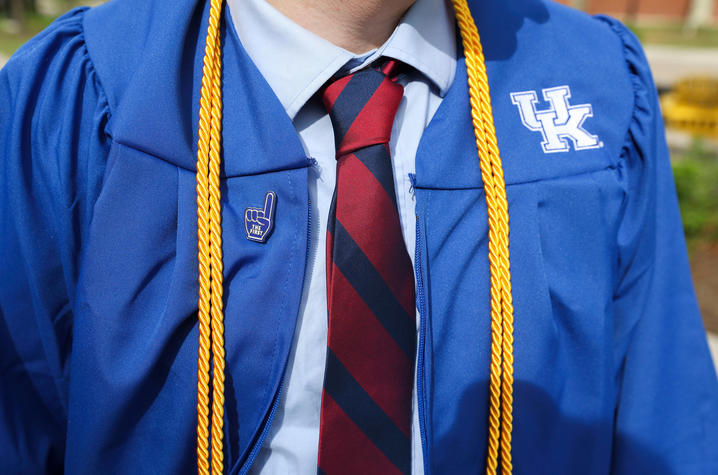
As a first-gen student, Antonelli’s struggles in his first few years of college hit his confidence hard. He’d been prepared to be the first in his family to earn a bachelor’s degree and saw the opportunity nearly slip away.
“I mean, I lost a full-ride scholarship,” he said. “So I thought, well, I guess I’m not going to break the cycle.”
The road to medical school would be difficult, but not insurmountable. His starting GPA of 2.67, while vastly improved, needed to be above a 3.2 for a medical school application. He did the calculations, and realized he needed to earn a 3.8 in his time at UK to get there. Antonelli credits Chris Miller, director of undergraduate advising for the College of Arts and Sciences, with giving him the chance to prove himself capable of getting to medical school.
“He had every statistical reason to tell me to consider other paths,” Antonelli said. “With that kind of record, I wouldn’t have blamed him. But the first moment I sat down with him, he was like, ‘Let’s figure this out. We can get this done.’ That was where it started, I think — that initial belief in me.”
From there, he thrived, even in courses that intimidated him — like organic chemistry, taught by Ashley Steelman, Ph.D., a senior lecturer in the Department of Chemistry.
Antonelli took advantage of help offered outside of regular class times, including Steelman’s office hours and an optional workshop called Organic Chemistry Excel. The workshop is designed to reinforce the material through structured practice and community learning and support.
“Jonathan took full advantage of that environment,” Steelman said. “He came prepared, asked thoughtful questions, and attended office hours regularly. His curiosity extends beyond the textbook.”
“Dr. Steelman's teaching style for organic chemistry just makes the material make so much sense,” he said. “I took one of her workshops, and it made the class so much more accessible. And to my surprise — I was extremely scared going into organic chemistry based on what I’d heard — but I think that was the class I’ve had the strongest performance in, period.”
He also joined the NeuroCATS, an undergraduate organization in the neuroscience program that aims to spread their love of neuroscience to the community through events, outreach and peer tutoring. Through this organization, Antonelli even got to go back to the Craft Academy as a guest speaker to talk about the science of the brain.
“That was probably one of the most fun experiences I had during my undergrad years here,” he said.
NeuroCATS is overseen by Mark Prendergast, Ph.D., endowed professor in the College of Arts and Sciences and director of the neuroscience bachelor’s degree program. Antonelli took several classes from Prendergast, describing him as “a fantastic lecturer.”
“He’s an absolute powerhouse — he’s passionate about neuroscience in a way that’s invigorating,” Antonelli said. “He really motivated me to want to dive deeper into science, to just ask more questions.”
“Jonathan was always very engaged in the classroom,” Prendergast said. “He contributed many meaningful discussions to my lectures on drug abuse and neuroscience in general.”
As Antonelli completed his pre-med courses, he also sought help from mentors in the UK College of Medicine. After meeting Scottie Day, M.D., physician-in-chief for Golisano Children’s at UK, at a Craft Academy alumni conference, Antonelli shadowed him during critical care rounds for some real-world experience.
“His bedside care is just great,” Antonelli said. “Being as calm and collected as he is, that’s who I strive to be.”
But perhaps his biggest cheerleader at UK has been Hubie Ballard, M.D., a UK neonatologist and professor of pediatrics in the College of Medicine. Ballard has a similar background, being from rural Bardstown, Kentucky, and the first of his family to earn a college degree.
“I cold-emailed him and was like, ‘Hey, I’m pre-med, can we talk?’” Antonelli said. “And when we met, I looked right at him and told him that I failed an entire semester, straight Fs, but wanted to go to medical school. So what do I do? And he’s worked with me ever since.”
That absence of belief is more limiting than any academic barrier, Ballard says. Failure is a normal part of life, but the most important thing is how a person responds to that roadblock. And in Antonelli’s case, his determination in spite of his previous struggles spoke volumes.
“Most students try to present a polished version of themselves, but Jonathan walked in and told me exactly where he had struggled — that takes a lot of courage,” Ballard said. “You could tell very quickly that he had the necessary ingredients. He just needed someone to help him see it. Mentorship, especially for students from backgrounds like ours, is about more than advice. It’s about belief and helping them recognize their own potential.”
“The hardest hurdle was being able to believe in myself,” Antonelli said. “Dr. Ballard helped me see that I could still be a doctor because he flipped my failure on its head in a way I never expected. For the longest time, the thing that got to me mentally was thinking, you’re screwed because of your past. And he was the first one who really pulled me out of that and said, ‘Look what you’ve done.’”
‘I want to be the doctor my dad needed.’
Two years ago, Antonelli’s father died in his sleep from an undiagnosed heart condition. And it wasn’t just because of the limited healthcare access in their rural hometown — Antonelli says that the physicians his father did see — in larger cities — lacked the communication skills to get through to a rural patient.
“I just feel like most of the physicians he saw didn’t get his circumstances,” Antonelli said. “They didn’t take extra time to sit down with him and to make him aware of what was happening. As someone who’s from a rural area, I feel like I’m uniquely equipped to understand what those areas need. I’ve lived the consequences and realities of scarcity.”
“I remember telling Jonathan on multiple occasions that he was going to be the only medical school applicant with his story,” Ballard said. “There would be no other applicants who could demonstrate his level of resilience based on all the challenges he has faced, including failing early in college, losing his father, and navigating first- generation challenges while growing up in rural Kentucky. I told him, ‘Be proud of your story. It is what makes you exceptional.’”
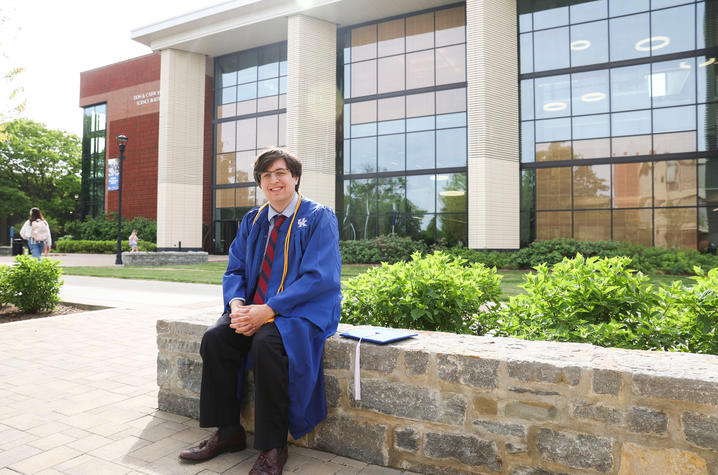
This Saturday, Antonelli will hit the next milestone on his journey toward becoming a doctor as he officially earns his bachelor’s degree from the College of Arts and Sciences. With a 3.9 GPA at UK, he surpassed what he needed to bring up the average for his medical school application.
In the meantime, he’s prepping for the Medical College Admission Test, commonly known as the MCAT, with plans to apply to a certain medical college this fall. If all goes to plan, he’ll be getting his white coat in the fall of 2027.
“I’m applying early decision to UK, which means I’m locked into that one school — you can’t apply anywhere else,” he said. “But I don’t want to go anywhere else. I know this is where I’d be best supported for a medical education.”
Motivated by his father, Antonelli plans to pursue family medicine. Kentucky, like the rest of the country, is facing a shortage of primary care physicians, especially in rural areas. He wants to be part of the solution to this problem — not just accessible in terms of location, but accessible on a personal level with the community he’ll care for.
“I love personal relationships. I want to know my patients, and know their families,” he said. “I want to be the kind of doctor who understands the realities of working class blue-collar guys and is willing to go to bat for them. I want to be the doctor my dad needed.”
“He is going to be a doctor who makes people feel seen, heard and cared for,” Ballard said. “And that’s exactly the kind of doctor Kentucky needs most.”
****
The May 2026 Commencement Ceremonies will be Friday, May 8 and Saturday, May 9, at Rupp Arena at Central Bank Center. More information is available at commencement.uky.edu.
As the state’s flagship, land-grant institution, the University of Kentucky exists to advance the Commonwealth. We do that by preparing the next generation of leaders — placing students at the heart of everything we do — and transforming the lives of Kentuckians through education, research and creative work, service and healthcare. We pride ourselves on being a catalyst for breakthroughs and a force for healing, a place where ingenuity unfolds. It's all made possible by our people — visionaries, disruptors and pioneers — who make up 200 academic programs, a $1.02 billion research and development enterprise and a world-class medical center, all on one campus.