


Andrew Pilny: 2026-27 University Research Professor Q&A
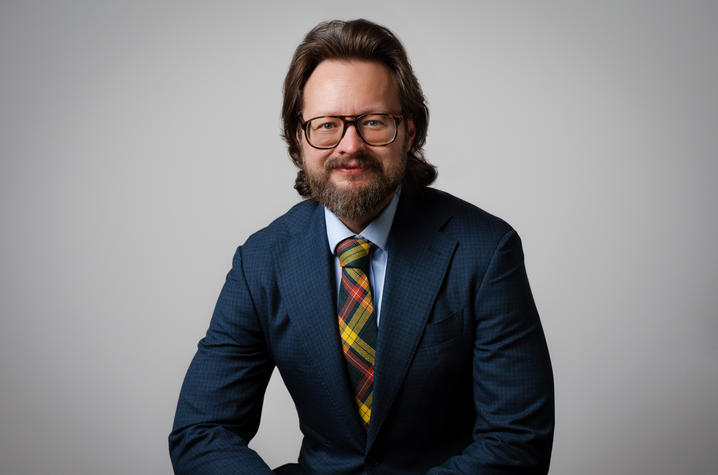
UKNow is highlighting the University of Kentucky’s 2026-27 University Research Professors. Established by the Board of Trustees in 1976, the professorship program recognizes excellence across the full spectrum of research at UK and is sponsored by the Office of the Vice President for Research.
LEXINGTON, Ky. (June 2, 2026) — Andrew Pilny, Ph.D., the Douglas A. and Carole A. Boyd Professor in the University of Kentucky College of Communication and Information, has been honored as a 2026-27 University Research Professor.
Since joining UK in 2015, Pilny has built a research program focused on social network analysis, organizational communication and artificial intelligence. His latest project, funded by the U.S. National Science Foundation (NSF), examines how financial and ownership networks shape power and inequality across organizations.
Pilny has authored more than 60 scholarly works, including serving as lead author of “AI in the Workplace.” The book explores how AI systems, particularly large language models, reshape communication, coordination and social structure within organizations.
Pilny also has a joint appointment in sociology in the College of Arts and Sciences and is a faculty affiliate in management in the Gatton College of Business and Economics.
He spoke with UKNow about his latest honor as a University Research Professor in this Q&A.
UKNow: What does it mean to you to be recognized as a University Research Professor?
Pilny: Honestly, it’s a mixed feeling. Researchers don’t typically pursue this work for awards, but the recognition can still provide a meaningful boost to morale. So, for me, it means somebody is sending a message that says, “Nice job. Keep going.”
UKNow: How will the professorships program advance your research?
Pilny: Funding, especially in the social sciences, is getting harder to come by these days. These funds will be vital for participant payment in a project on how individuals are using AI for social companionship. It will allow me to investigate long-term usage, something that’s currently lacking in the research.
UKNow: What inspired your focus on this area of research?
Pilny: As a social network researcher, I’m interested in the accelerating decline in face-to-face relationships, particularly since the COVID-19 pandemic, and our growing reliance on technology to fill those gaps. Some have called this the “anti-social century.” I’m not convinced of that, but I do want to better understand how social networks are changing.
UKNow: What continues to motivate your work?
Pilny: Probably one word: loneliness. It breaks my heart to read about growing isolation, social media addiction and the more recent edge cases of AI-induced psychosis. I think the research we do can shape societal dialogue and raise awareness about improving our social fitness.
UKNow: How does your research impact Kentucky?
Pilny: My recent NSF grant is about going into rural, farming-dependent counties and listening to small farmers’ stories about their recent struggles — rising costs of land and equipment, uncertain markets and the rest. We hope to identify the root causes that can steer legislation in the right direction.
About the University Research Professors
Each year, the University of Kentucky Board of Trustees approves a cohort of faculty as University Research Professors. The distinction recognizes excellence in work that addresses scientific, social, cultural and economic challenges in Kentucky and the world.
College leadership developed criteria for excellence within their area of expertise and then nominated faculty who excelled at these criteria. Each University Research Professor receives a one-year award of $10,000.
Research reported in this publication was supported by the U.S. National Science Foundation under Award No. 2434536. The opinions, findings, and conclusions or recommendations expressed are those of the author(s) and do not necessarily reflect the views of the U.S. National Science Foundation.
As the state’s flagship, land-grant institution, the University of Kentucky exists to advance the Commonwealth. We do that by preparing the next generation of leaders — placing students at the heart of everything we do — and transforming the lives of Kentuckians through education, research and creative work, service and healthcare. We pride ourselves on being a catalyst for breakthroughs and a force for healing, a place where ingenuity unfolds. It's all made possible by our people — visionaries, disruptors and pioneers — who make up 200 academic programs, a $1.02 billion research and development enterprise and a world-class medical center, all on one campus.